

Written by students who passed Immediately available after payment Read online or as PDF Wrong document? Swap it for free 4.6 TrustPilot
logo-home
Document preview thumbnail
Preview 1 out of 4 pages
Exam (elaborations)

Practicing Entrepreneurship- Chapter 2 Test Bank Solution Manual Already Passed (Rated A+)

Document preview thumbnail
Preview 1 out of 4 pages

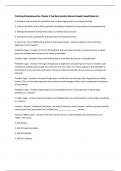
Practicing Entrepreneurship- Chapter 2 Test Bank Solution Manual Already Passed (Rated A+) 1. Compare and contrast the prediction and creation approaches to entrepreneurship 2. Create a portfolio of five skills essential to building a mindset for the practice of entrepreneurship 3. Distinguish between entrepreneurship as a method and a process 4. Illustrate the key components of the practice of Entrepreneurship 5. Assess the role of deliberate practice in achieving mastery - Answers What are the 5 learning objectives in this chapter? Predictive Logic - Answers A form of thinking that sees entrepreneurship as a linear process in which steps are followed and outcomes are ideally predictable Creation Logic - Answers A form of thinking that is used when the future is unpredictable Predictive Logic - Answers This type of logic puts a large focus on planning, less focus on actions, and emphasizes waiting until you get the resources that you need. It's a linear approach that attempts to avoid failure at all costs and works best in times of certainty and when there is assess to existing info and data. Creation Logic - Answers This type of logic puts a small focus on planning, and a large focus on taking actions. This is an iterative approach that embraces and leverages failure and is employed during times of uncertainty. Predictive Logic - Answers Optimization and Competitiveness are characteristics of which logic; predictive or creation? Creation Logic - Answers Experimentation and Collaboration are characteristics of which logic; predictive or creation? creative - Answers Traditional education, the need to find the correct answer, and the constant need for measurement and assessment has inhibited our _________________ nature. Theory of Effectuation - Answers The idea that the future is unpredictable and entrepreneurs can "effect" the future. 1. Skill of Play 2. Skill of Experimentation 3. Skill of Empathy 4. Skill of Creativity 5. Skill of Reflection - Answers What are the 5 skills an entrepreneur should develop by learning through action and managing uncertainty? Skill of Play - Answers Free the imagination, opens up our minds to a wealth of opportunities and possibilities, and helps us to be more innovative as entrepreneurs Skill of Experimentation - Answers Best described as acting in order to learn - trying something, learning from the attempt and building that learning into the next iteration Skill of Empathy - Answers Developing the ability to understand the emotion, circumstances, intentions, thoughts, and needs of others Skill of Creativity - Answers Requires a general openness to the world and relates unleashing our creative ability to create and find opportunities and solve problems Skill of Reflection - Answers Helps make sense of all the other actions required of play, empathy, creativity, and experimentation 1. Narrative reflection (describe what happened using Who, What, When, Where, Why) 2. Emotional reflection (how you felt during and how you managed those emotions) 3. Perceptive reflection (your perceptions and reactions, as well as the perceptions and reactions of others) 4. Analytical reflection (analyze situation by thinking about the skills and knowledge you gained from the experience and relating this to stuff you've learned before) 5. Evaluative reflection (What went well, what went badly, positive/negative, etc.) 6. Critical reflection (What part did you play and approach taken, what else you could have done, what you need to consider as a result, etc.) - Answers What are the 6 different ways in which we can practice reflection? Step 1: Think of an idea Step 2: Do market research Step 3: Get some financial projections Step 4: Find partner/team Step 5: Write business plan Step 6: Get financing Step 7: Find space, build prototype, hire people Step 8: Bring your product/service to market

Content preview

Practicing Entrepreneurship- Chapter 2 Test Bank Solution Manual Already Passed (Rated A+)

1. Compare and contrast the prediction and creation approaches to entrepreneurship

2. Create a portfolio of five skills essential to building a mindset for the practice of entrepreneurship

3. Distinguish between entrepreneurship as a method and a process

4. Illustrate the key components of the practice of Entrepreneurship

5. Assess the role of deliberate practice in achieving mastery - Answers What are the 5 learning
objectives in this chapter?

Predictive Logic - Answers A form of thinking that sees entrepreneurship as a linear process in which
steps are followed and outcomes are ideally predictable

Creation Logic - Answers A form of thinking that is used when the future is unpredictable

Predictive Logic - Answers This type of logic puts a large focus on planning, less focus on actions, and
emphasizes waiting until you get the resources that you need. It's a linear approach that attempts to
avoid failure at all costs and works best in times of certainty and when there is assess to existing info
and data.

Creation Logic - Answers This type of logic puts a small focus on planning, and a large focus on taking
actions. This is an iterative approach that embraces and leverages failure and is employed during times
of uncertainty.

Predictive Logic - Answers Optimization and Competitiveness are characteristics of which logic;
predictive or creation?

Creation Logic - Answers Experimentation and Collaboration are characteristics of which logic; predictive
or creation?

creative - Answers Traditional education, the need to find the correct answer, and the constant need for
measurement and assessment has inhibited our _________________ nature.

Theory of Effectuation - Answers The idea that the future is unpredictable and entrepreneurs can
"effect" the future.

1. Skill of Play

2. Skill of Experimentation

3. Skill of Empathy

4. Skill of Creativity

Document information

Uploaded on
November 28, 2024
Number of pages
4
Written in
2024/2025
Type
Exam (elaborations)
Contains
Questions & answers
$8.49

Wrong document? Swap it for free Within 14 days of purchase and before downloading, you can choose a different document. You can simply spend the amount again.
Written by students who passed
Immediately available after payment
Read online or as PDF

Seller avatar
Reputation scores are based on the amount of documents a seller has sold for a fee and the reviews they have received for those documents. There are three levels: Bronze, Silver and Gold. The better the reputation, the more your can rely on the quality of the sellers work.
TutorJosh
3.4
(74)
Sold
482
Followers
16
Items
32657
Last sold
6 hours ago


Why students choose Stuvia

Created by fellow students, verified by reviews

Quality you can trust: written by students who passed their tests and reviewed by others who've used these notes.

Didn't get what you expected? Choose another document

No worries! You can instantly pick a different document that better fits what you're looking for.

Pay as you like, start learning right away

No subscription, no commitments. Pay the way you're used to via credit card and download your PDF document instantly.

Student with book image

“Bought, downloaded, and aced it. It really can be that simple.”

Alisha Student

Working on your references?

Create accurate citations in APA, MLA and Harvard with our free citation generator.

Working on your references?

Frequently asked questions
