Joseph Thomson 13.3
Outline three pricing strategies a firm may adopt. (9 marks)
Traditional economic theory assumes that all firms aim to maximise profit, and will base price
and output on this, setting them at the level where marginal cost is equal to marginal revenue in
production. Galbrath however, theorised that pricing policies may begin to differ as firms grow in
size, and this economic phenomenon is known as the divorce of ownership and control. Large
firms owned by shareholders are likely to give control of the business to a group of managers,
removing any legal debt responsibility for them. Managers are likely to have different business
objectives than shareholders, and this often leads to satisficing, where asymmetric information
enables managers to present shareholders with a level of profit that may not be the maximum,
but they accept it as they have no way of knowing the potential profit.
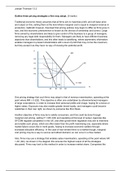
One pricing strategy that such firms may adopt is that of revenue maximisation, operating at the
point where MR = 0 (Q2). This objective is often one undertaken by aforementioned managers
of large corporations, in order to increase their personal profile and image, hoping for a bonus or
higher salary. Exposure may also enable greater brand loyalty, and managers could become
celebrities in their own right, as shown by someone like Elon Musk.
Another objective of firms may be to satisfy consumers, and this could be done through
marginal cost pricing, setting P = MC (Q3) and operating at this level of output. Agencies like
OFCOM regulate competition in the UK, and often government regulation may aim to intervene
and enable such prices, which are often lower than the profit maximising one, especially where
market failure occurs like in merit goods, hoping to increase economic welfare through
increased allocative efficiency. In the case of new entrant firms to a market though, marginal
cost pricing may be a way to survive and attract demand, so can occur in a free market.
Also, firms may use a strategy that enables sales maximisation, operating at the point where AR
= AC (Q4). As shown in the diagram this ensures the highest output of all the strategies
discussed. Firms may look to this method in order to increase market share. Companies like
Outline three pricing strategies a firm may adopt. (9 marks)
Traditional economic theory assumes that all firms aim to maximise profit, and will base price
and output on this, setting them at the level where marginal cost is equal to marginal revenue in
production. Galbrath however, theorised that pricing policies may begin to differ as firms grow in
size, and this economic phenomenon is known as the divorce of ownership and control. Large
firms owned by shareholders are likely to give control of the business to a group of managers,
removing any legal debt responsibility for them. Managers are likely to have different business
objectives than shareholders, and this often leads to satisficing, where asymmetric information
enables managers to present shareholders with a level of profit that may not be the maximum,
but they accept it as they have no way of knowing the potential profit.
One pricing strategy that such firms may adopt is that of revenue maximisation, operating at the
point where MR = 0 (Q2). This objective is often one undertaken by aforementioned managers
of large corporations, in order to increase their personal profile and image, hoping for a bonus or
higher salary. Exposure may also enable greater brand loyalty, and managers could become
celebrities in their own right, as shown by someone like Elon Musk.
Another objective of firms may be to satisfy consumers, and this could be done through
marginal cost pricing, setting P = MC (Q3) and operating at this level of output. Agencies like
OFCOM regulate competition in the UK, and often government regulation may aim to intervene
and enable such prices, which are often lower than the profit maximising one, especially where
market failure occurs like in merit goods, hoping to increase economic welfare through
increased allocative efficiency. In the case of new entrant firms to a market though, marginal
cost pricing may be a way to survive and attract demand, so can occur in a free market.
Also, firms may use a strategy that enables sales maximisation, operating at the point where AR
= AC (Q4). As shown in the diagram this ensures the highest output of all the strategies
discussed. Firms may look to this method in order to increase market share. Companies like