
NSG124 exam 2 (units 5-8) Questions & Answers 2024/2025
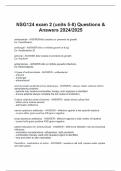
NSG124 exam 2 (units 5-8) Questions & Answers 2024/2025 antibacterial - ANSWER-kills bacteria or prevents its growth Ex: Ciprofloxacin antifungal - ANSWER-kills or inhibits growth of fungi Ex: Amphotericin B antiviral - ANSWER-kills viruses or prevents its growth Ex: Acyclovir antiprotozoal - ANSWER-kills or inhibits parasitic infections Ex: Metronidazole 4 types of antimicrobials - ANSWER-- antibacterial - antiviral - antifungal - antiprotozoal antimicrobials (antibiotics) key takeaways - ANSWER-- always obtain cultures before administering antibiotic - patients may receive combination therapy until organism is identified - ensure patients always complete the full course of antibiotics Culture collection order (timeline) - ANSWER-- obtain blood culture first - obtain urine culture second - administer antibiotics narrow spectrum antibiotics - ANSWER-- effective against a few specific bacteria - covers either gram-positive OR gram-negative broad spectrum antibiotics - ANSWER-- effective against a wide variety of bacteria - covers both gram-positive AND gram-negative patient education for antimicrobials - ANSWER-- difference between viral and bacterial infections - medication considerations: refrigeration, light sensitivity - combination therapy used until causative agent is identified - how and when to take medication Penicillins - mechanism of action - ANSWER-- weakens cell wall, causes water uptake and cell rupture - bactericidal (kills cells) Ampicillin - ANSWER-Penicillin preferred drug for gram-negative bacteria patient education for Penicillins - ANSWER-- take with full glass of water - take 1 hour before or 2 hours after meals - most common reaction is an allergic reaction (hives, shortness of breath, wheezing) cephalosporins - mechanism of action - ANSWER-- binds to penicillin-binding proteins, disrupts cell wall synthesis causing cell lysis (breakdown of the outer layer) - bactericidal (kills cells) 1st generation cephalosporins - therapeutic use - ANSWER-- used for simple respiratory, ear, skin, urinary tract infections - not as effective for gram-negative bacteria - do not give to patients with Penicillin allergy 1st generation cephalosporin medications - ANSWER-- cefazolin - cephalexin (Keflex) - cefadroxil 2nd generation cephalosporins - therapeutic use - ANSWER-- more effective for gram-negative bacteria - not effective against meningitis due to poor CSF concentration - do not give to patients with Penicillin allergy 2nd generation cephalosporin medications - ANSWER-- cefaclor (Ceclor) - cefotetan - cefoxitin - cefprozil - cefuroxime 3rd generation cephalosporin medications - ANSWER-- cefdinir - cefditoren - cefixime - cefotaxime - cefpodoxime - ceftazidime - ceftibuten - ceftriaxone 3rd generation cephalosporin - therapeutic use - ANSWER-- preferred therapy due to effectiveness against many bacteria - effective against gram-negative bacteria - good CSF penetration - do not give to patients with Penicillin allergy 4th generation cephalosporins - therapeutic use - ANSWER-- highest effectiveness of gram-negative bacteria - treats severe skin infections, hospital acquired pneumonia - good CSF penetration - do not give to patients with Penicillin allergy 4th generation cephalosporin medications - ANSWER-- cefepime 5th generation cephalosporin - therapeutic use - ANSWER-- treats MRSA - good CSF penetration - do not give to patients with Penicillin allergy 5th generation cephalosporin medications - ANSWER-- ceftaroline IV only cephalosporins adverse effects - ANSWER-- mostly hemolytic (bleeding, thrombophlebitis, anemia) - allergic reaction - maculopapular rash Vancomycin - ANSWER-- inhibits cell wall synthesis - treats MRSA, C. difficile - monitor renal function with creatinine levels - obtain trough level (30 minutes prior to next dose) - infuse slowly, at least over 60 minutes Vancomycin adverse effects - ANSWER-- nephrotoxicity - red man syndrome (rash, hives, flushing, itching) - do not stop infusion, just slow it down - thrombophlebitis (inflammation of the vein wall) - switch IV sites tetracycline - therapeutic use - ANSWER-- severe acne - Lyme disease - peptic ulcers - periodontal disease - not used often due to bacterial resistance macrolides - mechanism of action - ANSWER-- inhibits protein synthesis - broad spectrum antibiotics macrolides - medications - ANSWER-- erythromycin - azithromycin - clarithromycin macrolides - therapeutic use - ANSWER-- pertussis/whooping cough - diphtheria - chlamydia continues...
Document information
- Uploaded on
- November 21, 2024
- Number of pages
- 12
- Written in
- 2024/2025
- Type
- Exam (elaborations)
- Contains
- Questions & answers


