
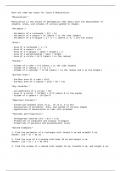
Here are some key notes for Class 8 Mensuration:
*Mensuration:*
Mensuration is the branch of mathematics that deals with the measurement of
lengths, areas, and volumes of various geometric shapes.
*Perimeter:*
- Perimeter of a rectangle = 2(l + b)
- Perimeter of a square = 4s (where s is the side length)
- Perimeter of a triangle = a + b + c (where a, b, c are the sides)
*Area:*
- Area of a rectangle = l × b
- Area of a square = s^2
- Area of a triangle = (base × height) / 2
- Area of a parallelogram = base × height
- Area of a circle = πr^2 (where r is the radius)
*Volume:*
- Volume of a cube = s^3 (where s is the side length)
- Volume of a cuboid = l × b × h
- Volume of a cylinder = πr^2h (where r is the radius and h is the height)
*Surface Area:*
- Surface area of a cube = 6s^2
- Surface area of a cuboid = 2(lb + bh + hl)
*Key Formulas:*
- Circumference of a circle = 2πr
- Area of a sector = (θ/360) × πr^2 (where θ is the angle)
- Volume of a sphere = (4/3)πr^3
*Important Concepts:*
- Conversion between units (e.g., cm to m, m to km)
- Calculation of perimeter, area, and volume of various shapes
- Application of mensuration in real-life problems
*Theorems and Properties:*
- Pythagorean theorem (a^2 + b^2 = c^2)
- Properties of congruent and similar triangles
- Properties of parallel and perpendicular lines
*Solved Examples:*
1. Find the perimeter of a rectangle with length 8 cm and breadth 5 cm.
Answer: 2(8 + 5) = 26 cm
2. Find the area of a triangle with base 10 cm and height 6 cm.
Answer: (10 × 6) / 2 = 30 cm^2
3. Find the volume of a cuboid with length 10 cm, breadth 8 cm, and height 5 cm.
*Mensuration:*
Mensuration is the branch of mathematics that deals with the measurement of
lengths, areas, and volumes of various geometric shapes.
*Perimeter:*
- Perimeter of a rectangle = 2(l + b)
- Perimeter of a square = 4s (where s is the side length)
- Perimeter of a triangle = a + b + c (where a, b, c are the sides)
*Area:*
- Area of a rectangle = l × b
- Area of a square = s^2
- Area of a triangle = (base × height) / 2
- Area of a parallelogram = base × height
- Area of a circle = πr^2 (where r is the radius)
*Volume:*
- Volume of a cube = s^3 (where s is the side length)
- Volume of a cuboid = l × b × h
- Volume of a cylinder = πr^2h (where r is the radius and h is the height)
*Surface Area:*
- Surface area of a cube = 6s^2
- Surface area of a cuboid = 2(lb + bh + hl)
*Key Formulas:*
- Circumference of a circle = 2πr
- Area of a sector = (θ/360) × πr^2 (where θ is the angle)
- Volume of a sphere = (4/3)πr^3
*Important Concepts:*
- Conversion between units (e.g., cm to m, m to km)
- Calculation of perimeter, area, and volume of various shapes
- Application of mensuration in real-life problems
*Theorems and Properties:*
- Pythagorean theorem (a^2 + b^2 = c^2)
- Properties of congruent and similar triangles
- Properties of parallel and perpendicular lines
*Solved Examples:*
1. Find the perimeter of a rectangle with length 8 cm and breadth 5 cm.
Answer: 2(8 + 5) = 26 cm
2. Find the area of a triangle with base 10 cm and height 6 cm.
Answer: (10 × 6) / 2 = 30 cm^2
3. Find the volume of a cuboid with length 10 cm, breadth 8 cm, and height 5 cm.


