

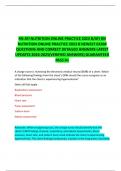
RN ATI NUTRITION ONLINE PRACTICE 2023 B/ATI RN
NUTRITION ONLINE PRACTICE 2023 B NEWEST EXAM
QUESTIONS AND CORRECT DETAILED ANSWERS LATEST
UPDATES 2024-2025(VERIFIED ANSWERS) GUARANTEED
PASS A+
A charge nurse is reviewing the electronic medical record (EMR) of a client. Which
of the following findings from the client's EMR should the nurse recognize as an
indication that the client is experiencing hypervolemia?
Select all that apply.
Respiratory assessment
Blood pressure
Heart rate
Pulse assessment
Sodium level
Edema assessment
Rationale: When recognizing cues, the charge nurse should identify that the
client’s EMR findings of pulse, respiratory, and edema assessments, blood
pressure, heart rate, and sodium level could indicate the client is experiencing
hypervolemia. The client findings tachycardia, crackles in the lung bases, bounding
,peripheral pulses, pitting edema, hyponatremia, and hypertension can be an
indication of fluid retention.
A nurse is caring for a client who is at 16 weeks of gestation. Drag words from the
choices below to fill in each blank in the following sentence.
After initiating the client's prescriptions, the nurse should identify that the client is
at risk for developing ________ and _________.
Venous thrombosis
Hyperglycemia
Rationale: When analyzing cues, the nurse should identify that after initiating TPN
therapy, the client is at risk for developing venous thrombosis and hyperglycemia.
Venous thrombosis can develop because of placement of PICC. Hyperglycemia is a
complication of TPN and requires routine assessment of the blood glucose level.
The nurse should monitor the client for these potential complications and report
any unexpected findings to the provider.
A nurse on a pediatric unit is planning care for a school-aged child. Complete the
following sentence by using the list of options.
The nurse should first address the child's ________, followed by the child's
________.
Temperature
Stool pattern
Rationale: When prioritizing hypotheses and using the urgent vs non-urgent
approach to the child’s care, the nurse determines to first address the child’s
, temperature followed by the child’s stool pattern. The child has a temperature
that is above the expected reference range, therefore the nurse should provide an
intervention such as administering an antipyretic to decrease the child’s
temperature. The nurse should address the parents' report of the child having
several loose stools which could indicate diarrhea. Diarrhea can cause a reduction
in fluid volume and should be addressed to determine the cause.
The nurse is caring for a client on a medical-surgical unit. Which of the following
findings indicate that the client is not tolerating enteral feedings?
Select all that apply.
Client's reported concern
Emesis output
Rationale: When evaluating outcomes, the nurse should recognize that the client
reported concern about being nauseous and the presence of emesis requires
follow up. These are manifestations of tube feeding intolerance and that the client
is not progressing as expected.
A nurse is teaching an older adult client about nutritional recommendations.
Which of the following statements should the nurse make?
"You should increase your daily protein intake."
Rationale: The nurse should instruct the client to increase the daily intake of
protein to increase strength and to enhance immune function and wound healing.
The nurse should recommend a protein intake of 1 to 1.2 g/kg/day of protein for a
healthy older adult client. If the older adult client has acute or chronic medical
diagnoses, the nurse should recommend 1.2 to 1.5 g/kg/day of protein.
NUTRITION ONLINE PRACTICE 2023 B NEWEST EXAM
QUESTIONS AND CORRECT DETAILED ANSWERS LATEST
UPDATES 2024-2025(VERIFIED ANSWERS) GUARANTEED
PASS A+
A charge nurse is reviewing the electronic medical record (EMR) of a client. Which
of the following findings from the client's EMR should the nurse recognize as an
indication that the client is experiencing hypervolemia?
Select all that apply.
Respiratory assessment
Blood pressure
Heart rate
Pulse assessment
Sodium level
Edema assessment
Rationale: When recognizing cues, the charge nurse should identify that the
client’s EMR findings of pulse, respiratory, and edema assessments, blood
pressure, heart rate, and sodium level could indicate the client is experiencing
hypervolemia. The client findings tachycardia, crackles in the lung bases, bounding
,peripheral pulses, pitting edema, hyponatremia, and hypertension can be an
indication of fluid retention.
A nurse is caring for a client who is at 16 weeks of gestation. Drag words from the
choices below to fill in each blank in the following sentence.
After initiating the client's prescriptions, the nurse should identify that the client is
at risk for developing ________ and _________.
Venous thrombosis
Hyperglycemia
Rationale: When analyzing cues, the nurse should identify that after initiating TPN
therapy, the client is at risk for developing venous thrombosis and hyperglycemia.
Venous thrombosis can develop because of placement of PICC. Hyperglycemia is a
complication of TPN and requires routine assessment of the blood glucose level.
The nurse should monitor the client for these potential complications and report
any unexpected findings to the provider.
A nurse on a pediatric unit is planning care for a school-aged child. Complete the
following sentence by using the list of options.
The nurse should first address the child's ________, followed by the child's
________.
Temperature
Stool pattern
Rationale: When prioritizing hypotheses and using the urgent vs non-urgent
approach to the child’s care, the nurse determines to first address the child’s
, temperature followed by the child’s stool pattern. The child has a temperature
that is above the expected reference range, therefore the nurse should provide an
intervention such as administering an antipyretic to decrease the child’s
temperature. The nurse should address the parents' report of the child having
several loose stools which could indicate diarrhea. Diarrhea can cause a reduction
in fluid volume and should be addressed to determine the cause.
The nurse is caring for a client on a medical-surgical unit. Which of the following
findings indicate that the client is not tolerating enteral feedings?
Select all that apply.
Client's reported concern
Emesis output
Rationale: When evaluating outcomes, the nurse should recognize that the client
reported concern about being nauseous and the presence of emesis requires
follow up. These are manifestations of tube feeding intolerance and that the client
is not progressing as expected.
A nurse is teaching an older adult client about nutritional recommendations.
Which of the following statements should the nurse make?
"You should increase your daily protein intake."
Rationale: The nurse should instruct the client to increase the daily intake of
protein to increase strength and to enhance immune function and wound healing.
The nurse should recommend a protein intake of 1 to 1.2 g/kg/day of protein for a
healthy older adult client. If the older adult client has acute or chronic medical
diagnoses, the nurse should recommend 1.2 to 1.5 g/kg/day of protein.


