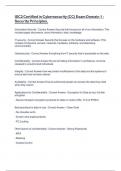
ISC2 Certified in Cybersecurity (CC) Exam Domain 1 -
Security Principles.
Information Security - Correct Answer Security that focuses on all of our information. This
includes paper documents, voice information, data, knowledge.
IT security - Correct Answer Security that focuses on the hardware and software. THis
includes Computers, servers, networks, hardware, software, and data being
communicated.
Cybersecurity - Correct Answer Everything from IT security that is accessible on the web.
Confidentiality - Correct Answer the act of holding information in confidence, not to be
released to unauthorized individuals
Integrity - Correct Answer How we protect modifications of the data and the systems to
ensure data has not been altered.
Availability - Correct Answer Ensure authorized people can access the data they need
when they need ti
Applications for Confidentiality - Correct Answer - Encryption for Data at rest, full disk
encyption
- Secure transport encryption protocols for data-in-motion (SSL, TLS or IPSEC)
Best practices for data-in-use - Correct Answer - Clean Desk
- No shoulder surfin
- Screen view angle protector
- PC Locking
Other factors of confidentiality - Correct Answer - Strong Passwords
- MFA
- Masking
- Access Control
,- Need-to-know
- Least Privilege
Threats to Confidentiality - Correct Answer - Attacks on encryption (cryptoanalysis)
- Social Engineering
- Key Loggers
- Cameras
- Steganography
- Internet of Things (IOT) devices
Applications for Integrity - Correct Answer - Cryptography
- Check Sums
- Message Digests
- Digital Signatures
- Non Repudiation
- Access Control
Threats to Integrity - Correct Answer - Alternations of data
- Code Injections
- Cryptoanalysis
Applications for Availability - Correct Answer - IPS / IDS
- Patch Management
- Redunancy on hardware power
- Disks (RAID)
- Traffic Paths
- Service Level Agreement (SLA)
Threats to Availability - Correct Answer - Malicious attacks (DDOS, physical, system,
compromise, staff)
- Application failures
, - Component failure
The DAD Triad - Correct Answer Disclosure;
Alteration; and,
Destruction.
Disclosure - Correct Answer Someone not authorized to access certain information
Alteration - Correct Answer Data has been changed
Destruction - Correct Answer Data or systems have been destroyed or have become
inaccessible
IAAA - Correct Answer Identification, authentication, authorization, accountability
Identification - Correct Answer Using a piece of information to identify who you are
Examples include name, username, ID, number, employe number, SSN
Authentication - Correct Answer Proving that a user is genuine, and not an imposter.
Type 1 Authentication - Correct Answer A type of authentication that requires the user to
provide something that they know, such as a password or PIN.
This is the weakest form of authentication.
key stretching - Correct Answer A technique used to increase the strength of stored
passwords. it adds additional bits (called salts) and can help thwart brute force and
rainbow table attacks.
Brute Force Attack - Correct Answer the password cracker tries every possible
combination of characters
Clipping levels - Correct Answer Put in place to prevent administrative overhead
Security Principles.
Information Security - Correct Answer Security that focuses on all of our information. This
includes paper documents, voice information, data, knowledge.
IT security - Correct Answer Security that focuses on the hardware and software. THis
includes Computers, servers, networks, hardware, software, and data being
communicated.
Cybersecurity - Correct Answer Everything from IT security that is accessible on the web.
Confidentiality - Correct Answer the act of holding information in confidence, not to be
released to unauthorized individuals
Integrity - Correct Answer How we protect modifications of the data and the systems to
ensure data has not been altered.
Availability - Correct Answer Ensure authorized people can access the data they need
when they need ti
Applications for Confidentiality - Correct Answer - Encryption for Data at rest, full disk
encyption
- Secure transport encryption protocols for data-in-motion (SSL, TLS or IPSEC)
Best practices for data-in-use - Correct Answer - Clean Desk
- No shoulder surfin
- Screen view angle protector
- PC Locking
Other factors of confidentiality - Correct Answer - Strong Passwords
- MFA
- Masking
- Access Control
,- Need-to-know
- Least Privilege
Threats to Confidentiality - Correct Answer - Attacks on encryption (cryptoanalysis)
- Social Engineering
- Key Loggers
- Cameras
- Steganography
- Internet of Things (IOT) devices
Applications for Integrity - Correct Answer - Cryptography
- Check Sums
- Message Digests
- Digital Signatures
- Non Repudiation
- Access Control
Threats to Integrity - Correct Answer - Alternations of data
- Code Injections
- Cryptoanalysis
Applications for Availability - Correct Answer - IPS / IDS
- Patch Management
- Redunancy on hardware power
- Disks (RAID)
- Traffic Paths
- Service Level Agreement (SLA)
Threats to Availability - Correct Answer - Malicious attacks (DDOS, physical, system,
compromise, staff)
- Application failures
, - Component failure
The DAD Triad - Correct Answer Disclosure;
Alteration; and,
Destruction.
Disclosure - Correct Answer Someone not authorized to access certain information
Alteration - Correct Answer Data has been changed
Destruction - Correct Answer Data or systems have been destroyed or have become
inaccessible
IAAA - Correct Answer Identification, authentication, authorization, accountability
Identification - Correct Answer Using a piece of information to identify who you are
Examples include name, username, ID, number, employe number, SSN
Authentication - Correct Answer Proving that a user is genuine, and not an imposter.
Type 1 Authentication - Correct Answer A type of authentication that requires the user to
provide something that they know, such as a password or PIN.
This is the weakest form of authentication.
key stretching - Correct Answer A technique used to increase the strength of stored
passwords. it adds additional bits (called salts) and can help thwart brute force and
rainbow table attacks.
Brute Force Attack - Correct Answer the password cracker tries every possible
combination of characters
Clipping levels - Correct Answer Put in place to prevent administrative overhead