

M1: Osteology, Anthropology
& Forensic Context
LECTURE 7
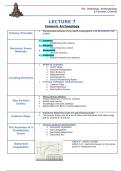
Forensic Archaeology
The principal purpose of any death investigation is to RECREATE THE
Primary Principle EVENT
Location
o Establishing the context
Mapping
Recovery Scene o Preserving the context
Excavation
Methods o Uncover remains
Collection
o Remove remains for analysis
REMOTE SENSING
o Aerial Views
o Infrared Photography
o Plant Evidence
o Magnetometer
Locating Remains o Soil Resistivity
o Ground Penetrating Radar
TYPICAL FORENSIC INVESTIGATION
o Cadaver Dogs
o Metal Detectors
o Site Surface Survey
Most Common Method
Visual inspection of area for remains
Site Surface Smells and insects
Survey Knowledge of human skeleton
Appreciation for Bone’s Varied Appearance
Trained to follow the scent of a decomposing body
Cadaver Dogs The human body puts off a lot of odors and chemicals that these dogs
will be trained to smell out
VISUAL SEARCH INDICATORS
The Anatomy of a o Disturbed Vegetation
Clandestine o Soil Compaction
o Secondary Depression
Grave o Disturbed Soil
AREA B – plants crushed
Disturbed AREA C-B – plantd removed time since
Vegetation burial is important here
, M1: Osteology, Anthropology
& Forensic Context
Height A Varies by environment
Mountainous Remote = Shallow
Sandy, Inhabited = Deeper
Impossible to Replicate NATURAL GEOLOGY
Soil compacts over time type of soil and amount of moisture affect
timing
Augers and Probes and
be used to feel the
difference in soil density
A – Grave Pit
Soil Compaction Depression
B – Secondary
Depression
C – Damaged
Vegetation
D – Cracks & Sloping
Different soil types have different depression rates
Sands generally DO NOT show depression
Soils and Depression forms when moisture penetration is THREE FEET DEEP
Moisture SNOW after burial usually results in depression when snow melts
FREEZING after burial inhibits depression formation
In some circumstances depression represents…
o Represents the abdominal cavity collapsing
Secondary o Shallow graves 24-36 inches deep
Depression o Shallower graves more pronounced secondary depression
BUT less pronounced primary depression
If stratification is significant and distinct, soil mixture will result in
mottling
Disturbed Soil Incorporation of plant remains into the matrix
EX.) SOIL STRATIFICATION
& Forensic Context
LECTURE 7
Forensic Archaeology
The principal purpose of any death investigation is to RECREATE THE
Primary Principle EVENT
Location
o Establishing the context
Mapping
Recovery Scene o Preserving the context
Excavation
Methods o Uncover remains
Collection
o Remove remains for analysis
REMOTE SENSING
o Aerial Views
o Infrared Photography
o Plant Evidence
o Magnetometer
Locating Remains o Soil Resistivity
o Ground Penetrating Radar
TYPICAL FORENSIC INVESTIGATION
o Cadaver Dogs
o Metal Detectors
o Site Surface Survey
Most Common Method
Visual inspection of area for remains
Site Surface Smells and insects
Survey Knowledge of human skeleton
Appreciation for Bone’s Varied Appearance
Trained to follow the scent of a decomposing body
Cadaver Dogs The human body puts off a lot of odors and chemicals that these dogs
will be trained to smell out
VISUAL SEARCH INDICATORS
The Anatomy of a o Disturbed Vegetation
Clandestine o Soil Compaction
o Secondary Depression
Grave o Disturbed Soil
AREA B – plants crushed
Disturbed AREA C-B – plantd removed time since
Vegetation burial is important here
, M1: Osteology, Anthropology
& Forensic Context
Height A Varies by environment
Mountainous Remote = Shallow
Sandy, Inhabited = Deeper
Impossible to Replicate NATURAL GEOLOGY
Soil compacts over time type of soil and amount of moisture affect
timing
Augers and Probes and
be used to feel the
difference in soil density
A – Grave Pit
Soil Compaction Depression
B – Secondary
Depression
C – Damaged
Vegetation
D – Cracks & Sloping
Different soil types have different depression rates
Sands generally DO NOT show depression
Soils and Depression forms when moisture penetration is THREE FEET DEEP
Moisture SNOW after burial usually results in depression when snow melts
FREEZING after burial inhibits depression formation
In some circumstances depression represents…
o Represents the abdominal cavity collapsing
Secondary o Shallow graves 24-36 inches deep
Depression o Shallower graves more pronounced secondary depression
BUT less pronounced primary depression
If stratification is significant and distinct, soil mixture will result in
mottling
Disturbed Soil Incorporation of plant remains into the matrix
EX.) SOIL STRATIFICATION


