

Written by students who passed Immediately available after payment Read online or as PDF Wrong document? Swap it for free 4.6 TrustPilot
logo-home
Document preview thumbnail
Preview 2 out of 7 pages
Exam (elaborations)

PEDS GI: Comprehensive Guide to Pediatric Gastrointestinal Disorders | Updated Edition

Document preview thumbnail
Preview 2 out of 7 pages

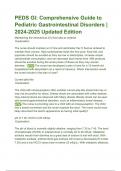
PEDS GI: Comprehensive Guide to Pediatric Gastrointestinal Disorders | Updated Edition Maintaining the intravenous (IV) fluid rate as ordered Explanation: The nurse should maintain an IV line and administer the IV fluid as ordered to maintain fluid volume. High-carbohydrate fluids like fruit juice, Kool-Aid, and popsicles should be avoided as they are low in electrolytes, increase simple carbohydrate consumption, and can decrease stool transit time. Milk products should be avoided during the acute phase of illness as they may worsen diarrhea. - -The nurse has developed a plan of care for a 12-month-old hospitalized with dehydration as a result of rotavirus. Which intervention would the nurse include in the plan of care? Currant jelly-like Explanation: The child with intussusception often exhibits currant jelly-like stools that may or may not be positive for blood. Greasy stools are associated with celiac disease. Clay-colored stools are observed with biliary atresia. Bloody stools can be seen with several gastrointestinal disorders, such as inflammatory bowel disease. - -The nurse is providing care to a child with an intussusception. The child has a bowel movement and the nurse inspects the stool. The nurse would most likely document the stool's appearance as having what quality? pH of 7.25, HCO3 of 20 mEq/L Explanation: The pH of blood is normally slightly alkaline, ranging from 7.35 to 7.45. The level of bicarbonate (HCO3) in arterial blood is normally 22 to 26 mEq/L. Metabolic acidosis results from diarrhea as a great deal of sodium is lost with stool. With metabolic acidosis, arterial blood gas analysis will reveal a decreased pH (under 7.35) and a low HCO3 value (near or below 22 mEq/L). With metabolic alkalosis, pH will be elevated (near or above 7.45), and HCO3 level will be near or above 28 mEq/L. - -A 7-year-old boy has experienced severe diarrhea resulting from an intestinal virus. The nurse is concerned that the child will develop an acid-base imbalance. Which of the following blood test results would indicate that the boy is experiencing metabolic acidosis? Take a stool culture Explanation: Treatment of severe diarrhea focuses on regulating electrolyte and fluid balance by initiating a temporary rest for the GI tract, oral or IV rehydration therapy, and discovering the organism responsible for the diarrhea. All children with severe diarrhea or diarrhea that persists longer than 24 hours should have a stool culture taken to determine if bacteria are causing the diarrhea, and if so, a definite antibiotic therapy can be prescribed. Because a side effect of many antibiotics is diarrhea, antibiotics should not routinely be used to treat diarrhea without an identifiable bacterial cause. Before the initial IV fluid is changed to a potassium solution, be certain the infant or child has voided—proof that the kidneys are functioning; in this case, the child is not voiding yet. The child should not be fed a cracker, as the GI tract should be rested until the diarrhea stops. - -The nurse is caring for a 6-month-old infant who was admitted to the emergency room 24 hours ago with signs of severe diarrhea. The infant's rectal temperature is 104° F (40° C), with weak and rapid pulse and respirations. The skin is pale and cool. The child is on IV rehydration therapy, but the diarrhea is persisting. The infant has not voided since being admitted. Which is the priority nursing intervention? In this disorder the sphincter that leads into the stomach is relaxed. Explanation: Gastroesophageal reflux (GER) occurs when the sphincter in the lower portion of the esophagus, which leads into the stomach, is relaxed and allows gastric contents to be regurgitated back into the esophagus. Congenital aganglionic megacolon is characterized by persistent constipation resulting from partial or complete intestinal obstruction of mechanical origin. Colic consists of recurrent paroxysmal bouts of abdominal pain. Pyloric stenosis is characterized by hypertrophy of the circular muscle fibers of the pylorus which leads to an obstruction at the distal end of the stomach. - -The nurse is teaching an in-service program to a group of nurses on the topic of gastrointestinal disorders. The nurses in the group make the following statements. Which statement is most accurate related to the diagnosis of gastroesophageal reflux? Gastroenteritis Explanation: Outbreaks of gastroenteritis routinely occur in day care centers, schools, institutions for the handicapped, and other places where overcrowding is prevalent and hygiene is inadequate. Typical signs and symptoms include diarrhea, nausea, vomiting, and abdominal pain. - -A father brings Jacob, age 2, to the health clinic with complaints of diarrhea, vomiting, and abdominal pain. The father tells the nurse that he is a single parent and Jacob is enrolled in a local daycare center. Based on this information, what gastrointestinal condition might the nurse suspect? Lower right Explanation: With appendicitis, percussion reveals irritation and pain in the right lower quadrant. Rebound tenderness present with palpation in the right lower quadrant, is referred to as the McBurney point, an area of tenderness 1.5 to 2 in. (3.8 to 5 cm) in from the right anterior superior iliac spine along a line extending to the umbilicus. - -A 10-year-old male presents with low-grade fever, nausea, and abdominal pain. The nurse examining him suspects appendicitis and checks for rebound tenderness in what quadrant? Persistent constipation Explanation: Congenital aganglionic megacolon, also called Hirschsprung disease, is characterized by persistent constipation resulting from partial or complete intestinal obstruction of mechanical origin. Prolonged bleeding is a manifestation of hemophilia. A chronic cough is noted in the child with cystic fibrosis. Irregular breathing occurs in children with seizures. - -The nurse is caring for a child admitted with congenital aganglionic megacolon. Which clinical manifestation would likely have been noted in the child with this diagnosis? Apply a barrier/healing cream or paste on the skin. Explanation: The nurse should use a barrier/healing cream or paste on the skin around the stoma to promote healing and prevent further skin breakdown. Diaper wipes that contain fragrance or alcohol can sting if used on nonintact skin and can worsen skin breakdown. The barrier wafer would be helpful, but does not address the skin breakdown. - -The nurse is caring for an infant with a temporary ileostomy. As part of the plan of care, the nurse monitors for skin breakdown around the stoma. If redness occurs, what would be most appropriate to promote healing and prevent further skin breakdown? Pyloric stenosis Explanation: With pyloric stenosis, at 4 to 6 weeks of age, infants typically begin to vomit almost immediately after each feeding. The vomiting grows increasingly forceful until it is projectile, possibly projecting as much as 3 to 4 feet. Infants are usually hungry immediately after vomiting because they are not nauseated. A definitive diagnosis can be made by watching the infant drink. If a pyloric stenosis is present, the sphincter feels round and firm, approximately the size of an olive in the right abdomen. Peptic ulcer disease in neonates usually presents with hematemesis (blood in vomitus) or melena (blood in the stool). Gastroesophageal reflux involves a small (1-2 tsp) volume and is not forceful. Appendicitis typically begins with anorexia for 12 to 24 hours; children do not eat and do not act like their usual selves. Nausea and vomiting may then occur, followed by diffuse abdominal pain. - -A mother is alarmed because her 6-week-old boy has begun vomiting almost immediately after every feeding. In the past week, the vomiting has grown more forceful, with the vomit projecting several feet from his mouth. He is always hungry again just after vomiting. At the physician's office, the nurse holds the child and gives him a bottle of water. While he drinks, she notes an olive-size lump in his right abdomen. Which condition should the nurse suspect in this child? Painless rectal bleeding Explanation: With Meckel diverticulum, most symptomatic children present younger than age 2 years. Intermittent, painless rectal bleeding is the most common clinical manifestation of Meckel diverticulum. The blood is most often bright red or maroon and may be passed independent of stool due to ulceration at the junction of the ectopic tissue and the normal ileal mucosa. - -The nurse caring for an 18-month-old infant with Meckel diverticulum knows that the most common clinical manifestation of this condition is: Sunken fontanels Bradycardia Cool mottled extremities - -A nurse is assessing an infant who has been vomiting and experiencing diarrhea. Which findings would indicate to the nurse that the infant is experiencing severe dehydration? Select all that apply. Prevention of hypoglycemia Explanation: Hypoglycemia is a major danger following liver transplantation because glucose levels are regulated by the liver, and the transplanted organ may not function efficiently at first. Assess serum glucose levels hourly by finger stick puncture. A 10% solution of dextrose IV may be necessary to prevent hypoglycemia. Careful tissue matching before the transplantation is needed to reduce the possibility of stimulating T-cell rejection. Sodium, potassium, chloride, and calcium levels are evaluated approximately every 6 to 8 hours to be certain electrolyte balance is maintained, but potassium is rarely added to IV solutions because of the risk that renal failure has occurred. IV therapy with hypotensive agents such as hydralazine (Apresoline) and nitroprusside may be needed to reduce hypertension. - -A 12-year-old boy has just undergone a liver transplantation and is recovering. After performing a finger stick puncture and assessing the results, the nurse administers a 10% solution of dextrose IV. What is the correct rationale for this intervention? False Explanation: The pH of blood is normally slightly alkaline, ranging from 7.35 to 7.45. - -The pH of blood is normally slightly acidic, ranging from 6.85 to 6.95. gastroesophageal reflux disease. Explanation: The child with gastroesophageal reflux disease may present with the physical findings of pneumonia secondary to aspiration of refluxed stomach contents. - -Noah is an 18-month-old who is brought to the ER with flu-like symptoms. He is diagnosed with pneumonia secondary to aspiration of stomach contents. The nurse explains to the parents that pneumonia is a condition that often occurs secondary to: "It is important to increase the intake of protein for these children." Explanation: Kwashiorkor results from severe deficiency of protein with an adequate caloric intake. It accounts for most of the malnutrition in the world's children today. The highest incidence is in children 4 months to 5 years of age. Although strenuous efforts are being made around the world to prevent this condition, its causes are complex. - -The nurse is teaching an in-service program to a group of nurses on the topic of children diagnosed with Kwashiorkor. The nurses in the group make the following statements. Which statement is most accurate related to the diagnosis of Kwashiorkor? "He attends a day care center four days a week while I am at work." Explanation: Giardiasis is caused by the protozoan parasite Giardia lamblia. It is a common cause of diarrhea and is prevalent in children who attend day care centers and other types of residential facilities; it may be found in contaminated mountain streams or pools frequented by diapered infants. Bubble baths can lead to urinary tract infections, but are not the cause of Giardiasis infestations. - -The nurse is doing teaching with the caregivers of toddler and preschool age children. One of the caregivers tells the group that her child had diarrhea and she was told that it was caused by giardiasis. Which of the following statements made by the caregiver indicates the most likely situation in which the child contacted the disorder? 1,600 mL Explanation: Using the following formula of 100 mL/kg for the first 10 kg, plus 50 mL/kg for the next 10 kg, and then 20 mL/kg for the remaining kg, the child would require (100 × 10) + (50 × 10) + (20 × 5) = 1,000 + 500 + 100 = 1,600 mL in 24 hours. - -The nurse is determining maintenance fluid requirements for a child who weighs 25 kg. How much fluid would the child need per day? Total parenteral nutrition (TPN) Explanation: Total parenteral nutrition (TPN) should be administered to preterm infants with necrotizing enterocolitis. In NEC, there is acute inflammation of the bowel associated with ischemia. This can lead to bowel necrosis and perforation. Preterm infants are at higher risk of developing NEC, due to gastric immaturity and an increased risk of infections. When NEC is detected in the preterm infant, TPN should be administered and enteral feeding should be withheld until the condition stabilizes. Gavage feeding and trophic feeding are different forms of enteral feeding given to preterm infants, but not to those having NEC. Oral breastfeeding should also be withheld in NEC. NEC is treated with IV fluids, antibiotics, blood transfusion and surgical resection of the segment. - -Which type of nutrition would the nurse expect to administer to a preterm infant who was born at 34 weeks' gestation and has developed necrotizing enterocolitis (NEC)?

Content preview

PEDS GI: Comprehensive Guide to
Pediatric Gastrointestinal Disorders |
2024-2025 Updated Edition
Maintaining the intravenous (IV) fluid rate as ordered
Explanation:

The nurse should maintain an IV line and administer the IV fluid as ordered to
maintain fluid volume. High-carbohydrate fluids like fruit juice, Kool-Aid, and
popsicles should be avoided as they are low in electrolytes, increase simple
carbohydrate consumption, and can decrease stool transit time. Milk products

✅✅
should be avoided during the acute phase of illness as they may worsen
diarrhea. - -The nurse has developed a plan of care for a 12-month-old
hospitalized with dehydration as a result of rotavirus. Which intervention would
the nurse include in the plan of care?

Currant jelly-like
Explanation:

The child with intussusception often exhibits currant jelly-like stools that may or
may not be positive for blood. Greasy stools are associated with celiac disease.
Clay-colored stools are observed with biliary atresia. Bloody stools can be seen

✅✅
with several gastrointestinal disorders, such as inflammatory bowel disease. -
-The nurse is providing care to a child with an intussusception. The child
has a bowel movement and the nurse inspects the stool. The nurse would most
likely document the stool's appearance as having what quality?

pH of 7.25, HCO3 of 20 mEq/L
Explanation:

The pH of blood is normally slightly alkaline, ranging from 7.35 to 7.45. The level
of bicarbonate (HCO3) in arterial blood is normally 22 to 26 mEq/L. Metabolic
acidosis results from diarrhea as a great deal of sodium is lost with stool. With
metabolic acidosis, arterial blood gas analysis will reveal a decreased pH (under
7.35) and a low HCO3 value (near or below 22 mEq/L). With metabolic alkalosis,

, ✅✅
pH will be elevated (near or above 7.45), and HCO3 level will be near or above
28 mEq/L. - -A 7-year-old boy has experienced severe diarrhea resulting
from an intestinal virus. The nurse is concerned that the child will develop an
acid-base imbalance. Which of the following blood test results would indicate that
the boy is experiencing metabolic acidosis?

Take a stool culture
Explanation:

Treatment of severe diarrhea focuses on regulating electrolyte and fluid balance
by initiating a temporary rest for the GI tract, oral or IV rehydration therapy, and
discovering the organism responsible for the diarrhea. All children with severe
diarrhea or diarrhea that persists longer than 24 hours should have a stool
culture taken to determine if bacteria are causing the diarrhea, and if so, a
definite antibiotic therapy can be prescribed. Because a side effect of many
antibiotics is diarrhea, antibiotics should not routinely be used to treat diarrhea
without an identifiable bacterial cause. Before the initial IV fluid is changed to a
potassium solution, be certain the infant or child has voided—proof that the
kidneys are functioning; in this case, the child is not voiding yet. The child should

✅✅
not be fed a cracker, as the GI tract should be rested until the diarrhea stops. -
-The nurse is caring for a 6-month-old infant who was admitted to the
emergency room 24 hours ago with signs of severe diarrhea. The infant's rectal
temperature is 104° F (40° C), with weak and rapid pulse and respirations. The
skin is pale and cool. The child is on IV rehydration therapy, but the diarrhea is
persisting. The infant has not voided since being admitted. Which is the priority
nursing intervention?

In this disorder the sphincter that leads into the stomach is relaxed.
Explanation:

Gastroesophageal reflux (GER) occurs when the sphincter in the lower portion of
the esophagus, which leads into the stomach, is relaxed and allows gastric
contents to be regurgitated back into the esophagus. Congenital aganglionic
megacolon is characterized by persistent constipation resulting from partial or
complete intestinal obstruction of mechanical origin. Colic consists of recurrent
paroxysmal bouts of abdominal pain. Pyloric stenosis is characterized by
hypertrophy of the circular muscle fibers of the pylorus which leads to an


Document information

Uploaded on
November 10, 2024
Number of pages
7
Written in
2024/2025
Type
Exam (elaborations)
Contains
Questions & answers
$8.49

Wrong document? Swap it for free Within 14 days of purchase and before downloading, you can choose a different document. You can simply spend the amount again.
Written by students who passed
Immediately available after payment
Read online or as PDF

Seller avatar
Reputation scores are based on the amount of documents a seller has sold for a fee and the reviews they have received for those documents. There are three levels: Bronze, Silver and Gold. The better the reputation, the more your can rely on the quality of the sellers work.
AnswersCOM
3.6
(235)
Sold
1405
Followers
355
Items
27145
Last sold
3 days ago


Why students choose Stuvia

Created by fellow students, verified by reviews

Quality you can trust: written by students who passed their tests and reviewed by others who've used these notes.

Didn't get what you expected? Choose another document

No worries! You can instantly pick a different document that better fits what you're looking for.

Pay as you like, start learning right away

No subscription, no commitments. Pay the way you're used to via credit card and download your PDF document instantly.

Student with book image

“Bought, downloaded, and aced it. It really can be that simple.”

Alisha Student

Working on your references?

Create accurate citations in APA, MLA and Harvard with our free citation generator.

Working on your references?

Frequently asked questions
