Nur 155 exam 2 study guide Galen
Study online at https://quizlet.com/_csywdq
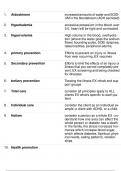
1. Aldosterone increased amounts of water and SODI-
UM in the bloodstream (ADH secreted)
2. Hyperkalemia excessive potassium in the blood. over
5.0, heart will be tight and contracted
3. Hypervolemia High volume in the blood, overhydra-
tion (where the water goes the sodium
flows) bounding pulse, SOB, dyspnea,
rales/crackles, peripheral edema.
4. primary prevention Efforts to prevent an injury or illness
from ever occurring. EX vaccines
5. Secondary prevention Efforts to limit the effects of an injury or
illness that you cannot completely pre-
vent. EX screening and being checked
for illnesses
6. tertiary prevention Treating the illness EX rehab and sup-
port groups
7. Total care consider all principles apply to ALL
clients EX what's specific to each pa-
tient
8. Individual care consider the client as an individual ex-
ample: a client with ADHD, or a child.
9. Holism consider a person as a whole EX -un-
derstand how one area can affect the
whole person or diabetic has a death
in the family, the stress increases hor-
mones which increase blood sugar,
which affects diabetes. Spiritual, phys-
ical needs, eating patterns, relation-
ships
10. Health promotion
, Nur 155 exam 2 study guide Galen
Study online at https://quizlet.com/_csywdq
the process of enabling people to in-
crease control over, and to improve,
their health
11. Health protection motivated by the desire to avoid illness
12. Acute illness rapidly occurring illness that runs its
course, allowing a person to return
to one's previous level of functioning.
Less then 6 months and vitals will be
higher then normal EX Flu
13. Chronic illness an illness that begins gradually and is
ongoing. loss or abnormality of body
functions. lasts longer then 6 months
EX cancer
14. BMI 18.5 underweight
15. BMI 18.5-24.9 Normal/healthy weight
16. BMI 25.0-29.9 overweight
17. BMI 30.0-34.9 stage 1 obesity
18. BMI 35.0-39.9 stage 2 obesity
19. BMI 40.0+ Morbid obese
20. polyuria excessive urination
21. disuresis abnormal increase in production of
urine can be caused by medications
22. oliguria scanty urination
23. nocturia excessive urination at night. more then
2x a night
24. retention of bladder
Study online at https://quizlet.com/_csywdq
1. Aldosterone increased amounts of water and SODI-
UM in the bloodstream (ADH secreted)
2. Hyperkalemia excessive potassium in the blood. over
5.0, heart will be tight and contracted
3. Hypervolemia High volume in the blood, overhydra-
tion (where the water goes the sodium
flows) bounding pulse, SOB, dyspnea,
rales/crackles, peripheral edema.
4. primary prevention Efforts to prevent an injury or illness
from ever occurring. EX vaccines
5. Secondary prevention Efforts to limit the effects of an injury or
illness that you cannot completely pre-
vent. EX screening and being checked
for illnesses
6. tertiary prevention Treating the illness EX rehab and sup-
port groups
7. Total care consider all principles apply to ALL
clients EX what's specific to each pa-
tient
8. Individual care consider the client as an individual ex-
ample: a client with ADHD, or a child.
9. Holism consider a person as a whole EX -un-
derstand how one area can affect the
whole person or diabetic has a death
in the family, the stress increases hor-
mones which increase blood sugar,
which affects diabetes. Spiritual, phys-
ical needs, eating patterns, relation-
ships
10. Health promotion
, Nur 155 exam 2 study guide Galen
Study online at https://quizlet.com/_csywdq
the process of enabling people to in-
crease control over, and to improve,
their health
11. Health protection motivated by the desire to avoid illness
12. Acute illness rapidly occurring illness that runs its
course, allowing a person to return
to one's previous level of functioning.
Less then 6 months and vitals will be
higher then normal EX Flu
13. Chronic illness an illness that begins gradually and is
ongoing. loss or abnormality of body
functions. lasts longer then 6 months
EX cancer
14. BMI 18.5 underweight
15. BMI 18.5-24.9 Normal/healthy weight
16. BMI 25.0-29.9 overweight
17. BMI 30.0-34.9 stage 1 obesity
18. BMI 35.0-39.9 stage 2 obesity
19. BMI 40.0+ Morbid obese
20. polyuria excessive urination
21. disuresis abnormal increase in production of
urine can be caused by medications
22. oliguria scanty urination
23. nocturia excessive urination at night. more then
2x a night
24. retention of bladder