Social Work Clinical Exam Questions And 100%
Correct Answers Latest Update
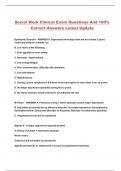
Dysthymic Disorder - ANSWER A. Depressed more days than not for at least 2 years.
Youth and children irritable 1 yr.
B. 2 or more of the following
1. Poor appetite or over eating
2. Insomnia - Hypersomnia
3. Low energy fatigue
4. Poor concentration, difficulty with decisions
5. Low self-esteem
6. Hopelessness
C. During 2 years symptoms A & B have never been gone for more than 2 mo. at a time.
D. No major depressive episodes during first 2 years.
E. No manic episode, mixed criteria for cyclothymia not met.
Bi Polar I - ANSWER A. Presence of only 1 manic episode no past major depression
B. Not better accounted for by affective disorder, not superimposed on Schizophrenia,
Schizophreniform, Delusional Disorder or Psychotic Disorder not otherwise specified.
C. Impairment social and occupational
Bipolar II - A major depressive episode present
A history of at least 1 hypomanic episode
Never manic
Criteria A & B not better accounted for
Significant distress or impairment in social, occupational functioning
, Psychotic Disorder Due to General Medical Condition - ANSWER The psychotic
symptoms are judged to be a direct physiological consequence of a general medical
condition.
Dyskinesia - ANSWER Voluntary movements are distorted through involuntary muscular
control.
Profound Mental Retardation - ANSWER IQ Below 20 -25
Considerable impairment, requires constant supervision and aid.
Severe Mental Retardation - ANSWER IQ 20 -25 to 35-40
Little or no speech in childhood, can perform elementary self care, can read survival
worlds, significant physical and sensory problems.
Conduct Disorder- ANSWER Aggressive conduct, threatens physical harm to other
people or animals, property damage or loss, serious violation of rules.
Must be present in past 12 mo, 1 behavior present past 6 months.
Can be over age 18 if anti social personality disorder criteria not met.
Pattern beginning before age 13.
Mild-moderate-severe
Genetic and environmental
Reactive Attachment Disorder- ANSWER Marked disturbance in social relatedness
before age 5 years.
Inhibited type frozen watchfullness
Disinhibited type
Selective Mutism-ANSWER Failure to speak in specific social situations
Correct Answers Latest Update
Dysthymic Disorder - ANSWER A. Depressed more days than not for at least 2 years.
Youth and children irritable 1 yr.
B. 2 or more of the following
1. Poor appetite or over eating
2. Insomnia - Hypersomnia
3. Low energy fatigue
4. Poor concentration, difficulty with decisions
5. Low self-esteem
6. Hopelessness
C. During 2 years symptoms A & B have never been gone for more than 2 mo. at a time.
D. No major depressive episodes during first 2 years.
E. No manic episode, mixed criteria for cyclothymia not met.
Bi Polar I - ANSWER A. Presence of only 1 manic episode no past major depression
B. Not better accounted for by affective disorder, not superimposed on Schizophrenia,
Schizophreniform, Delusional Disorder or Psychotic Disorder not otherwise specified.
C. Impairment social and occupational
Bipolar II - A major depressive episode present
A history of at least 1 hypomanic episode
Never manic
Criteria A & B not better accounted for
Significant distress or impairment in social, occupational functioning
, Psychotic Disorder Due to General Medical Condition - ANSWER The psychotic
symptoms are judged to be a direct physiological consequence of a general medical
condition.
Dyskinesia - ANSWER Voluntary movements are distorted through involuntary muscular
control.
Profound Mental Retardation - ANSWER IQ Below 20 -25
Considerable impairment, requires constant supervision and aid.
Severe Mental Retardation - ANSWER IQ 20 -25 to 35-40
Little or no speech in childhood, can perform elementary self care, can read survival
worlds, significant physical and sensory problems.
Conduct Disorder- ANSWER Aggressive conduct, threatens physical harm to other
people or animals, property damage or loss, serious violation of rules.
Must be present in past 12 mo, 1 behavior present past 6 months.
Can be over age 18 if anti social personality disorder criteria not met.
Pattern beginning before age 13.
Mild-moderate-severe
Genetic and environmental
Reactive Attachment Disorder- ANSWER Marked disturbance in social relatedness
before age 5 years.
Inhibited type frozen watchfullness
Disinhibited type
Selective Mutism-ANSWER Failure to speak in specific social situations