

AQA A-level Water & Carbon Cycle Knowledge Booklet
The Water Cycle
1. Aquifers:
There are two types of aquifers:
- Unconfined- where porous rock is open to surface water and is directly recharged by
precipitation
- Confined- where there are thick layers/beds of rockover the aquifer, known as the
confining beds; these contain the aquifer from the Earth's surface or other rocks
2. Residence Time:
- This is the time that water is held in a store (eg. water is held in soil for 1-2 weeks)
3. Changes in the Water Cycle’s Stores:
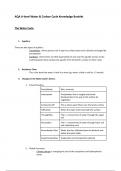
1. Flows/Transfers:
Precipitation Rain, snow etc.
Interception recipitation that is caught and stored
P
(temporarily) on its way to the surface by
vegetation
Surface Runoff This is when water flows over the land's surface
Infiltration When the water enters beneath the surface
Throughflow T he (-->) movement of water through the upper
soil
Percolation T he (-->) movement of water through lower soil
and underlying rock
Groundwater flow ater that has infiltrated past the bedrock and
W
below the water table
Evapotranspiration Evaporation and transpiration (plants)
2. Global Processes:
- Climate changeis changing the size of the cryosphere and hydrosphere's
stores
, 3. Local Processes:
- Farming practicescan interfere with natural processeseg. vegetation can
prevent infiltration & over-abstraction for farming removes natural stores of
water
- Deforestationreduces interception and infiltration
- without plant interception water will flow too fast to infiltrate and
soil won’t be broken up from roots to allow infiltration
- Urbanisationreduces infiltration by replacing permeablegeology with
impermeable geology (this can lead to high rates of surface runoff)
4. Drainage Basins:
- An area of land drained by a river and its tributaries. A drainage basin can also be
called a ‘catchment’
a . atershed = the ‘imaginary’ boundary that separates two drainage basins
W
b. Source = where the river starts
c. Confluence = where 2+ river meet
d. Tributary = where one stream meets the main river
e. Mouth = where the river meets the sea
NOTE: Hillslopes and Drainage Basins operate similarly, however, hillslopes are more localised
- the flows in both will be affected by antecedent conditions eg. saturation of soil
Many factors can affect drainage basin and hillslope runoff:
Basin shape/size Steeper and/or smaller = quicker runoff
Climate Heavier rain and/or quick snowmelt = quicker runoff
Geology Impermeable and deforested = quicker runoff
Land use rbanised = quicker runoff (impermeable surfaces and
U
deforested areas)
ntecedent
A ery dry/compacted/saturated/frozen soil = quicker
V
conditions runoff
5. What Impacts the Water Cycle:
1. Natural Factors
a. natural climate change (glacial and interglacial periods)
b. extreme climate events (droughts, floods etc)
The Water Cycle
1. Aquifers:
There are two types of aquifers:
- Unconfined- where porous rock is open to surface water and is directly recharged by
precipitation
- Confined- where there are thick layers/beds of rockover the aquifer, known as the
confining beds; these contain the aquifer from the Earth's surface or other rocks
2. Residence Time:
- This is the time that water is held in a store (eg. water is held in soil for 1-2 weeks)
3. Changes in the Water Cycle’s Stores:
1. Flows/Transfers:
Precipitation Rain, snow etc.
Interception recipitation that is caught and stored
P
(temporarily) on its way to the surface by
vegetation
Surface Runoff This is when water flows over the land's surface
Infiltration When the water enters beneath the surface
Throughflow T he (-->) movement of water through the upper
soil
Percolation T he (-->) movement of water through lower soil
and underlying rock
Groundwater flow ater that has infiltrated past the bedrock and
W
below the water table
Evapotranspiration Evaporation and transpiration (plants)
2. Global Processes:
- Climate changeis changing the size of the cryosphere and hydrosphere's
stores
, 3. Local Processes:
- Farming practicescan interfere with natural processeseg. vegetation can
prevent infiltration & over-abstraction for farming removes natural stores of
water
- Deforestationreduces interception and infiltration
- without plant interception water will flow too fast to infiltrate and
soil won’t be broken up from roots to allow infiltration
- Urbanisationreduces infiltration by replacing permeablegeology with
impermeable geology (this can lead to high rates of surface runoff)
4. Drainage Basins:
- An area of land drained by a river and its tributaries. A drainage basin can also be
called a ‘catchment’
a . atershed = the ‘imaginary’ boundary that separates two drainage basins
W
b. Source = where the river starts
c. Confluence = where 2+ river meet
d. Tributary = where one stream meets the main river
e. Mouth = where the river meets the sea
NOTE: Hillslopes and Drainage Basins operate similarly, however, hillslopes are more localised
- the flows in both will be affected by antecedent conditions eg. saturation of soil
Many factors can affect drainage basin and hillslope runoff:
Basin shape/size Steeper and/or smaller = quicker runoff
Climate Heavier rain and/or quick snowmelt = quicker runoff
Geology Impermeable and deforested = quicker runoff
Land use rbanised = quicker runoff (impermeable surfaces and
U
deforested areas)
ntecedent
A ery dry/compacted/saturated/frozen soil = quicker
V
conditions runoff
5. What Impacts the Water Cycle:
1. Natural Factors
a. natural climate change (glacial and interglacial periods)
b. extreme climate events (droughts, floods etc)


