
BIOB34 Prepared by: Hassan Alibhai
Lecture Notes Document Created: 2018-09-04
Lecture 1 2 3 4 5 6 7 7 8 9 10 11 12 12 13 14 15 16 17 17-22 22-24
Topic Intro Metabolic Rate Thermal Respiratory Digestive Nervous
Pages 1 – 3 4 – 18 19 – 39 40 – 64 64 – 96 97 – 107
All images and raw content are credited to Dr. Jason Brown, the instructor of this course in Fall 2018.
Topic 1, Lecture 1 – What are Animals
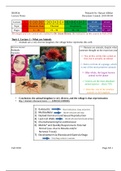
• Animals are a very diverse kingdom, the collage below represents this well:
=> Humans are animals, despite what
someone thought on the exam last year
=> Sea urchin, seems like a plant at
first, but is actually an animal
=> Fish is in front of a sponge, which
is one of the most primitive animals
=> Blue whale, the largest known
animal on the planet
=> Insects are the most abundant
animal species – about 75%
=> Rotorfur, one of the smallest
animals in the kingdom
• Conclusion: the animal kingdom is very diverse, and the collage is that representation
• Big 7 Animal Characteristics => EMDSLCHMRBG
Fall 2018 Page AP-1
,BIOB34 Prepared by: Hassan Alibhai
Lecture Notes Document Created: 2018-09-04
The Big 7 Animal Characteristics (All Animals are...) Relevant Images
1) Eukaryotic
• All animals have eukaryotic cells – their DNA is in a
nucleus that is enclosed
• The two rules above do not work in the opposite
direction – not all eukaryotic or multicellular
organisms are animals!
2) Multicellular
• All animals are composed of multiple cells, and cell
specialization is common
• Note: despite having “many cells”, this colony is not
multicellular, as each cell can live independently if it
so chooses.
3) Diploid Dominant and Sexual Reproduction
• The majority of the animal life cycle is spent in the
diploid stage (unlike plants and fungi, who spend
theirs in the haploid stage)
• Animals reproduce sexually, with gametes (as
opposed to bacteria, that use binary fission)
4) Lack of Cell Walls
• This appears unique to animals, but is also common
in some species of bacteria and archaea
• Animals obtain the same protection as a cell wall via
water intake, which needs to be high for most
animals
5) Chemotrophic and Holozoic
• Humans are chemoheterotrophs, and obtain energy
through the electron transport chain and carbon
• Humans require the holozoic pathway of obtaining
carbon, as opposed to Holophytic organisms, that
absorb dissolved nutrients from their environment
◦ Ingestion => Digestion => Absorption
6) Motile* and Quickly Responsive to External Stimuli (due to Muscle and/or Nervous Tissue)
• It helps to be motile in order to obtain food
• *The organism must only be motile at some point in their life (ex. sponge)
7) Development via Blastula and Gastrula Stage
• This is the only of the seven defining characteristics
that is entirely unique and defines all animals
◦ Animals have this trait, no other organism does,
so it becomes a hallmark characteristic Blastula => hollow “ball” of cells
Fall 2018 Page AP-2
,BIOB34 Prepared by: Hassan Alibhai
Lecture Notes Document Created: 2018-09-04
• The features above work hand in hand to assist with the function of the animal
▪ Being holozoic requires ingestion of organic material in order to survive, which is
helped by being motile
▪ The blastula may develop via gastrulation and create a cavity, which becomes the
beginnings of a digestive tract in the organism, which once again requires it to be
holozoic
• Animals and Phylogeny
◦ One of the 6 generally classified “Kingdoms” (but this number is always increasing)
◦ Animal Kingdom is also sometimes known as “metazoa” because of the history of the
kingdom:
Historic Animal Kingdom (2 sub-kingdoms) Current Animal Kingdom
Animalia Only consists of
metazoa
Protozoa => Metazoa =>
Basic, primitive Advanced, All protozoa moved over to
Animals Developed the more general protist
category, the “garbage can”.
• Historically, single-celled eurkaryotes with animal-like behaviour were called Protozoans
whereas single-celled eurkaryotes with plant-like behaviour were called algae. The species
count includes extinct animals.
Largest kingdom, over
1.5 million species
Fall 2018 Page AP-3
, BIOB34 Prepared by: Hassan Alibhai
Lecture Notes Document Created: 2018-09-04
Topic 2, Lecture 2 – Metabolic Rate (I)
• One of the most widely measured physiological traits in animals
• An essential property to animals, as mentioned last lecture, is that they are chemoheterotrophic
(require organic matter as a carbon and an energy source) and are holozoic
◦ The holozoic pathway is critical to this: Ingestion => Absorption => Digestion
▪ Digestion is the process of breaking down large, complex molecules into smaller,
simpler ones with the purpose of assimilation
Absorbed energy is “Foreign”
the energy entering to body Oxidation in animals
living tissue (loss of electrons)
means we need an
electron acceptor to run
ATP synthase, which is
O2
Food O2
Energy is stored as
lipids (as opposed to
glycogen or protein)
because of its high
energy density in dry
and wet matter and
low water content
• An important calculation with respect to metabolism is assimilation efficiency
absorbed chemical energy ACE
◦ AE = = => many contributing factors, including diet
injested chemical energy ICE
▪ Birds and mammals generally have an AE of 70-80%, with the exception of eating
plants and fruit, which contain a lot of cellulose, which is typically difficult to digest
▪ AE decreases when food is abundant (as opposed to increase) so as to prevent the
animal from being obese due to less natural advantages (but animals can store a lot)
Fall 2018 Page AP-4
Lecture Notes Document Created: 2018-09-04
Lecture 1 2 3 4 5 6 7 7 8 9 10 11 12 12 13 14 15 16 17 17-22 22-24
Topic Intro Metabolic Rate Thermal Respiratory Digestive Nervous
Pages 1 – 3 4 – 18 19 – 39 40 – 64 64 – 96 97 – 107
All images and raw content are credited to Dr. Jason Brown, the instructor of this course in Fall 2018.
Topic 1, Lecture 1 – What are Animals
• Animals are a very diverse kingdom, the collage below represents this well:
=> Humans are animals, despite what
someone thought on the exam last year
=> Sea urchin, seems like a plant at
first, but is actually an animal
=> Fish is in front of a sponge, which
is one of the most primitive animals
=> Blue whale, the largest known
animal on the planet
=> Insects are the most abundant
animal species – about 75%
=> Rotorfur, one of the smallest
animals in the kingdom
• Conclusion: the animal kingdom is very diverse, and the collage is that representation
• Big 7 Animal Characteristics => EMDSLCHMRBG
Fall 2018 Page AP-1
,BIOB34 Prepared by: Hassan Alibhai
Lecture Notes Document Created: 2018-09-04
The Big 7 Animal Characteristics (All Animals are...) Relevant Images
1) Eukaryotic
• All animals have eukaryotic cells – their DNA is in a
nucleus that is enclosed
• The two rules above do not work in the opposite
direction – not all eukaryotic or multicellular
organisms are animals!
2) Multicellular
• All animals are composed of multiple cells, and cell
specialization is common
• Note: despite having “many cells”, this colony is not
multicellular, as each cell can live independently if it
so chooses.
3) Diploid Dominant and Sexual Reproduction
• The majority of the animal life cycle is spent in the
diploid stage (unlike plants and fungi, who spend
theirs in the haploid stage)
• Animals reproduce sexually, with gametes (as
opposed to bacteria, that use binary fission)
4) Lack of Cell Walls
• This appears unique to animals, but is also common
in some species of bacteria and archaea
• Animals obtain the same protection as a cell wall via
water intake, which needs to be high for most
animals
5) Chemotrophic and Holozoic
• Humans are chemoheterotrophs, and obtain energy
through the electron transport chain and carbon
• Humans require the holozoic pathway of obtaining
carbon, as opposed to Holophytic organisms, that
absorb dissolved nutrients from their environment
◦ Ingestion => Digestion => Absorption
6) Motile* and Quickly Responsive to External Stimuli (due to Muscle and/or Nervous Tissue)
• It helps to be motile in order to obtain food
• *The organism must only be motile at some point in their life (ex. sponge)
7) Development via Blastula and Gastrula Stage
• This is the only of the seven defining characteristics
that is entirely unique and defines all animals
◦ Animals have this trait, no other organism does,
so it becomes a hallmark characteristic Blastula => hollow “ball” of cells
Fall 2018 Page AP-2
,BIOB34 Prepared by: Hassan Alibhai
Lecture Notes Document Created: 2018-09-04
• The features above work hand in hand to assist with the function of the animal
▪ Being holozoic requires ingestion of organic material in order to survive, which is
helped by being motile
▪ The blastula may develop via gastrulation and create a cavity, which becomes the
beginnings of a digestive tract in the organism, which once again requires it to be
holozoic
• Animals and Phylogeny
◦ One of the 6 generally classified “Kingdoms” (but this number is always increasing)
◦ Animal Kingdom is also sometimes known as “metazoa” because of the history of the
kingdom:
Historic Animal Kingdom (2 sub-kingdoms) Current Animal Kingdom
Animalia Only consists of
metazoa
Protozoa => Metazoa =>
Basic, primitive Advanced, All protozoa moved over to
Animals Developed the more general protist
category, the “garbage can”.
• Historically, single-celled eurkaryotes with animal-like behaviour were called Protozoans
whereas single-celled eurkaryotes with plant-like behaviour were called algae. The species
count includes extinct animals.
Largest kingdom, over
1.5 million species
Fall 2018 Page AP-3
, BIOB34 Prepared by: Hassan Alibhai
Lecture Notes Document Created: 2018-09-04
Topic 2, Lecture 2 – Metabolic Rate (I)
• One of the most widely measured physiological traits in animals
• An essential property to animals, as mentioned last lecture, is that they are chemoheterotrophic
(require organic matter as a carbon and an energy source) and are holozoic
◦ The holozoic pathway is critical to this: Ingestion => Absorption => Digestion
▪ Digestion is the process of breaking down large, complex molecules into smaller,
simpler ones with the purpose of assimilation
Absorbed energy is “Foreign”
the energy entering to body Oxidation in animals
living tissue (loss of electrons)
means we need an
electron acceptor to run
ATP synthase, which is
O2
Food O2
Energy is stored as
lipids (as opposed to
glycogen or protein)
because of its high
energy density in dry
and wet matter and
low water content
• An important calculation with respect to metabolism is assimilation efficiency
absorbed chemical energy ACE
◦ AE = = => many contributing factors, including diet
injested chemical energy ICE
▪ Birds and mammals generally have an AE of 70-80%, with the exception of eating
plants and fruit, which contain a lot of cellulose, which is typically difficult to digest
▪ AE decreases when food is abundant (as opposed to increase) so as to prevent the
animal from being obese due to less natural advantages (but animals can store a lot)
Fall 2018 Page AP-4



