

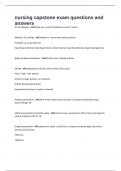
nursing capstone exam questions and
answers
Do not delegate - ANS What you can EAT E-evaluate A-assess T-teach
Addison's & Cushings - ANS Addison's = down down down up down
Cushings= up up up down up
hypo/hypernatremia, hypo/hypertension, blood volume, hypo/hyperkalemia, hypo/hyperglycemia
Better peripheral perfusion? - ANS EleVate Veins, DAngle Arteries
APGAR - ANS Appearance (all pink, pink and blue, blue (pale)
Pulse (>100, <100, absent)
Grimace (cough, grimace, no response)
Activity (flexed, flaccid, limp)
Respirations (strong cry, weak cry, absent)
Airborne precautions - ANS MTV or My chicken hez tb measles, chickenpox (varicella) Herpes
zoster/shingles TB
Airborne precautions protective equip - ANS private room, neg pressure with 6-12 air exchanges/hr
mask & respirator N95 for TB
Droplet precautions - ANS spiderman! sepsis, scarlet fever, streptococcal pharyngitis, parvovirus,
pneumonia, pertussis,
influenza,
diptheria,
,epiglottitis,
rubella,
mumps, meningitis, mycoplasma or meningeal pneumonia, adeNovirus
(Private room and mask)
Contact precaution - ANS MRS WHISE
protect visitors & caregivers when 3 ft of the pt.
Multidrug-resistant organisms
RSV, Shigella, Wound infections, Herpes simplex, Impetigo, Scabies, Enteric diseases caused by micro-
organisms (C diff),
Gloves and gowns worn by the caregivers and visitors
Disposal of infectious dressing material into a single, nonporous bag without touching the outside of the
bag
PMGG= Private room/ share same illness, mask, gown and gloves
Skin infection - ANS VCHIPS
Varicella zoster
Cutaneous diptheria
Herpes simplez
Impetigo
Peduculosis
Scabies
Air or Pulmonary Embolism - ANS S/S chest pain, dyspnea, tachycardia, pale/cyanotic, sense of
impending doom. (turn pt to LEFT side and LOWER the head of bed.)
,Woman in labor (un-reassuring FHR) - ANS (late decels, decreased variability, fetal bradycardia, etc) Turn
pt on Left side, give O2, stop pitocin, Increase IV fluids!
Tube feeding with decreased LOC - ANS Pt on Right side (promotes emptying of the stomach) Head of
bed elevated (prevent aspiration)
After lumbar puncture and oil based myelogram - ANS pt is flat SUPINE (prevent headache and leaking
of CSF)
Pt with heat stroke - ANS flat with legs elevated
during Continuous Bladder Irrigation (CBI) - ANS catheter is taped to the thigh. leg must be kept straight.
After Myringotomy - ANS position on the side of AFFECTED ear, allows drainage.
After Cateract surgery - ANS pt sleep on UNAFFECTED side with a night shield for 1-4 weeks
after Thyroidectomy - ANS low or semi-fowler's position, support head, neck and shoulders.
Infant with Spina Bifida - ANS Prone so that sac does not rupture
Buck's Traction (skin) - ANS elevate foot of bed for counter traction
After total hip replacement - ANS don't sleep on side of surgery, don't flex hip more than 45-60 degress,
don't elevate Head Of Bed more than 45 degrees. Maintain hip abduction by separating thighs with
pillows.
, Prolapsed cord - ANS Knee to chest or Trendelenburg
oxygen 8 to 10 L
Cleft Lip - ANS position on back or in infant seat to prevent trauma to the suture line. while feeding hold
in upright position.
To prevent dumping syndrome - ANS (post operative ulcer/stomach surgeries) eat in reclining position.
Lie down after meals for 20-30 min. also restrict fluids during meals, low CHO and fiber diet. small,
frequent meals.
AKA (above knee amputation) - ANS elevate for first 24 hours on pillow. position prone daily to maintain
hip extension.
BKA (below knee amputation) - ANS foot of bed elevated for first 24 hours. position prone to provide hip
extension.
detached retina - ANS area of detachment should be in the dependent position
administration of enema - ANS pt should be left side lying (Sim's) with knee flexed.
After supratentorial surgery - ANS (incision behind hairline on forhead) elevate HOB 30-40 degrees
After infratentorial surgery - ANS (incision at the nape of neck) position pt flat and lateral on either side.
During internal radiation - ANS on bed rest while implant in place
answers
Do not delegate - ANS What you can EAT E-evaluate A-assess T-teach
Addison's & Cushings - ANS Addison's = down down down up down
Cushings= up up up down up
hypo/hypernatremia, hypo/hypertension, blood volume, hypo/hyperkalemia, hypo/hyperglycemia
Better peripheral perfusion? - ANS EleVate Veins, DAngle Arteries
APGAR - ANS Appearance (all pink, pink and blue, blue (pale)
Pulse (>100, <100, absent)
Grimace (cough, grimace, no response)
Activity (flexed, flaccid, limp)
Respirations (strong cry, weak cry, absent)
Airborne precautions - ANS MTV or My chicken hez tb measles, chickenpox (varicella) Herpes
zoster/shingles TB
Airborne precautions protective equip - ANS private room, neg pressure with 6-12 air exchanges/hr
mask & respirator N95 for TB
Droplet precautions - ANS spiderman! sepsis, scarlet fever, streptococcal pharyngitis, parvovirus,
pneumonia, pertussis,
influenza,
diptheria,
,epiglottitis,
rubella,
mumps, meningitis, mycoplasma or meningeal pneumonia, adeNovirus
(Private room and mask)
Contact precaution - ANS MRS WHISE
protect visitors & caregivers when 3 ft of the pt.
Multidrug-resistant organisms
RSV, Shigella, Wound infections, Herpes simplex, Impetigo, Scabies, Enteric diseases caused by micro-
organisms (C diff),
Gloves and gowns worn by the caregivers and visitors
Disposal of infectious dressing material into a single, nonporous bag without touching the outside of the
bag
PMGG= Private room/ share same illness, mask, gown and gloves
Skin infection - ANS VCHIPS
Varicella zoster
Cutaneous diptheria
Herpes simplez
Impetigo
Peduculosis
Scabies
Air or Pulmonary Embolism - ANS S/S chest pain, dyspnea, tachycardia, pale/cyanotic, sense of
impending doom. (turn pt to LEFT side and LOWER the head of bed.)
,Woman in labor (un-reassuring FHR) - ANS (late decels, decreased variability, fetal bradycardia, etc) Turn
pt on Left side, give O2, stop pitocin, Increase IV fluids!
Tube feeding with decreased LOC - ANS Pt on Right side (promotes emptying of the stomach) Head of
bed elevated (prevent aspiration)
After lumbar puncture and oil based myelogram - ANS pt is flat SUPINE (prevent headache and leaking
of CSF)
Pt with heat stroke - ANS flat with legs elevated
during Continuous Bladder Irrigation (CBI) - ANS catheter is taped to the thigh. leg must be kept straight.
After Myringotomy - ANS position on the side of AFFECTED ear, allows drainage.
After Cateract surgery - ANS pt sleep on UNAFFECTED side with a night shield for 1-4 weeks
after Thyroidectomy - ANS low or semi-fowler's position, support head, neck and shoulders.
Infant with Spina Bifida - ANS Prone so that sac does not rupture
Buck's Traction (skin) - ANS elevate foot of bed for counter traction
After total hip replacement - ANS don't sleep on side of surgery, don't flex hip more than 45-60 degress,
don't elevate Head Of Bed more than 45 degrees. Maintain hip abduction by separating thighs with
pillows.
, Prolapsed cord - ANS Knee to chest or Trendelenburg
oxygen 8 to 10 L
Cleft Lip - ANS position on back or in infant seat to prevent trauma to the suture line. while feeding hold
in upright position.
To prevent dumping syndrome - ANS (post operative ulcer/stomach surgeries) eat in reclining position.
Lie down after meals for 20-30 min. also restrict fluids during meals, low CHO and fiber diet. small,
frequent meals.
AKA (above knee amputation) - ANS elevate for first 24 hours on pillow. position prone daily to maintain
hip extension.
BKA (below knee amputation) - ANS foot of bed elevated for first 24 hours. position prone to provide hip
extension.
detached retina - ANS area of detachment should be in the dependent position
administration of enema - ANS pt should be left side lying (Sim's) with knee flexed.
After supratentorial surgery - ANS (incision behind hairline on forhead) elevate HOB 30-40 degrees
After infratentorial surgery - ANS (incision at the nape of neck) position pt flat and lateral on either side.
During internal radiation - ANS on bed rest while implant in place


