
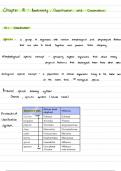
Chapter 18 Biodiversity Classification and Conservation
18.1 Classification
species a group of organisms with similar morphological and physiological feature
that are able to breed together and produce fertile offspring
morphological species concept grouping together organisms that share many
physical features that distinguish them from other speci
cological species concept a population of similar organisms living in the same area
at the same time ecological species
Binomial species naming system
Genus specific epithet trivial name
hierarchical
lassification
system
in
,3 domains
archaea prokaryotes Archaea has more in common with
bacteria prokaryotes Eukarya than Bacteria
entanga eukaryotes diverged later
Archaea
live in extreme environments
some produce methane can't survive
where there is 02
have unusual enzymes
, Bacteria
Eukaryotes
The three domains are each divided into Kingdoms
4 Kingdoms of the domain Eukarya
Protoctista


