

Written by students who passed Immediately available after payment Read online or as PDF Wrong document? Swap it for free 4.6 TrustPilot
logo-home
Document preview thumbnail
Preview 1 out of 4 pages
Exam (elaborations)

Surgical Technology Chapter 4 Review Questions with Verified Answers Already Passed

Document preview thumbnail
Preview 1 out of 4 pages

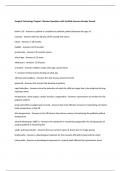
Surgical Technology Chapter 4 Review Questions with Verified Answers Already Passed birth to 18 - Answers a patient is considered a pediatric patient between the ages of neonate - Answers the first 28 days of life outside the uterus infant - Answers 1-18 months toddler - Answers 18-30 months preschooler - Answers 30 months-5years school age - Answers 6-12 years adolescent - Answers 13-18 years 6 months - Answers children under what age cannot shiver 7 - Answers frontal sinuses develop at what age ethmoid and maxillary - Answers the only sinuses present at birth sphenoid - Answers the sinuses that develop at puberty rapid induction - Answers since the induction of what the child no longer has to be subjected to long induction times temperature, urine output, cardiac function, oxygenation - Answers 4 parameters to monitor for the pediatric patient keep extremities wrapped and covered - Answers the most effective means for maintaining an infant's body temperature in the OR skin temperature - Answers in the OR what is the primary means of monitoring the pediatric patient temperature arterial blood gases (ABG's) - Answers the standard for monitoring oxygenation for all age groups of surgical patients is measuring the septic and hypovolemic - Answers the two common types of shock seen in all age groups bradycardia - Answers a physiological response for the neonate affected by hypovolemic shock tachycardia - Answers a physiological response for a typical adult affected by hypovolemic shock dehydration - Answers the most common cause of hypovolemic shock in infants hypotonic solution of sodium chloride - Answers emergengy treatment for hypovolmic shock in infants septic shock - Answers is usually caused by gram-negative bacteria septic shock - Answers initial treatment is the infusion of colloid solutions and broad spectrum antibiotics, if still hypotension is still present dopamine is the agent of choice to increase cardiac output fever - Answers the initial sign of postoperative infection kernicterus - Answers excess of bilirubin in the blood sulfonamides - Answers should not be administered to newborns because they are associated with an increased incidence of kernicterus in neonates enterocolitis - Answers a common side effect of antibiotics in pediatric patients accidents - Answers the number one cause of death in children aged 1-15 motor vehicle accidents - Answers are the major cause for trauma in children clavicle - Answers the most common bone fracture as a result of dystocia dystocia - Answers difficult labor or delivery of a baby

Content preview

Surgical Technology Chapter 4 Review Questions with Verified Answers Already Passed


birth to 18 - Answers a patient is considered a pediatric patient between the ages of

neonate - Answers the first 28 days of life outside the uterus

infant - Answers 1-18 months

toddler - Answers 18-30 months

preschooler - Answers 30 months-5years

school age - Answers 6-12 years

adolescent - Answers 13-18 years

6 months - Answers children under what age cannot shiver

7 - Answers frontal sinuses develop at what age

ethmoid and maxillary - Answers the only sinuses present at birth

sphenoid - Answers the sinuses that develop at puberty

rapid induction - Answers since the induction of what the child no longer has to be subjected to long
induction times

temperature, urine output, cardiac function, oxygenation - Answers 4 parameters to monitor for the
pediatric patient

keep extremities wrapped and covered - Answers the most effective means for maintaining an infant's
body temperature in the OR

skin temperature - Answers in the OR what is the primary means of monitoring the pediatric patient
temperature

arterial blood gases (ABG's) - Answers the standard for monitoring oxygenation for all age groups of
surgical patients is measuring the

septic and hypovolemic - Answers the two common types of shock seen in all age groups

bradycardia - Answers a physiological response for the neonate affected by hypovolemic shock

tachycardia - Answers a physiological response for a typical adult affected by hypovolemic shock

Document information

Uploaded on
October 29, 2024
Number of pages
4
Written in
2024/2025
Type
Exam (elaborations)
Contains
Questions & answers
$8.49

Wrong document? Swap it for free Within 14 days of purchase and before downloading, you can choose a different document. You can simply spend the amount again.
Written by students who passed
Immediately available after payment
Read online or as PDF

Seller avatar
Reputation scores are based on the amount of documents a seller has sold for a fee and the reviews they have received for those documents. There are three levels: Bronze, Silver and Gold. The better the reputation, the more your can rely on the quality of the sellers work.
TutorJosh
3.5
(76)
Sold
491
Followers
16
Items
32839
Last sold
2 hours ago


Why students choose Stuvia

Created by fellow students, verified by reviews

Quality you can trust: written by students who passed their tests and reviewed by others who've used these notes.

Didn't get what you expected? Choose another document

No worries! You can instantly pick a different document that better fits what you're looking for.

Pay as you like, start learning right away

No subscription, no commitments. Pay the way you're used to via credit card and download your PDF document instantly.

Student with book image

“Bought, downloaded, and aced it. It really can be that simple.”

Alisha Student

Working on your references?

Create accurate citations in APA, MLA and Harvard with our free citation generator.

Working on your references?

Frequently asked questions
