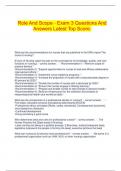
Role And Scope - Exam 3 Questions And
Answers Latest Top Score.
What are the recommendations for nurses that are published in the IOM's report The
future of nursing?
[Future of Nursing report focuses on the convergence of knowledge, quality, and new
functions in nursing.] - correct answer. -Recommendation 1: *Remove scope-of-
practice barriers.*
-Recommendation 2: *Expand opportunities for nurses to lead and diffuse collaborative
improvement efforts. *
-Recommendation 3: *Implement nurse residency programs. *
-Recommendation 4: *Increase the proportion of nurses with a baccalaureate degree to
80 percent by 2020.*
-Recommendation 5: *Double the number of nurses with a doctorate by 2020.*
-Recommendation 6: *Ensure that nurses engage in lifelong learning.*
-Recommendation 7: *Prepare and enable nurses to lead change to advance health.*
-Recommendation 8: *Build an infrastructure for the collection and analysis of
interprofessional health care workforce data.*
What are the components of a professional identity in nursing? - correct answer. -
First steps, education process and passing state boards [NCLEX]
-Professional ethics; principles [Rules, codes, standards], Consequences [outcome],
virtue [based on character]
-Continued development
-Doing and being a good nurse
Who determines laws and rules for professional nurses? - correct answer. The
Nurses Practice Act [State board of Nursing]
-Laws coming into being is a political process: 3 Branches; Judicial [interprets laws],
legislative [represent the people in forming the laws], executive [enforce the laws]
What can nurses do to become more professional? - correct answer. -Be active in a
professional organization such as; ANA, NLN, or other nursing organization
, Care coordination in nursing - correct answer. Using the nursing process to develop
plan of care for patient; using interdisciplinary care teams working together to achieve
optimal health for the patient
Collaboration - correct answer. *Several categories of collaboration*: Nurse-patient,
Nurse-Nurse [INTRAprofessional; mentoring, "shift handoffs"], INTERprofessional
collaboration [PT, OT, medicine, pharmacy, social worker],
Interorganizational [Hospice, health care consortiums]
How can nurses work with researchers to improve evidence based practice? - correct
answer. integrate best research with clinical expertise and patient values for
optimum care, and participate in learning and research activities to the extent feasible
Nursing informatics - correct answer. The blending of information and computer
science to study processes, management, and retrieval of health-related information.
-Technologically driven organizations have improved competitive edge
Assertive Communication - correct answer. -allows expression in direct, honest, and
nonthreatening ways do not infringe upon the rights of others
-It accurately expresses a person's feelings, beliefs, ideas, and opinion
Aggressive Communication - correct answer. -Used to humiliate, control, or
embarrass the other person or lower self-esteem
-Creates an "I win, you loss" situation
Conflictual Communication - correct answer. Conflict proceeds through four stages:
frustration, conceptualization, action, and outcomes
-Resolve conflicts productively depends on addressing thoughts, feelings, and
behaviors that form barriers to resolution.
Educational Communication - correct answer. -Learned from classes, workshops,
books, seminars
Teamwork in healthcare - correct answer. Multiple health disciplines with diverse
knowledge and skills who share an integrated set of goals and who utilize
interdependent collaboration that involves communications, sharing of knowledge and
coordination of services to provide services to patients and their caregiving systems
What does an effective team need? - correct answer. Collaboration! Working
together in a respectful civil manner; providing input that generates positive outcomes
for patient
-Participate in effective problem solving, increased creativity, and safe and improved
healthcare
Active listening - correct answer. -Postponing judgement about what is being said
and listening to *all* that is said.
Answers Latest Top Score.
What are the recommendations for nurses that are published in the IOM's report The
future of nursing?
[Future of Nursing report focuses on the convergence of knowledge, quality, and new
functions in nursing.] - correct answer. -Recommendation 1: *Remove scope-of-
practice barriers.*
-Recommendation 2: *Expand opportunities for nurses to lead and diffuse collaborative
improvement efforts. *
-Recommendation 3: *Implement nurse residency programs. *
-Recommendation 4: *Increase the proportion of nurses with a baccalaureate degree to
80 percent by 2020.*
-Recommendation 5: *Double the number of nurses with a doctorate by 2020.*
-Recommendation 6: *Ensure that nurses engage in lifelong learning.*
-Recommendation 7: *Prepare and enable nurses to lead change to advance health.*
-Recommendation 8: *Build an infrastructure for the collection and analysis of
interprofessional health care workforce data.*
What are the components of a professional identity in nursing? - correct answer. -
First steps, education process and passing state boards [NCLEX]
-Professional ethics; principles [Rules, codes, standards], Consequences [outcome],
virtue [based on character]
-Continued development
-Doing and being a good nurse
Who determines laws and rules for professional nurses? - correct answer. The
Nurses Practice Act [State board of Nursing]
-Laws coming into being is a political process: 3 Branches; Judicial [interprets laws],
legislative [represent the people in forming the laws], executive [enforce the laws]
What can nurses do to become more professional? - correct answer. -Be active in a
professional organization such as; ANA, NLN, or other nursing organization
, Care coordination in nursing - correct answer. Using the nursing process to develop
plan of care for patient; using interdisciplinary care teams working together to achieve
optimal health for the patient
Collaboration - correct answer. *Several categories of collaboration*: Nurse-patient,
Nurse-Nurse [INTRAprofessional; mentoring, "shift handoffs"], INTERprofessional
collaboration [PT, OT, medicine, pharmacy, social worker],
Interorganizational [Hospice, health care consortiums]
How can nurses work with researchers to improve evidence based practice? - correct
answer. integrate best research with clinical expertise and patient values for
optimum care, and participate in learning and research activities to the extent feasible
Nursing informatics - correct answer. The blending of information and computer
science to study processes, management, and retrieval of health-related information.
-Technologically driven organizations have improved competitive edge
Assertive Communication - correct answer. -allows expression in direct, honest, and
nonthreatening ways do not infringe upon the rights of others
-It accurately expresses a person's feelings, beliefs, ideas, and opinion
Aggressive Communication - correct answer. -Used to humiliate, control, or
embarrass the other person or lower self-esteem
-Creates an "I win, you loss" situation
Conflictual Communication - correct answer. Conflict proceeds through four stages:
frustration, conceptualization, action, and outcomes
-Resolve conflicts productively depends on addressing thoughts, feelings, and
behaviors that form barriers to resolution.
Educational Communication - correct answer. -Learned from classes, workshops,
books, seminars
Teamwork in healthcare - correct answer. Multiple health disciplines with diverse
knowledge and skills who share an integrated set of goals and who utilize
interdependent collaboration that involves communications, sharing of knowledge and
coordination of services to provide services to patients and their caregiving systems
What does an effective team need? - correct answer. Collaboration! Working
together in a respectful civil manner; providing input that generates positive outcomes
for patient
-Participate in effective problem solving, increased creativity, and safe and improved
healthcare
Active listening - correct answer. -Postponing judgement about what is being said
and listening to *all* that is said.