Chapter 6 Therapeutic Communication
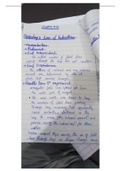
WHAT IS THERAPEUTIC COMMUNICATION?
-Therapeutic communication is an interpersonal interaction between RN & client >
focuses on client’s specific needs to promote an effective exchange of info.
-Therapeutic Communication helps to achieve 6 Goals:
● Establish a therapeutic nurse–client relationship.
● Identify most important client concern at that moment ( client-centered goal).
● Assess the client’s perception of the problem as it unfolds. This includes detailed
actions (behaviors and messages) of the people involved and the client’s
thoughts and feelings about the situation, others, and self.
● Facilitate the client’s expression of emotions.
● Teach the client and family necessary self-care skills.
● Recognize the client’s needs.
● Implement interventions designed to address the client’s needs.
● Guide client toward identifying a plan of action to a satisfying & socially
acceptable resolution.
-To have effective therapeutic communication, RN must also consider privacy & respect
of boundaries, use of touch, & active listening & observation.
Privacy & Respecting Boundaries
-Proxemics: study of distance zones between people during communication.
-The 4 distance zones:
● Intimate zone (0–18 inches between people): comfortable for parents w/ young
children, people who mutually desire personal contact, or people whispering.
Invasion anyone else is threatening & creates anxiety.
● Personal zone (18–36 inches): comfortable between family & friends talking.
● Social zone (4–12 feet): communication in social, work, & business settings.
● Public zone (12–25 feet): between a speaker & audience, small groups, & other
informal functions
-Some cultures (e.g., Hispanic, Mediterranean, East Indian, Asian, & Middle Eastern)
>more comfortable w/ less than 4-12 ft of space between them while talking.
- European American/African American heritage >may feel uncomfortable if clients from
these cultures stand close when talking.
-Both client & nurse can feel threatened if one invades other’s personal or intimate
zone> result in tension, irritability, fidgeting, or even flight.
- Ask for permission > if need to invade intimate or personal zone
Touch
5 types of touch:
, ● Functional–professional touch is used in exams or procedures such as when RN
touches a client to assess skin turgor or a masseuse performs a massage.
● Social–polite touch is used in greeting, like handshake & “air kisses” or when a
gentle hand guides someone in correct direction.
● Friendship–warmth touch involves a hug in greeting, an arm thrown around
shoulder of a good friend, or backslapping some men use to greet friends
● Love–intimacy touch involves tight hugs & kisses between lovers/close relatives.
● Sexual–arousal touch is used by lovers.
-RN must evaluate use of touch based on client’s preferences, history, and needs. -The
nurse may find touch supportive, but the client may not. Likewise, a client may use
touch too much, and again the nurse must set appropriate boundaries
-Also get verbal consent from patient before performing procedure requiring touch
Active Listening & Observation
-Active listening: means refraining from other internal mental activities & concentrating
exclusively on what the client says.
-Active observation: means watching speaker’s nonverbal actions as he/she
communicates.
-Observation is first step of therapeutic interpretation
-RN observe client & guides them to provide enough info to understand the behavior
-RN then document > analyze > find the needs r/t behavior > connects info
-Ask Specific Questions: understand clients perspective, clarify assumption, & develop
empathy ( develop by gathering as much info to avoid misinterpretation)
-Active listening & observation help the nurse to:
● Recognize the issue that is most important to the client at this time
● Know what further questions to ask the client
● Use additional therapeutic communication techniques to guide client to describe
his or her perceptions fully
● Understand client’s perceptions of the issue instead of jumping to conclusions
● Interpret and respond to the message objectively
VERBAL COMMUNICATION SKILLS
Using Concrete Messages
-Concrete messages: are important for accurate info exchange> words are explicit &
need no interpretation
WHAT IS THERAPEUTIC COMMUNICATION?
-Therapeutic communication is an interpersonal interaction between RN & client >
focuses on client’s specific needs to promote an effective exchange of info.
-Therapeutic Communication helps to achieve 6 Goals:
● Establish a therapeutic nurse–client relationship.
● Identify most important client concern at that moment ( client-centered goal).
● Assess the client’s perception of the problem as it unfolds. This includes detailed
actions (behaviors and messages) of the people involved and the client’s
thoughts and feelings about the situation, others, and self.
● Facilitate the client’s expression of emotions.
● Teach the client and family necessary self-care skills.
● Recognize the client’s needs.
● Implement interventions designed to address the client’s needs.
● Guide client toward identifying a plan of action to a satisfying & socially
acceptable resolution.
-To have effective therapeutic communication, RN must also consider privacy & respect
of boundaries, use of touch, & active listening & observation.
Privacy & Respecting Boundaries
-Proxemics: study of distance zones between people during communication.
-The 4 distance zones:
● Intimate zone (0–18 inches between people): comfortable for parents w/ young
children, people who mutually desire personal contact, or people whispering.
Invasion anyone else is threatening & creates anxiety.
● Personal zone (18–36 inches): comfortable between family & friends talking.
● Social zone (4–12 feet): communication in social, work, & business settings.
● Public zone (12–25 feet): between a speaker & audience, small groups, & other
informal functions
-Some cultures (e.g., Hispanic, Mediterranean, East Indian, Asian, & Middle Eastern)
>more comfortable w/ less than 4-12 ft of space between them while talking.
- European American/African American heritage >may feel uncomfortable if clients from
these cultures stand close when talking.
-Both client & nurse can feel threatened if one invades other’s personal or intimate
zone> result in tension, irritability, fidgeting, or even flight.
- Ask for permission > if need to invade intimate or personal zone
Touch
5 types of touch:
, ● Functional–professional touch is used in exams or procedures such as when RN
touches a client to assess skin turgor or a masseuse performs a massage.
● Social–polite touch is used in greeting, like handshake & “air kisses” or when a
gentle hand guides someone in correct direction.
● Friendship–warmth touch involves a hug in greeting, an arm thrown around
shoulder of a good friend, or backslapping some men use to greet friends
● Love–intimacy touch involves tight hugs & kisses between lovers/close relatives.
● Sexual–arousal touch is used by lovers.
-RN must evaluate use of touch based on client’s preferences, history, and needs. -The
nurse may find touch supportive, but the client may not. Likewise, a client may use
touch too much, and again the nurse must set appropriate boundaries
-Also get verbal consent from patient before performing procedure requiring touch
Active Listening & Observation
-Active listening: means refraining from other internal mental activities & concentrating
exclusively on what the client says.
-Active observation: means watching speaker’s nonverbal actions as he/she
communicates.
-Observation is first step of therapeutic interpretation
-RN observe client & guides them to provide enough info to understand the behavior
-RN then document > analyze > find the needs r/t behavior > connects info
-Ask Specific Questions: understand clients perspective, clarify assumption, & develop
empathy ( develop by gathering as much info to avoid misinterpretation)
-Active listening & observation help the nurse to:
● Recognize the issue that is most important to the client at this time
● Know what further questions to ask the client
● Use additional therapeutic communication techniques to guide client to describe
his or her perceptions fully
● Understand client’s perceptions of the issue instead of jumping to conclusions
● Interpret and respond to the message objectively
VERBAL COMMUNICATION SKILLS
Using Concrete Messages
-Concrete messages: are important for accurate info exchange> words are explicit &
need no interpretation