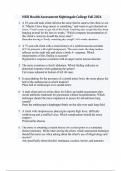
HESI Health Assessment Nightingale College Fall 2024
1. A 29-year-old male client informs the nurse that he came to the clinic to see if, "Maybe I have lung cancer or something," and wants to get checked out since, "I can't seem to get rid of this body-wracking dry cough that has been hanging around for the last six weeks." Which computer documentation of this client's concerns should the nurse enter? Describe having a "body-wracking dry cough" of 6 weeks duration. 2. A 75-year-old client with a recent history of a cerebrovascular accident (CVA) presents with right hemiparesis. The nurse tests the deep tendon reflexes on the right side and elicits a brisk 4+ response. Which interpretation of this finding is accurate? Hyperactive response consistent with an upper motor neuron disorder. 3. The nurse examines a client's abdomen. Which finding indicates an abnormal response when palpating the spleen? Firm mass palpated at bottom of left rib cage. 4. In auscultating for the presence of a carotid artery bruit, the nurse places the bell of the stethoscope at which location? Place bell of stethoscope over carotid artery 6. A male client arrives at the clinic for follow-up health assessment after recent antibiotic treatment for pneumonia without hospitalization. Which technique should the nurse implement to assess for adventitious lung sounds? Press the stethoscope's diaphragm firmly on the skin over each lung field. 7. A client with streptococcus pharyngitis reports high fever, difficulty swallowing and a muffled voice. Which complication should the nurse suspect? Peritonsillar abscess. 8. The nurse is obtaining a health history for a client prior to a scheduled cholecystectomy. While interviewing the client, which assessment technique should the nurse use when asking about the client's use of illegal drugs and alcohol? Ask specifically about alcohol, marijuana, cocaine, heroin, and amounts. 9. The nurse applies pressure over an area of the lower abdomen where the client reports pain. The client denies pain upon palpation, but reports pain when the pressure is released. What action should the nurse implement? Notify the healthcare provider of the rebound tenderness. 10. The nurse is assessing an ulcer on a client's lower extremity, which is likely the result of either venous or arterial insufficiency. Which assessment technique should the nurse use to differentiate the pathophysiology causing the ulcer? Observe the specific location and appearance of the ulceration. A. What type of ulcer is this? Which pathophysiology? venous or arterial? Venous leg ulcers usually develop on the inner lower leg, above the medial malleolus. 12.B. What type of ulcer is this? Which pathophysiology? venous or arterial? Arterial wounds occur most often on the foot, in between or at the tips of the toes, at pressure points from foot wear, on the heels and around the lateral malleolus (the bone on the outside of the ankle joint). 14. The nurse is conducting a physical assessment of a young adult. Which information provides the best indication of the individual’s nutritional status? Condition of hair, nails, and skin. 15. The nurse is assessing a healthy adult male during an annual physical examination. The nurse auscultates the client's abdomen and hears gurgling sound every ten seconds. What action should the nurse take in response to this finding? Document this normal bowel sound activity in the record. 16. In observing a client's face, which assessment finding requires the most immediate intervention by the nurse? Oral mucosa is cyanotic. 17. While obtaining a health history, a male client tells the nurse that he sometimes experiences shortness of breath. The nurse determines that the client's respirators are regular and deep, and his respiratory rate is 14 breaths/minutes. What is the best nursing action? Ask the client to describe the episodes of dyspnea in more detail. 18. When assessing a male client's respiratory status, which technique should the nurse use to assess his anterior- posterior (AP) chest diameter? Observation. 19. Which assessment finding supports the client statement, "My feet swell all the time?" 2+ pitting edema of ankles bilaterally. 20. The nurse is performing a cranial nerve exam on an 87-year-old client. The nurse notes that the client has a reduced upward gaze, a decreased corneal reflex, a high frequency hearing loss, and a reduced gag reflex. What action should the nurse take next? Continue the assessment to the next pairs of cranial nerves.
Document information
- Uploaded on
- October 24, 2024
- Number of pages
- 13
- Written in
- 2024/2025
- Type
- Exam (elaborations)
- Contains
- Questions & answers