

10/24/24,250 AM
EUNICE
PRN 1178 client centered care 2 exam 1
WITH QUESTIONS AND 100% SURE
ANSWERS
Terms in this set (66)
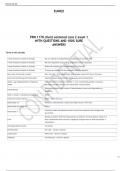
4 main functions of water in the body Act as a vehicle of transportation of substances to and from cells
4 main functions of water in the body Aid heat regulations by providing perspiration which evaporates
4 main functions of water in the body Assist with maintence of hydrogen balance in the body
4 main functions of water in the body To serve as a medium for the enzymatic action for digestion
How much of the body is water? More than half - 60% males contain 50% females contain 60% due to fat tissue
Lose more fluid through skin than adults Infants - kidneys are not as efficient as adults less fluid absorption
Adults - age related decline in total body Diminished thirst sensations; decrease in urine concentrating abilities of kidneys;
water decreases the effectiveness of the antidiuretic hormone (ADH)
Abnormal decrease in the volume of blood plasma (occurs with dehydration or
Hypovolemia
bleeding)
What is critical in maintaining homeostasis Water
Cells can't function without Water - death will occur
Electrolytes are Minerals or salt dissolved in body fluid. Major source is from diet
Electrolytes are measured MEq/L
A solution breaks into particles known as ions from reactions from hydrogen and
Electrolytes in
electrolyte
Develop a positive electrical charge known as citations; for each positive charge in a
Ions fluid compartment there must be a negatively charged anion so that the balance is
maintained
Circulating blood volume 4 to 6 liters
Erythrocytes Red cells - carried in plasma
Leukocytes White cells - carried in plasma
Platelets thrombocytes - carried in plasma
1/4
EUNICE
PRN 1178 client centered care 2 exam 1
WITH QUESTIONS AND 100% SURE
ANSWERS
Terms in this set (66)
4 main functions of water in the body Act as a vehicle of transportation of substances to and from cells
4 main functions of water in the body Aid heat regulations by providing perspiration which evaporates
4 main functions of water in the body Assist with maintence of hydrogen balance in the body
4 main functions of water in the body To serve as a medium for the enzymatic action for digestion
How much of the body is water? More than half - 60% males contain 50% females contain 60% due to fat tissue
Lose more fluid through skin than adults Infants - kidneys are not as efficient as adults less fluid absorption
Adults - age related decline in total body Diminished thirst sensations; decrease in urine concentrating abilities of kidneys;
water decreases the effectiveness of the antidiuretic hormone (ADH)
Abnormal decrease in the volume of blood plasma (occurs with dehydration or
Hypovolemia
bleeding)
What is critical in maintaining homeostasis Water
Cells can't function without Water - death will occur
Electrolytes are Minerals or salt dissolved in body fluid. Major source is from diet
Electrolytes are measured MEq/L
A solution breaks into particles known as ions from reactions from hydrogen and
Electrolytes in
electrolyte
Develop a positive electrical charge known as citations; for each positive charge in a
Ions fluid compartment there must be a negatively charged anion so that the balance is
maintained
Circulating blood volume 4 to 6 liters
Erythrocytes Red cells - carried in plasma
Leukocytes White cells - carried in plasma
Platelets thrombocytes - carried in plasma
1/4


