D322 INTRODUCTION TO IT STUDY GUIDE WESTERN GOVERNORS’
UNIVERSITY
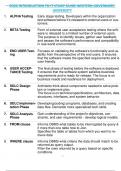
1. ALPHA Testing Early stage testing. Developers within the organization
test software before it's released to external users or cus-
tomers.
2. BETA Testing Form of external user acceptance testing where the soft-
ware is released to a limited number of external users.
The purpose is to identify issues, gather user feedback,
and assess the software's performance and compatibility
in real-world environments.
3. END USER Test- Focuses on validating the software's functionality and us-
ing ability from the perspective of the end users. It ensures
that the software meets the specified requirements and is
user-friendly.
4. USER ACCEP- The final phase of testing before the software is deployed.
TANCE Testing It ensures that the software system satisfies business
requirements and is ready for release. The focus is on
business needs and readiness for deployment.
5. SDLC Design Architects think about components needed to solve prob-
Phase lem or implement plan.
The focus is on technical specifications, architecture, data
structures, interfaces, and system behavior.
6. SDLC Implemen- Developing(coding) programs, databases, and creating
tation Phase data files. Demands more specialized tech skills.
7. SDLC Analysis Gain understanding of the project's objectives, con-
Phase straints, and user requirements - develop logical models.
8. FROM clause Informs DBMS what tables to be interrogated by query &
if more than one table how to Join.
Specifies the table or tables from which you want to re-
trieve data
9. WHERE clause Informs DBMS what criteria the data should match to be
returned as query output.
Filter the rows returned by a query based on specific
conditions.
1/6
, D322 INTRODUCTION TO IT STUDY GUIDE WESTERN GOVERNORS’
UNIVERSITY
10. SELECT clause Specifies which columns or expressions to retrieve in the
query
from the table(s) specified in the FROM clause.
11. Memory Stores programs being executed and quickly retrieves
data that is being actively used or processed.
An electronic component, stores instructions for future
use.
"Memory" typically refers to RAM (volatile)
12. Hard Drive/Disk Enables communication between components, stores and
retrieves digital information.
Non-volatile
Hardware component attached to motherboard
13. Shell directory Linux directory Paths written as /
paths (Linux vs Windows directory Paths written as \
Windows)
14. Database Opera- "IUD" INSERT UPDATE DELETE
tions
*Also "CRUD" Create Read Update Delete
15. Compiler Source code ’ Machine Code/Language
Translates entire program first, creating an executable
program that can be run at a later time.
read-translate all-execute
16. Interpreter Translates source code line by line and executes it imme-
diately
read line-translate line-execute line-repeat
17. Compiled Lan- Java , C ++ , C , C # , Go/Golang , Visual Basic . NET
guages
18. Interpreted Lan- Python , Perl , Javascript , TCL , PHP
guages
2/6
UNIVERSITY
1. ALPHA Testing Early stage testing. Developers within the organization
test software before it's released to external users or cus-
tomers.
2. BETA Testing Form of external user acceptance testing where the soft-
ware is released to a limited number of external users.
The purpose is to identify issues, gather user feedback,
and assess the software's performance and compatibility
in real-world environments.
3. END USER Test- Focuses on validating the software's functionality and us-
ing ability from the perspective of the end users. It ensures
that the software meets the specified requirements and is
user-friendly.
4. USER ACCEP- The final phase of testing before the software is deployed.
TANCE Testing It ensures that the software system satisfies business
requirements and is ready for release. The focus is on
business needs and readiness for deployment.
5. SDLC Design Architects think about components needed to solve prob-
Phase lem or implement plan.
The focus is on technical specifications, architecture, data
structures, interfaces, and system behavior.
6. SDLC Implemen- Developing(coding) programs, databases, and creating
tation Phase data files. Demands more specialized tech skills.
7. SDLC Analysis Gain understanding of the project's objectives, con-
Phase straints, and user requirements - develop logical models.
8. FROM clause Informs DBMS what tables to be interrogated by query &
if more than one table how to Join.
Specifies the table or tables from which you want to re-
trieve data
9. WHERE clause Informs DBMS what criteria the data should match to be
returned as query output.
Filter the rows returned by a query based on specific
conditions.
1/6
, D322 INTRODUCTION TO IT STUDY GUIDE WESTERN GOVERNORS’
UNIVERSITY
10. SELECT clause Specifies which columns or expressions to retrieve in the
query
from the table(s) specified in the FROM clause.
11. Memory Stores programs being executed and quickly retrieves
data that is being actively used or processed.
An electronic component, stores instructions for future
use.
"Memory" typically refers to RAM (volatile)
12. Hard Drive/Disk Enables communication between components, stores and
retrieves digital information.
Non-volatile
Hardware component attached to motherboard
13. Shell directory Linux directory Paths written as /
paths (Linux vs Windows directory Paths written as \
Windows)
14. Database Opera- "IUD" INSERT UPDATE DELETE
tions
*Also "CRUD" Create Read Update Delete
15. Compiler Source code ’ Machine Code/Language
Translates entire program first, creating an executable
program that can be run at a later time.
read-translate all-execute
16. Interpreter Translates source code line by line and executes it imme-
diately
read line-translate line-execute line-repeat
17. Compiled Lan- Java , C ++ , C , C # , Go/Golang , Visual Basic . NET
guages
18. Interpreted Lan- Python , Perl , Javascript , TCL , PHP
guages
2/6