

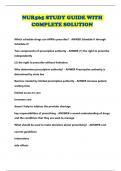
NUR565 STUDY GUIDE WITH
COMPLETE SOLUTION
Which schedule drugs can APRNs prescribe? - ANWER Schedule II through
Schedule IV
Two components of prescriptive authority - ANWER (1) the right to prescribe
independently
(2) the right to prescribe without limitation.
Who determines prescriptive authority? - ANWER Prescriptive authority is
determined by state law
Barriers created by limited prescriptive authority - ANWER increase patient
waiting time
limited access to care
increases cost
doesn't help to address the provider shortage
key responsibilities of prescribing - ANSWER a sound understanding of drugs
and the conditions that they are used to manage
What should be used to make decisions about prescribing? - ANSWER cost
current guidelines
interactions
side effects
,allergies
hepatic and renal function
need for monitoring
special populations
What does a prescription require? - ANSWER Prescriber name, license
number, and contact information
• Prescriber U.S. Drug Enforcement Administration (DEA) number, if
applicable
• Patient name and date of birth
• Patient allergies
• Drug name
• Drug indication (e.g., atenolol for hypertension)
• Drug strength (e.g., 25 mg, 500 mg/mL)
• Drug dose and frequency (e.g., 12.5 mg once daily)
• Quantity of tablets or capsules to dispense
• Number of refills
Pharmokinetic changes in older adults: absorption - ANSWER Increased
gastric pH
Decreased absorptive surface area
Decreased splanchnic blood flow
Decreased gastrointestinal motility
, Delayed gastric emptying
Pharmokinetic changes in older adults: distribution - ANSWER Increased
body fat
Decreased lean body mass
Decreased total body water
Decreased serum albumin
Decreased cardiac output
Pharmokinetic changes in older adults: metabolism - ANSWER
Decreased hepatic blood flow
Decreased hepatic mass
Decreased activity of hepatic enzymes
Pharmokinetic changes in older adults: excretion - ANSWER
Decreased renal blood flow
Decreased glomerular filtration rate
Decreased tubular secretion
Decreased number of nephrons
Beers criteria-ANSWER The Beers List enumerates drugs with high risk of
causing adverse effects in older adults. Thus, all medications on this list
should be avoided in adults older than 65 years unless significant benefit
outweighs the risks.
What are CYP450 inhibitor - ANSWER Inhibitors are medications that inhibit
COMPLETE SOLUTION
Which schedule drugs can APRNs prescribe? - ANWER Schedule II through
Schedule IV
Two components of prescriptive authority - ANWER (1) the right to prescribe
independently
(2) the right to prescribe without limitation.
Who determines prescriptive authority? - ANWER Prescriptive authority is
determined by state law
Barriers created by limited prescriptive authority - ANWER increase patient
waiting time
limited access to care
increases cost
doesn't help to address the provider shortage
key responsibilities of prescribing - ANSWER a sound understanding of drugs
and the conditions that they are used to manage
What should be used to make decisions about prescribing? - ANSWER cost
current guidelines
interactions
side effects
,allergies
hepatic and renal function
need for monitoring
special populations
What does a prescription require? - ANSWER Prescriber name, license
number, and contact information
• Prescriber U.S. Drug Enforcement Administration (DEA) number, if
applicable
• Patient name and date of birth
• Patient allergies
• Drug name
• Drug indication (e.g., atenolol for hypertension)
• Drug strength (e.g., 25 mg, 500 mg/mL)
• Drug dose and frequency (e.g., 12.5 mg once daily)
• Quantity of tablets or capsules to dispense
• Number of refills
Pharmokinetic changes in older adults: absorption - ANSWER Increased
gastric pH
Decreased absorptive surface area
Decreased splanchnic blood flow
Decreased gastrointestinal motility
, Delayed gastric emptying
Pharmokinetic changes in older adults: distribution - ANSWER Increased
body fat
Decreased lean body mass
Decreased total body water
Decreased serum albumin
Decreased cardiac output
Pharmokinetic changes in older adults: metabolism - ANSWER
Decreased hepatic blood flow
Decreased hepatic mass
Decreased activity of hepatic enzymes
Pharmokinetic changes in older adults: excretion - ANSWER
Decreased renal blood flow
Decreased glomerular filtration rate
Decreased tubular secretion
Decreased number of nephrons
Beers criteria-ANSWER The Beers List enumerates drugs with high risk of
causing adverse effects in older adults. Thus, all medications on this list
should be avoided in adults older than 65 years unless significant benefit
outweighs the risks.
What are CYP450 inhibitor - ANSWER Inhibitors are medications that inhibit


