
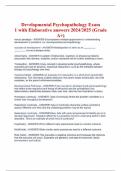
Developmental Psychopathology Exam 1 with Elaborative answers 2024/2025 (Grade A+)
Developmental Psychopathology Exam 1 with Elaborative answers 2024/2025 (Grade A+) macro paradigm - ANSWER-Encompasses multiple approaches to understanding development of problems. Ex: developmental psychopathology. outcome of development - ANSWER-Maladaptation is seen as an ______ __ ________, not as a disease entity. Abnormality - ANSWER-A pattern of behavioral, cognitive, or physical symptoms associated with distress, disability, and/or increased risk for further suffering or harm. Transaction - ANSWER-A key concept in developmental psychopathology, where outcomes are due to dynamic, reciprocal interactions, such as the interplay between biology and psychology over time. Coercion Model - ANSWER-An example of a transaction in a short-term parent/child relationship. The child does problem behavior, the parent reacts emotionally, the child escalates, so the parent withdraws/escalates. Developmental Pathways - ANSWER-A key concept in developmental psychopathology that refers to the sequence and timing of behaviors and the probabilistic (not deterministic) relationship between them over time. (like the tree illustration in-class) Homotypic continuity - ANSWER-Type of continuity where the problem manifests in a similar way throughout development. Heterotypic continuity - ANSWER-Type of continuity where the surface symptoms appear different over time (but the underlying problem may be the same). Heterotypic continuity - ANSWER-Many kids with early temperament irritability go on to develop depression. Negative affectivity is a possible common underlying factor in both disorders. This is an example of which kind of continuity? Equifinality - ANSWER-When different early experiences lead to a similar outcome. Multifinality - ANSWER-When similar early experiences lead to a different outcome. Risk Factor - ANSWER-This precedes a negative outcome and increases the chances that the outcome will occur. Examples are genetics, perinatal environment, family environment, and culture. Protective factor - ANSWER-This occurs before a positive outcome and increases the chance that it will occur, promoting healthy adaptation in the face of risk exposure. Examples include faith, talents, family, school attendance. Inoculation effect - ANSWER-An example of a protective mechanism where exposure to low-level stress may foster positive coping/adaptation. Promotive Factors - ANSWER-These are just generally good for a child, whether they are "at-risk" or not. Examples include secure attachment relationship, authoritative parenting, and high IQ. Resilience - ANSWER-The ability to avoid negative outcomes despite being at risk for psychopathology (this is not a fixed attribute). Protective triad. - ANSWER-Health-promoting resources or events including the child, the family, and the school/community. Competence - ANSWER-The ability to adapt to the environment, influenced by culture and ethnicity. 3 - ANSWER-Gender differences are negligible in children under the age of _____. Adolescence - ANSWER-Anxiety and depression increase for girls during ______________. boys - ANSWER-Reading impairment, autism, and early onset conduct issues are all more common in (boys/girls). poverty - ANSWER-Impairments in learning ability and school achievement, less education, inadequate health care, single parenting, poor nutrition, and greater exposure to violence are all associated with ___________. 20 - ANSWER-_______% of children will have significant difficulties throughout their lives. Behavior Genetics - ANSWER-This field decomposes phenotypic variability into genetic and environmental influences. Family aggregation studies - ANSWER-This is the first step of behavior genetics, which involves looking for clusterings of disorder within families (the limit of this is that it is impossible to figure out what is genetic and what is environmental). Behavior Genetics studies - ANSWER-The second step of behavior genetics, which employs special samples with known genetic characteristics to establish heritability and differentiate environmental influences. Twin Studies - ANSWER-These compare MZ and DZ twins to see if the disorder occurs at different rates. 2(rMZ-rDZ) - ANSWER-The formula for Heritability with MZ and DZ twins. Adoption Studies - ANSWER-This is when adopted children are compared to their biological and adoptive parents, like with the Colorado Adoption Project. Colorado Adoption Project - ANSWER-An adoption study that found that adoptees more closely resemble biological mothers with respect to depressive symptoms than adoptive mothers. Passive - ANSWER-The fact that a child and parent share genetic tendencies is an example of a ______ genetic/environmental correlation. Reactive - ANSWER-The fact that a child has genetic tendencies that evoke reactions is an example of a ________ genetic/environmental correlation. Active - ANSWER-The fact that a child seeks environments that are consistent with genetic tendencies is an example of a(n) _________ genetic/environmental correlation. Molecular genetics - ANSWER-An approach to child psychopathology that directly examines the link between differences in DNA sequences and variation in phenotype. Neurobiological - ANSWER-The ___________ perspective considers brain and nervous system functions as an underlying cause of psychological disorders. neurodevelopment - ANSWER-MR, seizure disorders, autism, and schizophrenia are all examples of disruptions in ________________. Central nervous system - ANSWER-This is made up of your brain and spinal cord. Peripheral nervous system - ANSWER-This is made up of the somatic and autonomic nervous systems. Somatic - ANSWER-This branch of the PNS conveys sensory info to the CNS and motor commands to muscles. Autonomic - ANSWER-This branch of the PNS controls regulation and involuntary responses. Sympathetic - ANSWER-This branch of the autonomic nervous system is associated with "fight or flight". Parasympathetic - ANSWER-This branch of the autonomic nervous system is associated with "rest and digest". Continues.....
Document information
- Uploaded on
- October 19, 2024
- Number of pages
- 9
- Written in
- 2024/2025
- Type
- Exam (elaborations)
- Contains
- Questions & answers


