NUR 210 Exam 1 Modules 1-3 Galen
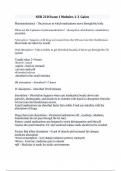
Pharmacokinetics - The process in which medications move through the body What are the 4 phases of pharmacokinetics? - absorption, distribution, metabolism, excretion Absorption - happens with drug movement from the GI tract into the bloodstream. Most meds are taken by mouth. Oral absorption - Takes awhile to get absorbed because it has to go through the GI system Usually takes 2-4 hours •Enteric coated aspirin - hard on stomach can not crush pill •Extended release absorbed in the small intestine IM absorption - Absorbed 1-2 hours IV absorption - Absorbed 30-60 minutes dissolution - Dissolution happens when a po medication breaks down into particles, disintegrates, and dissolves to combine with liquid so absorption from the GI tract into the bloodstream occurs. Liquid medications are absorbed faster than solids. Food can interfere with the absorption of drugs. Drugs that resist dissolution - Parenteral medications (SL, eyedrops, inhalants, transdermal) do not pass through the GI tract. Enteric coated medications are designed to resist disintegration until the pill reaches the small intestine. EC and sustained release meds should not be crushed. Factors that affect absorption - •Lack of muscle and increased fat changes medicine absorption •Food consumption - will change medicine potency (delayed) •Stress - Exercise, medicine goes to muscle •pH - Medicine is made for acidic environments •Antacid changes absorption •Taken alone so it doesn't change the action Excipients - Fillers and other substances that make up tablets as a pill is not 100% drug. Sometimes an excipient enhances the absorption of a drug such as with PCN, which is not well absorbed from the GI tract. Adding Na to PCN, which makes it penicillin sodium, will increase the absorption of PCN first pass effect - •the oral drugs go to liver via portal vein where some of the drug becomes inactive •Only happens with oral medications delayed gastric emptying - Food doesn't move like it should Distribution - refers to the movement of the drug from the circulation to body tissues Factors affecting distribution - -blood flow to tissues -protein binding -blood brain barrier -drug's affinity to the tissue protein binding - Drugs bind with proteins in blood Some drugs are highly protein bound and other are weakly protein bound free drugs - drugs not bound to protein Drug Toxicity - -Two highly protein bound drugs compete and one might accumulate and cause a toxicity -it is important to know if you are administering highly protein bound medications and monitor albumin levels in patients with liver or kidney disease. -Some drugs that are highly protein bound include: Warfarin Furosemide Diazepam Drug distribution and albumin - -A decrease in albumin levels decrease the protein-binding sites, which means more of the free drug is circulated. -This can be fatal with some meds. -Free drugs are those not bound to protein, which means they are active in the body and cause a pharmacologic response. -Older adults, malnourished individuals, and those with liver or kidney disease have low albumin levels. Blood Brain Barrier (BBB) - -The BBB protects the brain from most drugs. -Some meds are able to cross the BBB such as benzodiazepines. -Drugs can cross the placenta and cause spontaneous abortion or alter fetal growth and development. Metabolism - •Chemically changes drug to a form that can be excreted •Liver primary site half-life - •the time it takes for the drug in the body to be reduced by half Loading dose - use of a higher dose than what is usually used for treatment to allow the drug to reach the critical concentration (therapeutic level) sooner •Blood thinner •Antibiotic Exceretion - the removal of waste products from medications which is done mainly through the kidneys Other routes for include lungs, sweat, saliva, and bile Factors effecting excretion - Disorders in which the blood flow to the kidneys is reduced will influence drug excretion. Dehydration, CKD, and glomerulonephritis are examples. Drug Elimination and Patients with Kidney Disease - Lab tests to determine kidney and renal function include: Creatinine (0.5-1.1 female, 0.6-1.2 male) BUN (10-20) eGFR (60-90+) You should be aware of patients kidney function status as this will determine drug dosage.) Drug Elimination and patients with liver disease - Lab tests to determine liver function include: ALT (4-36) and AST (0-35) Onset - time it takes for drug to start working Peak - highest concentration in blood duration - length of therapeutic effect Peak and Trough - •highest (30 minutes after giving) and lowest (right before giving second dose) amount of drug in blood Agonist - desired response Antagonist - undesired response side effects - Expected Secondary effects Can be desirable or undesirable Report if effects are desirable or not Adverse Reactions - •Unexpected •Mild to severe Drug toxicity - •Overdose •Drug level exceeds therapeutic range additive effect - Sum effect of 2 drugs synergistic effect - •On purpose •2 drugs given together is greater than either drug by itself Food-drug interactions - •Grapefruit juice (increases drug potency), Warfarin (leafy vegetables) Changes that take place with aging - •decreased kidney, liver function, GI changes, body composition, malnourished Polypharmacy - •5 more more medication/pharmacies adherence - •Cost, hearing, sight, organization, timing, side effects, knowledge rights of med administration - Right drug Right dose Right client Right route Right time Right documentation 3 checks of drug administration - Pulling medication, MAR, bedside Non-pharmacological methods for sleep - No: daytime naps Caffeine Alcohol Nicotine Heavy meals Yes: Warm bath Warm milk Relaxing music Sedatives / Hypnotics - Sedatives mildest form of CNS depressant daytime to produce anxiety relieve avoid if severe respiratory disorder barbiturates Benzodiazepines Nonbenzodiazepines Hypnotics Nighttime Can become dependent Anesthetics - Work to promote CNS depression Barbiturates - •Many side effects •Not first choice •Highly sedating •Used for seizures •Maintaining sleep •Procedural sedation Benzodiazepines - •Midazolam, Alprazolam •Antianxiety, sleep Nonbenzodiazepines - Zolpidem Short term treatment of insomnia local anesthesia - •Lidocaine •Rapid onset •Long duration •Topical, Cream, Sprays •Dental •sutures general anesthesia - •Inhalation •Nitrous oxide •IV •Midazolam and propofol (white in color, endo procedures, effects reverse quickly) •Spinal/epidural anesthesia - •Blocks •Watch respiratory system •Side effect: •Headache •Hypotension: patient to lay flat after, increase fluids Anesthetics - •Major adverse effects are on respiratory and cardiovascular system •Goal is balanced anesthesia •Combination of drugs Midazolam (Versed) - Classification: benzodiazepine Uses: anxiety, pre-op sedation, sleep disorders Side Effects: lethargy, drowsiness, dizziness, blurred vision, headache Adverse Effects: hypotension, depression, dependence, liver failure Contraindications: respiratory depression, allergy Interactions: other CNS depressants, alcohol Eval/Monitor/Teach: monitor for signs of depression/ suicidal ideation, monitor renal/ hepatic function, use caution in older adults Alprazolam (Xanax) - Classification: benzodiazepine Uses: anxiety, pre-op sedation, sleep disorders Side Effects: lethargy, drowsiness, dizziness, blurred vision, headache Adverse Effects: hypotension, depression, dependence, liver failure Contraindications: respiratory depression, allergy Interactions: other CNS depressants, alcohol Eval/Monitor/Teach: monitor for signs of depression/ suicidal ideation, monitor renal/ hepatic function, use caution in older adults Zolpidem (Ambien) - Classification: non-benzodiazepine Uses: insomnia, conscious sedation Side Effects: dizziness, drowsiness, residual sedation, headache, blurred vision Adverse Effects: hypotension, tolerance, phycological and physical dependence Contraindications: allergy to benzodiazepines, respiratory depression, renal/ liver dysfunction Interactions: other CNS depressants, alcohol, food decreases absorption Eval/Monitor/Teach: use caution in children and older adults, monitor for dependency, avoid alcohol NSAIDS in general - •Prostaglandin inhibitors •pain inhibitor COX 1 and enzyme Needing for prostaglandin inhibitors to work Protects stomach lining Regulates platelets COX 2 enzymes Anti-inflammatory Pain Stiffness in joints Mildly work for fever Preferred drugs for headache and fever (mild) Salicylates - Aspirin Prostaglandin inhibitor Decreases inflammatory process Antiplatelet Reduces pain by blocking COX 1 and 2 enzyme GI bleeding, ulcers (cox 1) Antiplatelet property (cox 1) Reduces pain/inflammation (cox 2) Side effects N/V Diarrhea Constipation Abdominal pain Take with food or enteric coated Hypersensitivity Tinnitus (ringing of the ear) Vertigo (spinning) Bronchospasm (throat spasm) Not given to children Reye's syndrome (brain/liver damage) Propionic Acid Derivatives - Ibuprofen Aspirin like Stronger (6-8 hours) Less GI distress Highly protein bound so can interact with other drugs Avoid Warfarin Sulfonamides Cephalosporins Phenytoin Hypoglycemia can happen if taken with diabetic meds Side effects GI upset if taken without food (COX 1) Sodium and water retention Fenamates - Used for chronic arthritis, watch GI effects Oxicams - Used for RA, long half life, so once a day dosing COX-2 inhibitors - •No effect on COX 1 so will not see GI distress or bleeding •Only works on pain and inflammation (COX 2) •Increased risk of heart attack and stroke, so use cautiously Celecoxib - •Only COX 2 inhibitor and doesn't produce GI bleeding •Affects heart disease patients DMARDS - •Immunosuppressants •Increased risk of infection Immunomodulators •Antimalarials •Used for RA •Severe psoriasis •Crohn's disease •UC •Must assess risk of infection Antigout - •High level of uric acid in blood, causes inflammation/severe pain •Increase fluids while taking meds to flush out uric acid Colchicine - Inflammation related to gout, not for other inflammatory conditions Aspirin - Classification: salicylate, NSAID Uses: pain, arthritis, inflammation, anticoagulation Action: COX 1/2 inhibitor, prostaglandin inhibitor Side Effects: dizziness, abdominal pain, drowsiness, HA Adverse Effects: tinnitus, hearing loss, GI distress/ bleeding/ ulceration, thrombocytopenia, agranulocytosis, hepatotoxicity, Reye syndrome Contraindications: GI bleeding, sensitivity to NSAIDs, flu or viral illnesses, pregnancy Interactions: anticoagulants, hypoglycemics Eval/Monitor/Teach: monitor for bleeding/ bruising, GI, no alcohol or warfarin, inform dentist before procedure, stop 7 days before surgery, watch liver function, do not give to children Ibuprofen - Classification: NSAID, propionic acid derivative Uses: arthritis pain, inflammation, mild-moderate pain Action: Inhibits COX 1/2 enzyme, prostaglandin inhibitor Side Effects: GI upset, peripheral edema, dizziness Adverse Effects: hearing loss/ tinnitus, GI bleeding/ulcers, petechiae Contraindications: cross sensitivity to other NSAIDs, hypersensitivity to aspirin, peptic ulcers Interactions: anticoagulants, lithium, herbal products Eval/Monitor/Teach: monitor for GI bleeding (severe stomach pain, black/tarry stools) Celecoxib (Celebrex) - Classification: COX-2 inhibitor, NSAID Action: Inhibits prostaglandin synthesis in COX 2, decreases inflammation/pain Uses: osteoarthritis, RA, mild-moderate pain, fever Side Effects: GI upset, dizziness, diarrhea Adverse Effects: headaches, peripheral edema, bleeding, HTN, can cause strokes Contraindications: cardiac conditions Interactions: anticoagulants, lithium, herbal products (gingko biloba) Eval/Monitor/Teach: monitor for GI bleeding (severe stomach pain, black/tarry stools), monitor VS, caution with hepatic or renal dysfunction, highly protein bound, dysrhythmias, Allopurinol - Classification: uric acid inhibitor, anti-gout Action: reduces serum uric acid levels Uses: gout, chronic gout prophylactic Side Effects: GI upset, dizziness, pruritus, HA, flushed skin Adverse Effects: blood dyscrasias, n/v, anemia, metallic taste, pruritus Contraindications: severe kidney disease Interactions: cyclosporine, anticoagulants, diuretics Eval/Monitor/Teach: monitor uric acid, increase fluids, encourage yearly eye exams, take with food, avoid high purine foods (meats, salmon, legumes, gravy, coffee), increase fluids, assess renal/liver function Acetominophen - •Analgesic, antipyretic •Not an NSAID •no anti-inflammatory properties •Little GI effects, no antiplatelet properties •Short half life - taken q 4 •Watch liver function •no more than 4 g/24 hours •Hepatic toxicity •N/V •Diarrhea •Abdominal pain •Used for mild headache and mild fever antidote is acetylcysteine Opioid Analgesics - •Moderate to severe pain •Antitussive •Antidiarrheal •Act on PNS and CNS Pain receptor sites Respiratory depression Euphoria Sedation Constipation Orthostatic hypotension (consider safety, falls risk) N/V •In the older adult with high doses Respiratory depression Urinary retention •Morphine Acute pain
Document information
- Uploaded on
- October 19, 2024
- Number of pages
- 19
- Written in
- 2024/2025
- Type
- Exam (elaborations)
- Contains
- Questions & answers