
INTRODUCTION TO LAW
UNIT 1: WHAT IS LAW
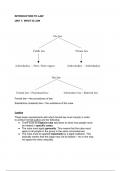
Formal law = the procedures of law
Substantive (material) law = the substance of the case
Justice
These basic requirements with which formal law must comply in order
to achieve formal justice are the following:
● There must be explicit rules laid down to show how people must
be treated in specific cases.
● The rules must apply generally. This means that the rules must
apply to all people in the group in the same circumstances.
● The rules must be applied impartially by a legal institution. This
basically means that the judge may not be biased – he or she may
not apply the rules unequally.
,Substantiative Justice
The contents of the circumstance that determine whether decision is just or not.
The law and other normative systems
Normative systems:
*secular approach to law = religion and law are mutually exclusive
UNIT 2: LAW AND RIGHTS
- Law is a system of rules, but also a system of rights
- Always consider limitations of rights
- With a right, comes a duty
Every right concerns a relationship made up of two parts:
(1) a relationship between a legal subject and the object of the right (right TO)
(2) a relationship between the legal subject who is the holder of the
right, and other legal subjects – anything with value (right AGAINST)
*Legal subject can also be a body of people
, 4 kinds of rights:
1. Real right
- An object (a thing)
- Ownership
- Pledge (movable things as security of debt)
- Servitude (e.g power/content of right to use another’s land for a specific purpose
– limited right due to only allowed to use for that purpose)
2. Personality right
- An object (personality property)
- (a good reputation, physical integrity, your honor)
3. Intellectual property or immaterial property rights
- An object (a nontangible creation of the human mind)
4. Personal right
- An object (performance)
- (doing something or not doing something – to pay, not to compete)
Typically (with legal subject / object)
● A right TO
● A right AGAINST
When no legal subject / object = CAPCITY
UNIT 1: WHAT IS LAW
Formal law = the procedures of law
Substantive (material) law = the substance of the case
Justice
These basic requirements with which formal law must comply in order
to achieve formal justice are the following:
● There must be explicit rules laid down to show how people must
be treated in specific cases.
● The rules must apply generally. This means that the rules must
apply to all people in the group in the same circumstances.
● The rules must be applied impartially by a legal institution. This
basically means that the judge may not be biased – he or she may
not apply the rules unequally.
,Substantiative Justice
The contents of the circumstance that determine whether decision is just or not.
The law and other normative systems
Normative systems:
*secular approach to law = religion and law are mutually exclusive
UNIT 2: LAW AND RIGHTS
- Law is a system of rules, but also a system of rights
- Always consider limitations of rights
- With a right, comes a duty
Every right concerns a relationship made up of two parts:
(1) a relationship between a legal subject and the object of the right (right TO)
(2) a relationship between the legal subject who is the holder of the
right, and other legal subjects – anything with value (right AGAINST)
*Legal subject can also be a body of people
, 4 kinds of rights:
1. Real right
- An object (a thing)
- Ownership
- Pledge (movable things as security of debt)
- Servitude (e.g power/content of right to use another’s land for a specific purpose
– limited right due to only allowed to use for that purpose)
2. Personality right
- An object (personality property)
- (a good reputation, physical integrity, your honor)
3. Intellectual property or immaterial property rights
- An object (a nontangible creation of the human mind)
4. Personal right
- An object (performance)
- (doing something or not doing something – to pay, not to compete)
Typically (with legal subject / object)
● A right TO
● A right AGAINST
When no legal subject / object = CAPCITY


