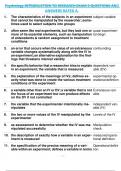
Psychology INTRODUCTION TO RESEARCH EXAM 2 QUESTIONS AND
ANSWERS RATED A.
1. The characteristics of the subjects in an experiment subject variable
that cannot be manipulated by the researcher; some-
times used to select subjects into groups
2. often seem like real experiments, but they lack one or quasi-experimen-
more of its essential elements, such as manipulation tal deign
of antecedents & random assignment to treatment
conditions
3. an error that occurs when the value of an extraneous confounding
variable changes systematically along with the IV in
an experiment; an alternative explanation for the find-
ings that threatens internal validity
4. the specific behavior that a researcher tries to explain dependent vari-
in an experiment; the variable that is measured able (DV)
5. the explanation of the meanings of IVs; defines ex- experimental op-
actly what was done to create the various treatment erational defintion
conditions of the experiment
6. a variable other than an IV or DV; a variable that is not Extraneous vari-
the focus of an experiment but can produce effects able
on the DV if not controlled
7. the variable that the experimenter intentionally ma- independent vari-
nipulates able (IV)
8. the two or more values of the IV manipulated by the Levels of the IV
experimenter
9. as assessment to determine whether the IV was ma- Manipulation
nipulated successfully check
10. the description of exactly how a variable in an exper- measured opera-
iment is measured tional definition
11. the specification of the precise meaning of a vari- Operational defini-
able within an experiment; defines a variable in terms tion
, Psychology INTRODUCTION TO RESEARCH EXAM 2 QUESTIONS AND
ANSWERS RATED A.
of observable operations; procedures, and measure-
ments
12. the degree to which scores on the measuring in- concurrent validity
strument correlate with another known standard for
measuring the variable being studied
13. a threat to internal validity in which an outside event history threat
or occurrence might have produced effects on the DV
14. a threat to interval validity produced by changes in instrumentation
the measuring instrument itself threat
15. the certainty that the changes in behavior observed internal validity
across treatment conditions in the experiment were
actually caused by the IV
16. a threat to internal validity produced by internal maturation threat
(physical or psychological) changes in subjects
17. a threat to internal validity that can occur when non- selection threat
random procedures are used to assign subjects to
conditions or when random assignment fails to bal-
ance out differences among subjects across the dif-
ferent conditions of the experiment
18. a threat to internal validity produced by differences subject mortality
in dropout rates across the conditions of the experi- threat
ment
19. a threat to internal validity produced by a pervious testing threat
administration of the same test or measure
20. the degree to which an operational definition accu- content validity
rately represents the construct it is intended to ma-
nipulate or measure
21. the degree to which different items measuring the interitem reliability
same variable attain consistent results
ANSWERS RATED A.
1. The characteristics of the subjects in an experiment subject variable
that cannot be manipulated by the researcher; some-
times used to select subjects into groups
2. often seem like real experiments, but they lack one or quasi-experimen-
more of its essential elements, such as manipulation tal deign
of antecedents & random assignment to treatment
conditions
3. an error that occurs when the value of an extraneous confounding
variable changes systematically along with the IV in
an experiment; an alternative explanation for the find-
ings that threatens internal validity
4. the specific behavior that a researcher tries to explain dependent vari-
in an experiment; the variable that is measured able (DV)
5. the explanation of the meanings of IVs; defines ex- experimental op-
actly what was done to create the various treatment erational defintion
conditions of the experiment
6. a variable other than an IV or DV; a variable that is not Extraneous vari-
the focus of an experiment but can produce effects able
on the DV if not controlled
7. the variable that the experimenter intentionally ma- independent vari-
nipulates able (IV)
8. the two or more values of the IV manipulated by the Levels of the IV
experimenter
9. as assessment to determine whether the IV was ma- Manipulation
nipulated successfully check
10. the description of exactly how a variable in an exper- measured opera-
iment is measured tional definition
11. the specification of the precise meaning of a vari- Operational defini-
able within an experiment; defines a variable in terms tion
, Psychology INTRODUCTION TO RESEARCH EXAM 2 QUESTIONS AND
ANSWERS RATED A.
of observable operations; procedures, and measure-
ments
12. the degree to which scores on the measuring in- concurrent validity
strument correlate with another known standard for
measuring the variable being studied
13. a threat to internal validity in which an outside event history threat
or occurrence might have produced effects on the DV
14. a threat to interval validity produced by changes in instrumentation
the measuring instrument itself threat
15. the certainty that the changes in behavior observed internal validity
across treatment conditions in the experiment were
actually caused by the IV
16. a threat to internal validity produced by internal maturation threat
(physical or psychological) changes in subjects
17. a threat to internal validity that can occur when non- selection threat
random procedures are used to assign subjects to
conditions or when random assignment fails to bal-
ance out differences among subjects across the dif-
ferent conditions of the experiment
18. a threat to internal validity produced by differences subject mortality
in dropout rates across the conditions of the experi- threat
ment
19. a threat to internal validity produced by a pervious testing threat
administration of the same test or measure
20. the degree to which an operational definition accu- content validity
rately represents the construct it is intended to ma-
nipulate or measure
21. the degree to which different items measuring the interitem reliability
same variable attain consistent results