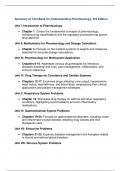
Summary of Test Bank for Understanding Pharmacology, 3rd Edition
Unit I: Introduction to Pharmacology
Chapter 1: Covers the fundamental concepts of pharmacology,
including drug classifications and the regulatory processes that govern
drug approval.
Unit II: Mathematics for Pharmacology and Dosage Calculation
Chapter 4: Focuses on the medical systems of weights and measures,
essential for accurate dosage calculations.
Unit III: Pharmacology for Multisystem Application
Chapters 6-10: Addresses various drug therapies for infectious
diseases (bacterial and viral), pain management, inflammation, and
immune responses.
Unit IV: Drug Therapy for Circulatory and Cardiac Systems
Chapters 12-17: Examines drugs affecting urine output, hypertension,
heart failure, dysrhythmias, and blood lipids, emphasizing their clinical
applications and patient management strategies.
Unit V: Respiratory System Problems
Chapter 18: Discusses drug therapy for asthma and other respiratory
conditions, highlighting bronchodilators and anti-inflammatory
medications.
Unit VI: Gastrointestinal System Problems
Chapters 19-20: Focuses on gastrointestinal disorders, including ulcers
and inflammatory bowel disease, detailing drug classes and their
therapeutic uses.
Unit VII: Endocrine Problems
Chapters 21-22: Explores diabetes management and therapies related
to thyroid and adrenal gland disorders.
Unit VIII: Nervous System Problems
, Chapters 23-26: Covers seizure medications, treatments for
Alzheimer’s and Parkinson’s diseases, psychiatric medications, and
insomnia therapies.
Unit IX: Reproductive System Problems
Chapters 28-29: Discusses drug therapies for male and female
reproductive issues, including hormonal therapies and contraceptives.
UNIT I: GENERAL ASPECTS OF PHARMACOLOGY
Chapter 1: Drug Therapy: Roles, Regulations, Actions, and
Responses
1. A nurse is explaining the importance of drug regulations to a patient. Which
statement correctly describes the purpose of the Food and Drug Administration
(FDA)?
a. The FDA approves drugs for clinical trials.
b. The FDA ensures the safety and efficacy of drugs.
c. The FDA regulates the price of medications.
,d. The FDA tests all new drugs for effectiveness.
ANS: B
The FDA ensures that drugs available on the market are both safe and effective for
public use, but it does not directly set prices or test drugs.
DIF: Cognitive Level: Understanding
6
TOP: Nursing Process: Education
MSC: NCLEX Client Needs Category: Safe and Effective Care Environment
2. When administering medications, the nurse is responsible for ensuring which
of the following?
a. The patient follows the instructions given.
b. The correct drug is given to the correct patient at the right time.
c. The drug prescribed is appropriate for the patient’s condition.
d. The nurse contacts the physician for dose adjustments.
ANS: B
The nurse's responsibility includes following the "Five Rights" of medication
administration: right patient, right drug, right dose, right route, and right time.
DIF: Cognitive Level: Application
9
TOP: Nursing Process: Implementation
MSC: NCLEX Client Needs Category: Safe and Effective Care Environment
3. A nurse is discussing the phases of drug action with a group of students. What
is the correct order of drug action within the body?
a. Distribution, absorption, metabolism, excretion
b. Absorption, metabolism, distribution, excretion
, c. Absorption, distribution, metabolism, excretion
d. Metabolism, absorption, distribution, excretion
ANS: C
The correct order is absorption, distribution, metabolism, and excretion, representing
how drugs move through the body.
DIF: Cognitive Level: Understanding
12
TOP: Nursing Process: Education
MSC: NCLEX Client Needs Category: Physiological Integrity
4. Which factor influences the absorption of a medication?
a. The half-life of the drug
b. The time of day the drug is taken
c. The route of administration
d. The patient's metabolic rate
ANS: C
The route of administration (e.g., oral, intravenous) directly affects how quickly a drug is
absorbed into the bloodstream.
DIF: Cognitive Level: Application
14
TOP: Nursing Process: Planning
MSC: NCLEX Client Needs Category: Physiological Integrity
5. The nurse is educating a patient about prescription medications. Which
regulatory body determines whether a drug should be prescribed or available
over the counter?
a. Drug Enforcement Agency (DEA)
b. Food and Drug Administration (FDA)
Unit I: Introduction to Pharmacology
Chapter 1: Covers the fundamental concepts of pharmacology,
including drug classifications and the regulatory processes that govern
drug approval.
Unit II: Mathematics for Pharmacology and Dosage Calculation
Chapter 4: Focuses on the medical systems of weights and measures,
essential for accurate dosage calculations.
Unit III: Pharmacology for Multisystem Application
Chapters 6-10: Addresses various drug therapies for infectious
diseases (bacterial and viral), pain management, inflammation, and
immune responses.
Unit IV: Drug Therapy for Circulatory and Cardiac Systems
Chapters 12-17: Examines drugs affecting urine output, hypertension,
heart failure, dysrhythmias, and blood lipids, emphasizing their clinical
applications and patient management strategies.
Unit V: Respiratory System Problems
Chapter 18: Discusses drug therapy for asthma and other respiratory
conditions, highlighting bronchodilators and anti-inflammatory
medications.
Unit VI: Gastrointestinal System Problems
Chapters 19-20: Focuses on gastrointestinal disorders, including ulcers
and inflammatory bowel disease, detailing drug classes and their
therapeutic uses.
Unit VII: Endocrine Problems
Chapters 21-22: Explores diabetes management and therapies related
to thyroid and adrenal gland disorders.
Unit VIII: Nervous System Problems
, Chapters 23-26: Covers seizure medications, treatments for
Alzheimer’s and Parkinson’s diseases, psychiatric medications, and
insomnia therapies.
Unit IX: Reproductive System Problems
Chapters 28-29: Discusses drug therapies for male and female
reproductive issues, including hormonal therapies and contraceptives.
UNIT I: GENERAL ASPECTS OF PHARMACOLOGY
Chapter 1: Drug Therapy: Roles, Regulations, Actions, and
Responses
1. A nurse is explaining the importance of drug regulations to a patient. Which
statement correctly describes the purpose of the Food and Drug Administration
(FDA)?
a. The FDA approves drugs for clinical trials.
b. The FDA ensures the safety and efficacy of drugs.
c. The FDA regulates the price of medications.
,d. The FDA tests all new drugs for effectiveness.
ANS: B
The FDA ensures that drugs available on the market are both safe and effective for
public use, but it does not directly set prices or test drugs.
DIF: Cognitive Level: Understanding
6
TOP: Nursing Process: Education
MSC: NCLEX Client Needs Category: Safe and Effective Care Environment
2. When administering medications, the nurse is responsible for ensuring which
of the following?
a. The patient follows the instructions given.
b. The correct drug is given to the correct patient at the right time.
c. The drug prescribed is appropriate for the patient’s condition.
d. The nurse contacts the physician for dose adjustments.
ANS: B
The nurse's responsibility includes following the "Five Rights" of medication
administration: right patient, right drug, right dose, right route, and right time.
DIF: Cognitive Level: Application
9
TOP: Nursing Process: Implementation
MSC: NCLEX Client Needs Category: Safe and Effective Care Environment
3. A nurse is discussing the phases of drug action with a group of students. What
is the correct order of drug action within the body?
a. Distribution, absorption, metabolism, excretion
b. Absorption, metabolism, distribution, excretion
, c. Absorption, distribution, metabolism, excretion
d. Metabolism, absorption, distribution, excretion
ANS: C
The correct order is absorption, distribution, metabolism, and excretion, representing
how drugs move through the body.
DIF: Cognitive Level: Understanding
12
TOP: Nursing Process: Education
MSC: NCLEX Client Needs Category: Physiological Integrity
4. Which factor influences the absorption of a medication?
a. The half-life of the drug
b. The time of day the drug is taken
c. The route of administration
d. The patient's metabolic rate
ANS: C
The route of administration (e.g., oral, intravenous) directly affects how quickly a drug is
absorbed into the bloodstream.
DIF: Cognitive Level: Application
14
TOP: Nursing Process: Planning
MSC: NCLEX Client Needs Category: Physiological Integrity
5. The nurse is educating a patient about prescription medications. Which
regulatory body determines whether a drug should be prescribed or available
over the counter?
a. Drug Enforcement Agency (DEA)
b. Food and Drug Administration (FDA)