
• Wrong document? Swap it for free
  • Written by students who passed
  • Immediately available after payment
  • Read online or as PDF
Sell
Where do you study
Your language
Document preview thumbnail
Preview 2 out of 7 pages
Exam (elaborations)

CMY 385: Theme 5 Acids and Bases Comprehensive Actual Exam Questions And Answers.

Document preview thumbnail
Preview 2 out of 7 pages

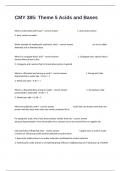
What is a Bronsted acid? base? - correct answer 1. Acid: proton donor 2. base: proton acceptor. Water example of amphiprotic substance, why? - correct answer can act as either Brønsted acid or Brønsted base What is a conjugate base/ acid? - correct answer 1. Conjugate base: species that is formed when proton is lost 2. Conjugate acid: species that is formed when proton is gained When is a Bronsted acid strong or weak? - correct answer 1. Strong acid: fully deprotonated in water pKa 0; Ka 1 2. Weak acid: pKa 0; Ka 1 When is a Bronsted base strong or weak? - correct answer 1. Strong base: fully protonated in water pKb 0; Kb 1 2. Weak base: pKb 0; Kb 1 What are polyprotic acids? - correct answer Acids that can donate more than one proton and they have more than one acidity constants (Ka's) For polyprotic acids, why is Ka2 almost always smaller than Ka1 - correct answer because deprotonation is less favourable since a proton has to be removed from a negative ion Characteristics of Brønsted acids - correct answer - Largest class of acids in water contains an -OH group (acidic proton) attached to central atom 1. Aqua acid: acidic proton is on water molecule coordinated to central metal ion 2. Hydroxoacid: acidic proton is on hydroxyl group without a neighbouring oxo (=O) group e.g. Te(OH)6 3. Oxoacid: acidic proton is on hydroxyl group with a neighbouring oxo (=O) group e.g. H2SO4 Successive stages in deprotonation of aqua acid - correct answer slide 6 Periodic trends in aqua acid strength - correct answer Increases with increasing positive charge of central metal ion and decreasing ionic radius of central metal ion Why do some D block metal ions deviate from the ionic model/ have high pka/ are strong acids? - correct answer Metal ions repel departing proton more strongly than predicted by ionic model because cation's positive charge is delocalized over ligands and closer to departing proton, thus there is greater repulsion Types of oxoacids - correct answer 1. Substituted oxoacids: One or more -OH groups are replaced by other groups e.g. fluorosulfuric acid, O2SF(OH); F high electronegativity, withdraws electrons from central S, making it more positive and a stronger acid than sulfuric acid 2. Aminosulfuric acid contains NH2 group which are electron donating and places electron density on S and weakens acid compared to sulfuric acid 3. Phosphonic acid, H3PO3 - exception to oxoacid pattern - contains P-H bond and is only a diprotic acid - For Pauling's rules: OPH(OH)2 Describe Pauling's rules in determining acid strength - correct answer 1. Acid strengths increase with increasing number of oxygen atoms; Oxygen is electron-withdrawing, weakens O-H bond and proton is more readily released 2. More resonance structures for a conjugate base of the acid means the acid is a stronger acid. 3. Rules: - For oxoacid OpE(OH)q pKa = 8 - 5p - Successive pKa values of polyprotic acids increase by 5 units for each proton transfer Shortcomings of Brønsted theory of acid-bases - correct answer don't take into account reaction between substances that show similar features but where no proton transfer takes place What is a Lewis Acid? Base? - correct answer 1. Acid: electron PAIR acceptor 2. Base: electron PAIR donor _________ formation if A (Lewis acid) and :B (Lewis base) combines to form A-B - correct answer adduct Describe Adduct formation from MO perspective - correct answer 1. Lewis acid accept lone pair in LUMO donated by Lewis base pair of electrons (HOMO) 2. Newly formed bonding orbital populated by the two electrons supplied by the base 3. Newly formed antibonding orbital is left unoccupied 4. Result: Net lowering of energy when the bond forms (stabilizing effect) Are beryllium dihalides e.g. BeCl2, strong or weak acids? why? - correct answer Weak bc. Be acts as a Lewis acid and accepts an electron pair from the halide to form polymeric chains. Both acceptor orbitals of Be are continuously filled and there is no empty orbital to accepts an electron pair from other bases. Describe group 13 Lewis acids (slides 19-20) - correct answer 1. Planar molecules BX3 and AℓX3 have incomplete octets and can accept lone pair in vacant p orbital perpendicular to plane 2. Order of thermodynamic stability of complexes of :N(CH3)3 with BX3: BF3 BCl3 BBr3 3. Order is reversed in comparison to electronnegtivity arguments, why? 4. Because: - Halogens in BX3 can form π-bonds with empty B2p orbital, these bonds must be disrupted to make acceptor orbital available for lone pair donation from Lewis base - The small F atom forms the strongest π- bond with B2p orbital: due to small radii and significant overlap of their compact 2p orbitals; Therefore BF3 has strongest π-bond to be broken before adduct formation with amine and is a weaker acid. Describe Group 14 Lewis acids - correct answer 1. Si can expand valence shell to become hypervalent 2. Ge and Sn behave similarly 3. Trend in acidity of SiX4: SiI4 SiBr4 SiCℓ4 SiF4 4. This trend Correlates with increase in electronegativity (electron withdrawing power) of halide 5. Tin(II) chloride can act as both a Lewis base or Lewis acid Describe Group 15 Lewis acids - correct answer SbF5 used to produce superacid: mixture that can protonate almost any organic compound Describe Group 16 Lewis acids - correct answer 1. Sulfur dioxide is both a Lewis acid and Lewis base 2. Acid: S accepts lone pair from base 3. Base: Either S or O can donate an electron pair to an acid. 4. Sulfur trioxide is a strong Lewis acid and weak Lewis base (O-donor) 5. Formation of H2SO4 slide 24 Br2 and I2 are both strongly coloured, why? - correct answer 1. due to transitions to low-lying unfilled orbitals 2. Colours suggest that empty orbitals may be low enough to serve as acceptor orbitals in acid-base complex formation (they are Lewis acids) Iodine is violet in non-donor solvents e.g. CHCℓ3 (chloroform) and brown in donor solvents like water, acetone etc. Why? - correct answer 1. colour is brown due to solvent-solute complex formed 2. a lone pair from donor O atoms (base) donated in low-lying σ* orbital of dihalogen (acid) Describe the Interaction of Br2 with carbonyl group of propanone - correct answer 1. New absorption band observed on spectrum 2. Orbital from which the electron originates in the transition is predominantly the lone-pair orbital of the base (the ketone). 3. Orbital to which the transition occurs is predominantly the LUMO of the acid (the dihalogen). 4. Transition transfers an electron from the base to the acid and is thus a charge-transfer transition Lewis Acids and bases types of reactions (slide 27- 28) - correct answer 1. Complex formation: - Typical reaction: A + :B → A-B - Results in net lowering of energy when bond is formed 2. Displacement reaction: - An acid or base drives out another acid or base - B-A + :B' → :B + A-B' - All Brønsted proton transfer reactions are of this type - Displacement of acid by another: A' + B-A → A'-B + A - For d-metal complexes: a displacement reaction will replace one ligand of complex with another (substitution reaction) 3. Metathesis reaction: - Double displacement reaction - A'-B + B'-A → A'-B' + A-B Describe the types of steric effects of Lewis acids and bases - correct answer 1. Front strain - Reactions between boranes or boron halides (Lewis acids) and amines (Lewis bases) where one or both species have bulky substituents can affect the stability of the adduct and causes steric hindrance between substituents - Front strain makes it difficult for a base to approach the acid due to bulky substituents taking up space and blocking incoming bases, as they rotate. 2. Back strain: - Back strain ("B-strain") results from structural necessity of the N atom of the base to have approximate tetrahedral geometry (sp3-N) to be an effective base. - If bulky groups are bonded to N, they can force the angles of the amine to open up and the extreme result is formation of trigonal planar geometry (sp2-N) with lone pair in pure p orbital and causes it to be a weak base 3. Internal strain ("I-strain") - In cyclic amines or ethers, basicity varies with ring size - basicity increases: NH3 NH2(Me) NH(Me)2 N(Me)3 - because Me is electron donating group and pushes electron density towards N:, making lone pair available for donation; effect is enhanced with every Me-substituent added - In aqueous medium this sequence is reversed - Because more hydrogens in solution leads to more H-bonding (solvation) with water which increases stability and thus increases basicity in water. Describe the Gutmann rules for behaviour of bonds in acid-base adducts (slide 33) - correct answer 1. The stronger and shorter the bond formed between a donor atom (Lewis base) and an acceptor atom (Lewis acid), the greater will be the lengthening of the adjacent bonds in both donor and acceptor molecules 2. A σ bond is lengthened when, as a result of the interaction, the electron density shift occurs from a nucleus carrying a positive fractional charge, whereas the σ bond is shortened when the electron density shift is in the opposite direction

Content preview

CMY 385: Theme 5 Acids and Bases

What is a Bronsted acid? base? - correct answer 1. Acid: proton donor

2. base: proton acceptor.


Water example of amphiprotic substance, why? - correct answer can act as either
Brønsted acid or Brønsted base


What is a conjugate base/ acid? - correct answer 1. Conjugate base: species that is
formed when proton is lost

2. Conjugate acid: species that is formed when proton is gained


When is a Bronsted acid strong or weak? - correct answer 1. Strong acid: fully
deprotonated in water pKa < 0; Ka >> 1

2. Weak acid: pKa > 0; Ka < 1


When is a Bronsted base strong or weak? - correct answer 1. Strong base: fully
protonated in water pKb < 0; Kb >> 1

2. Weak base: pKb > 0; Kb < 1


What are polyprotic acids? - correct answer Acids that can donate more than one
proton and they have more than one acidity constants (Ka's)


For polyprotic acids, why is Ka2 almost always smaller than Ka1 - correct answer
because deprotonation is less favourable since a proton has to be removed from a negative ion


Characteristics of Brønsted acids - correct answer - Largest class of acids in water
contains an -OH group (acidic proton) attached to central atom

1. Aqua acid: acidic proton is on water molecule coordinated to central metal ion

2. Hydroxoacid: acidic proton is on hydroxyl group without a neighbouring oxo (=O) group e.g. Te(OH)6

, 3. Oxoacid: acidic proton is on hydroxyl group with a neighbouring oxo (=O) group e.g. H2SO4


Successive stages in deprotonation of aqua acid - correct answer slide 6


Periodic trends in aqua acid strength - correct answer Increases with increasing
positive charge of central metal ion and decreasing ionic radius of central metal ion


Why do some D block metal ions deviate from the ionic model/ have high pka/ are strong acids? -
correct answer Metal ions repel departing proton more strongly than predicted by
ionic model because cation's positive charge is delocalized over ligands and closer to departing proton,
thus there is greater repulsion


Types of oxoacids - correct answer 1. Substituted oxoacids: One or more -OH groups
are replaced by other groups e.g. fluorosulfuric acid, O2SF(OH); F high electronegativity, withdraws
electrons from central S, making it more positive and a stronger acid than sulfuric acid


2. Aminosulfuric acid contains NH2 group which are electron donating and places electron density on S
and weakens acid compared to sulfuric acid


3. Phosphonic acid, H3PO3

- exception to oxoacid pattern

- contains P-H bond and is only a diprotic acid

- For Pauling's rules: OPH(OH)2


Describe Pauling's rules in determining acid strength - correct answer 1. Acid
strengths increase with increasing number of oxygen atoms; Oxygen is electron-withdrawing, weakens
O-H bond and proton is more readily released

2. More resonance structures for a conjugate base of the acid means the acid is a stronger acid.

3. Rules:

- For oxoacid OpE(OH)q pKa = 8 - 5p

- Successive pKa values of polyprotic acids increase by 5 units for each proton transfer

Document information

Uploaded on
October 8, 2024
Number of pages
7
Written in
2024/2025
Type
Exam (elaborations)
Contains
Questions & answers
$13.49

Wrong document? Swap it for free Within 14 days of purchase and before downloading, you can choose a different document. You can simply spend the amount again.
Written by students who passed
Immediately available after payment
Read online or as PDF

Seller avatar
Reputation scores are based on the amount of documents a seller has sold for a fee and the reviews they have received for those documents. There are three levels: Bronze, Silver and Gold. The better the reputation, the more your can rely on the quality of the sellers work.
RealGrades
4.0
(26)
Sold
197
Followers
52
Items
12335
Last sold
1 month ago


Why students choose Stuvia

Created by fellow students, verified by reviews

Quality you can trust: written by students who passed their tests and reviewed by others who've used these notes.

Didn't get what you expected? Choose another document

No worries! You can instantly pick a different document that better fits what you're looking for.

Pay as you like, start learning right away

No subscription, no commitments. Pay the way you're used to via credit card and download your PDF document instantly.

Student with book image

“Bought, downloaded, and aced it. It really can be that simple.”

Alisha Student

Working on your references?

Create accurate citations in APA, MLA and Harvard with our free citation generator.

Working on your references?

Frequently asked questions
