

Written by students who passed Immediately available after payment Read online or as PDF Wrong document? Swap it for free 4.6 TrustPilot
logo-home
Document preview thumbnail
Preview 1 out of 4 pages
Exam (elaborations)

Fundamentals of Chemical Thermodynamics Practice Solution Manual Already Passed

Document preview thumbnail
Preview 1 out of 4 pages

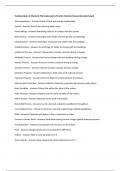
Fundamentals of Chemical Thermodynamics Practice Solution Manual Already Passed Thermodynamics - Answers Study of heat and energy relationships. System - Answers Part of the universe under study. Surroundings - Answers Remaining universe in contact with the system. Open System - Answers Exchanges both matter and energy with surroundings. Closed System - Answers Exchanges energy but not matter with surroundings. Isolated System - Answers No exchange of matter or energy with surroundings. Isothermal Process - Answers Temperature remains constant during a change. Adiabatic Process - Answers No heat exchange with surroundings during change. Isobaric Process - Answers Pressure remains constant during a change. Isochoric Process - Answers Volume remains constant during a change. Extensive Property - Answers Depends on total amount of material present. Intensive Property - Answers Does not depend on total amount of material. Macroscopic Properties - Answers Collective behavior properties like pressure and volume. State Variables - Answers Values that define the state of the system. State Function - Answers Depends only on state variables of the system. Path Function - Answers Depends on the path of transition. Reversible Process - Answers Can be reversed, maintains equilibrium throughout. Irreversible Process - Answers Cannot be reversed, rapid changes disturb equilibrium. Work - Answers Displacement against a force, measured in Joules. Pressure-Volume Work - Answers Work done during volume change against external pressure. Free Expansion - Answers Gas expands into vacuum, no work done. Heat - Answers Energy transfer due to temperature difference. Calorie - Answers Heat to raise 1g water by 1°C. Heat Capacity - Answers Heat required to raise temperature by 1°C. Specific Heat - Answers Heat to raise 1g of substance by 1°C. Molar Heat Capacity - Answers Heat to raise 1 mole of substance by 1°C. Work Done - Answers Calculated as W = -PextΔV. Joule - Answers SI unit of energy and work. Expansion Work - Answers Work done by gas during expansion. Compression Work - Answers Work done on gas during compression. Heat Capacity (C) - Answers Heat required for temperature change of one mole. Constant Volume Heat Capacity (C_v) - Answers Heat capacity measured at constant volume conditions. Constant Pressure Heat Capacity (C_p) - Answers Heat capacity measured at constant pressure conditions. Internal Energy (E) - Answers Total energy stored in a substance under conditions. Enthalpy (H) - Answers Total heat content of a system at constant pressure. First Law of Thermodynamics - Answers Energy cannot be created or destroyed, only transformed. Potential Energy - Answers Energy due to position or state of an object. Kinetic Energy - Answers Energy of a body due to its motion. Heat of Reaction (ΔH) - Answers Heat absorbed or released during a chemical reaction. Exothermic Reaction - Answers Reaction that releases heat, ΔH is negative. Endothermic Reaction - Answers Reaction that absorbs heat, ΔH is positive. Thermochemical Equation - Answers Balanced equation with enthalpy changes included. Poisson's Ratio (γ) - Answers Ratio of heat capacities C_p to C_v. Ideal Gas Law - Answers PV = nRT, relates pressure, volume, and temperature. Calorimetry - Answers Experimental technique to measure heat changes. Heat Absorption - Answers Heat taken in by a system, positive value. ΔE - Answers Change in internal energy of a system. Δn - Answers Change in number of moles during a reaction.

Content preview

Fundamentals of Chemical Thermodynamics Practice Solution Manual Already Passed

Thermodynamics - Answers Study of heat and energy relationships.

System - Answers Part of the universe under study.

Surroundings - Answers Remaining universe in contact with the system.

Open System - Answers Exchanges both matter and energy with surroundings.

Closed System - Answers Exchanges energy but not matter with surroundings.

Isolated System - Answers No exchange of matter or energy with surroundings.

Isothermal Process - Answers Temperature remains constant during a change.

Adiabatic Process - Answers No heat exchange with surroundings during change.

Isobaric Process - Answers Pressure remains constant during a change.

Isochoric Process - Answers Volume remains constant during a change.

Extensive Property - Answers Depends on total amount of material present.

Intensive Property - Answers Does not depend on total amount of material.

Macroscopic Properties - Answers Collective behavior properties like pressure and volume.

State Variables - Answers Values that define the state of the system.

State Function - Answers Depends only on state variables of the system.

Path Function - Answers Depends on the path of transition.

Reversible Process - Answers Can be reversed, maintains equilibrium throughout.

Irreversible Process - Answers Cannot be reversed, rapid changes disturb equilibrium.

Work - Answers Displacement against a force, measured in Joules.

Pressure-Volume Work - Answers Work done during volume change against external pressure.

Free Expansion - Answers Gas expands into vacuum, no work done.

Heat - Answers Energy transfer due to temperature difference.

Calorie - Answers Heat to raise 1g water by 1°C.

Heat Capacity - Answers Heat required to raise temperature by 1°C.

Document information

Uploaded on
October 6, 2024
Number of pages
4
Written in
2024/2025
Type
Exam (elaborations)
Contains
Questions & answers
$8.49

Wrong document? Swap it for free Within 14 days of purchase and before downloading, you can choose a different document. You can simply spend the amount again.
Written by students who passed
Immediately available after payment
Read online or as PDF

Seller avatar
Reputation scores are based on the amount of documents a seller has sold for a fee and the reviews they have received for those documents. There are three levels: Bronze, Silver and Gold. The better the reputation, the more your can rely on the quality of the sellers work.
TutorJosh
3.4
(74)
Sold
485
Followers
16
Items
32701
Last sold
1 day ago


Why students choose Stuvia

Created by fellow students, verified by reviews

Quality you can trust: written by students who passed their tests and reviewed by others who've used these notes.

Didn't get what you expected? Choose another document

No worries! You can instantly pick a different document that better fits what you're looking for.

Pay as you like, start learning right away

No subscription, no commitments. Pay the way you're used to via credit card and download your PDF document instantly.

Student with book image

“Bought, downloaded, and aced it. It really can be that simple.”

Alisha Student

Working on your references?

Create accurate citations in APA, MLA and Harvard with our free citation generator.

Working on your references?

Frequently asked questions
