
• Wrong document? Swap it for free
  • Written by students who passed
  • Immediately available after payment
  • Read online or as PDF
Sell
Where do you study
Your language
Document preview thumbnail
Preview 2 out of 15 pages
Exam (elaborations)

PSC 140 Midterm 3

Document preview thumbnail
Preview 2 out of 15 pages

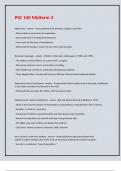
Attachment - answer-- Strong affectional tie between caregiver and infant. - Allows infants a secure base for exploration. - May be the basis of emotional development. - Forms over the first year of development. - Allows child to develop a sense of trust of the world (security). Romanian orpanages - answer-- Children in Romanian orphanages in 1980's and 1990's. - The children received little to no contact with a caregiver. - Were given necessary care to survive but no bonding. - Their intellectual, emotional, and physical development suffered. - Those adopted after 6 months old had more difficulty with social and emotional stability. Behaviorists view of attachment - answer-- Proposed that infant-mother bond is classically conditioned as the mother provides nourishment to the child. - Child positively associates the mother with food she provides. Reinforcement model of attachment - answer-- Bell and Ainsworth study in Baltimore 1970's - Study of how maternal history of responding to crying influence crying behavior later in infancy. - Duration: 1 month to 1 year later. - One group of mothers responded quickly and other group rarely responded. - Amount of crying does not correlate with their crying behavior later. - The highly responsive mothers had babies that cried less. - Conclusion: Mother's behavior influences child's behavior. Harry Harlow's work with monkeys - answer-- Proposed that the attachment/bond with mother/caregiver develops due to the sense of security provided by the mother/caregiver. - Security is considered a "base of operations." - There is more to attachment that providing nourishment. - Monkeys were given wire monkeys, one with cloth and one with food. - Monkeys spent more time on cloth monkey than food monkey. - They gained great presence of security with cloth mother. Bowlby's attachment theory - answer-- Children are biologically predisposed to develop attachments to caregivers. Imprinting - answer-- Konrad Lorenz - Automatic recognition of a parent or caregiver during critical period (irreversible). - Common in baby ducks and geese. - Happens first few days after birth. Biological basis of attachment - answer-- Behaviors like imprinting in babies include visual preferences for faces, orienting to familiar sounds, tastes, and smells (learned in utero). Secure base - answer-- The presence of a trusted caregiver provides the child with a sense of security, making it possible for the child to explore their environment. - Baby will not be as fearful to explore their surroundings. Development of attachment - answer-- Four stages developed by Bowlby. Stages of attachment - answer-1. Preattachment: Innate signals that bring the caregiver (ex. crying, smiling) [birth-6 weeks] 2. Attachment-in-the-making: The child forms expectations about how the caregiver will respond. [6 weeks-6/8m] 3. Clear-cut attachment: Child seeks contact with caregiver (secure base); separation protest/distress. [6/8m-1/2 years] 4. Reciprocal relationships: Mutually regulated relationships [from 1/2 years] Internal working model - answer-- The child's mental representation of attachment figures and relationships in general. - Constructed as a result of experiences with caregivers. - This model guides children's interactions with caregivers. - Child makes connections to who the caregiver is and what they provide. - A set of expectations about parents' availability and responsiveness. Attachment security - answer- Strange situation - answer-- Mary Ainsworth's study where child was brought into a lab and a structured observation takes place. - Mother plays with toys with the baby. - Stranger enters the room and plays with the baby and mother. - The mother leaves the baby with the stranger. - Baby will elicit a particular reaction that indicates their type of attachment. - Mother comes back in and soothes the baby. - Baby is left alone again and the stranger comes back. Insecure-avoidant attachment - answer-- Child did not care when mother left, seemingly unattached to mother. - When mother returns to the room, the baby does not seem to notice. - 20% of infants in the study. Secure attachment - answer-- Child plays happily when the mother is present. - Child will notice and react when the mother leaves. - Child will welcome mother when she returns and returns to play. - 62% of infants showed this type of attachment (majority group) in the study. - Uses mother as a secure base and can leave her side to explore. - Mothers of securely attached infants usually respond warmly to their offspring and are sensitive to child's needs. Insecure-resistant attachment - answer-- Child clings and is preoccupied with the mother when the mother is present. - The child will be very unhappy and stop playing when mother leaves. - Child will be angry, cry, or even hit the mother when she returns. - 15% of infants in the study. Disorganized attachment - answer-- Child will be cautious when mother is in the room playing with them. - Child may stare or yell when mother leaves; look scared or confused. - Child will act oddly, may scream, hit, throw things when mother returns. Parental sensitivity - answer-- Caregiving behavior that involves the expression of warmth and contingent responsiveness in children. - Can be exhibited in a variety of ways, including responsive caregiving when an infant is distressed or upset and engaging in coordinated play with the infant. Maternal sensitivity - answer-- Mothers of securely attached infants respond readily to their children's signals. - Mothers of anxious/resistant infants are inconsistent with their caregiving. - Mothers of anxious/avoidant infants tend to be indifferent and emotionally unavailable. - Mothers of distressed/disorganized infants are intrusive, emotionally unavailable, may dissociate or be in a trance-like state, confuses or frightens the child, may be harsh or abusive. Adult attachment - answer-- Three styles: Secure, dismissive, and preoccupied - Adult's attachment style can influence how sensitive one is as a parent. - Adult attachment style also reflects their own attachment - shows continuity. - Parents with secure adult attachment tend to have securely attached children. Child's temperament - answer-- Can influence parent's behavior and security of child attachment. - Parents could be frustrated by difficult children. - Children who are problematic or abnormal elicit negative responses from parents and are more likely to be insecure than other children. Long term effects of attachment - answer-- Affects peer relationships, adult romantic relationships. - Zimmerman 2004 study of 43 people surveyed. - Asked what their childhood attachment is and how their current friendships are like. - Secure attachment as children predicted closer friendships as adolescents. - Simpson 2007 study followed 78 individuals that were part of the strange situation study. - Asked at ages 20-23 what their attachment styles were like. - Securely attached individuals had better friendships as teens and better romantic relationships. Cultural differences in attachment - answer-- Similarities of strange situation behavior was seen in infants in China, Western Europe, and parts of Africa. - Japanese infants behave differently than U.S infants in the strange situation. - They were more inconsolable babies but little to no babies were insecure avoidant. - They reacted similarly to securely attached children. - Many German children were insecure avoidant. Moral development - answer-- Involves changes in thoughts, feelings, and behaviors regarding standards of right and wrong. - Moral judgement, prosocial behavior, antisocial behavior, and factors influencing developing these behaviors. Piaget's theory of moral development - answer-- Moral reasoning develops with the decline in egocentrism and increase in abstract reasoning. - Movement from preoperational - concrete operational. - Being able to see in other's perspectives allows for understanding consequences of actions. - Thought of in terms of children's cognitive development. - Interactions with peers triggers thinking of judgment and rules. - Studied kids playing games. - When people play games, they learn different rules for it to go smoothly; reflecting on agreed conventions; could be arbitrary and flexible rules. Stages of moral development - answer-1. Heteronomous morality 2. Transitional period 3. Autonomous morality Heteronomous morality - answer-- Before concrete operational stage. - Rules are strict, cannot be changed. - Immanent justice - breaking the rules always leads to punishment. Tran

Content preview

PSC 140 Midterm 3

Attachment - answer-- Strong affectional tie between caregiver and infant.

- Allows infants a secure base for exploration.

- May be the basis of emotional development.

- Forms over the first year of development.

- Allows child to develop a sense of trust of the world (security).


Romanian orpanages - answer-- Children in Romanian orphanages in 1980's and 1990's.

- The children received little to no contact with a caregiver.

- Were given necessary care to survive but no bonding.

- Their intellectual, emotional, and physical development suffered.

- Those adopted after 6 months old had more difficulty with social and emotional stability.


Behaviorists view of attachment - answer-- Proposed that infant-mother bond is classically conditioned
as the mother provides nourishment to the child.

- Child positively associates the mother with food she provides.


Reinforcement model of attachment - answer-- Bell and Ainsworth study in Baltimore 1970's

- Study of how maternal history of responding to crying influence crying behavior later in infancy.

- Duration: 1 month to 1 year later.

- One group of mothers responded quickly and other group rarely responded.

- Amount of crying does not correlate with their crying behavior later.

- The highly responsive mothers had babies that cried less.

- Conclusion: Mother's behavior influences child's behavior.


Harry Harlow's work with monkeys - answer-- Proposed that the attachment/bond with
mother/caregiver develops due to the sense of security provided by the mother/caregiver.

- Security is considered a "base of operations."

, - There is more to attachment that providing nourishment.

- Monkeys were given wire monkeys, one with cloth and one with food.

- Monkeys spent more time on cloth monkey than food monkey.

- They gained great presence of security with cloth mother.


Bowlby's attachment theory - answer-- Children are biologically predisposed to develop attachments to
caregivers.


Imprinting - answer-- Konrad Lorenz

- Automatic recognition of a parent or caregiver during critical period (irreversible).

- Common in baby ducks and geese.

- Happens first few days after birth.


Biological basis of attachment - answer-- Behaviors like imprinting in babies include visual preferences
for faces, orienting to familiar sounds, tastes, and smells (learned in utero).


Secure base - answer-- The presence of a trusted caregiver provides the child with a sense of security,
making it possible for the child to explore their environment.

- Baby will not be as fearful to explore their surroundings.


Development of attachment - answer-- Four stages developed by Bowlby.


Stages of attachment - answer-1. Preattachment: Innate signals that bring the caregiver (ex. crying,
smiling) [birth-6 weeks]

2. Attachment-in-the-making: The child forms expectations about how the caregiver will respond. [6
weeks-6/8m]

3. Clear-cut attachment: Child seeks contact with caregiver (secure base); separation protest/distress.
[6/8m-1/2 years]

4. Reciprocal relationships: Mutually regulated relationships [from 1/2 years]

Document information

Uploaded on
October 5, 2024
Number of pages
15
Written in
2024/2025
Type
Exam (elaborations)
Contains
Questions & answers
$11.99

Wrong document? Swap it for free Within 14 days of purchase and before downloading, you can choose a different document. You can simply spend the amount again.
Written by students who passed
Immediately available after payment
Read online or as PDF

Seller avatar
Reputation scores are based on the amount of documents a seller has sold for a fee and the reviews they have received for those documents. There are three levels: Bronze, Silver and Gold. The better the reputation, the more your can rely on the quality of the sellers work.
TOPDOCTOR
5.0
(1)
Sold
10
Followers
5
Items
3387
Last sold
1 year ago


Why students choose Stuvia

Created by fellow students, verified by reviews

Quality you can trust: written by students who passed their tests and reviewed by others who've used these notes.

Didn't get what you expected? Choose another document

No worries! You can instantly pick a different document that better fits what you're looking for.

Pay as you like, start learning right away

No subscription, no commitments. Pay the way you're used to via credit card and download your PDF document instantly.

Student with book image

“Bought, downloaded, and aced it. It really can be that simple.”

Alisha Student

Working on your references?

Create accurate citations in APA, MLA and Harvard with our free citation generator.

Working on your references?

Frequently asked questions
