
Personality and Personality Disorders Lectures
Lecture 1: Origins of personality and personality theories
Personality: Who is someone and how did they become that way?
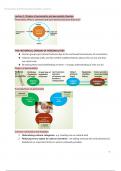
THE HISTORICAL ORIGINS OF PERSONALITIES
★ Human groups get cultural histories due to the continued transmission of conventions
★ Cultures develop orally and the written traditions/stories about who we are and how
we came to be
★ By telling these stories/reflecting on them→ change understanding of who we are
Origins of personalities
3 perspectives on personality
Common confusions and mistakes
1. Naturalizing cultural categories- e.g. treating race as natural kind
2. Reducing every aspect to cultural narratives- not taking seriously the evolved physical
body/brain as important limits on what is culturally possible
1
,Personality and Personality Disorders Lectures
3. Forgetting about the cultural and subjective position from where the author speaks-
any theory that is narrated is influenced by the narrator→ position in
history/culture/society matters→ in many aspects of personality theories this cannot be
erased
4. Treating all accounts as equally subjective opinions
AN ORGANISM IN NATURE
Step 1: Obligate collaborative foraging
➔ Humans have developed strong skills for collaborating with each other
◆ Crucial is the strong tendency of young children towards joint intentionality and
the capacity for shared goals/mental states- intersubjectivity
● Shared meanings/stories come to existence then
➔ Humans from birth are particularly attuned to sharing mental states with others
Step 2: Group-mindedness
➔ Developed capacity for conventions⇒ children are born in a world of pre-existing
conventional structures that they grow into and only later partially become aware of
◆ In this, they are introduced into a pre-existing ‘symbolic order’: the universe of
signs and meanings typical for human societies
● We have agreed to do cultural practices in a particular way, even though
we know there are other ways to do them
From natural history→ to cultural histories → to individual life stories
A PERSON IN A CULTURE
What is the psychological self?
A reflexive arrangement of the subjective ‘I’ and the constructed
‘me’ → evolves and expands over human life course
2
,Personality and Personality Disorders Lectures
● Begins life as a social actor
Development of the self (McAdams)
The self as an actor (in the present)
1. We discover what society says we are
2. Build our identity on performance in that part
3. If we uphold our part in the performance… we are rewarded with social affirmation of
our identity
a. We are created in the performance
4. If we bungle the performance (no merit)… we are (literally)destroyed
McAdams- Self as a social actor encompasses semantic representations of traits, social roles,
and other features of self that result in and from repeated performances on the social stage of
life
- Persona (masker and character): what your meaning is in the perspective of others
- Appearance (way one appears): may be disconnected from subjective experience
The self as an agent (towards the future)
To be an agent: Make choices and move forward in life in a self-determined and goal-directed
manner⇒ Human agency suggests intention, volition, will, purpose, and some modicum of
personal control in life
● Humans do not consciously and reflexively understand themselves as motivated agents
in a full sense until much later
The self as an author (integrating and reflecting on past + present + future)
To be an author: The ‘I’ becomes an autobiographical authors and the ‘me’ becomes the story
it tells⇒ narrative identity: the internalized and evolving amalgam of self stories (aims to
integrate the reconstructed past/present/imagined future)
3
, Personality and Personality Disorders Lectures
Lecture 2: Observing personality: Traits and stories
MEASURING SELF-REPORTED TRAITS
Traits: Words in natural language to describe individual characteristics
Lexical hypothesis:
1. Those personality characteristics that are important to a group will eventually become
a part of that group’’s language
2. More important personality characteristics are more likely to be encoded into language
in many words
3. Principle component analysis of the covariance-structure of traits can be used to extract
the most important aspects of variation in a population
Methods for studying covariance patterns:
● Take a large list of traits in a language
● Use a method to derive principal components on these traits
● Arrive at a factor structure of 5 to 7 factor
INTERPRETING COVARIANCE OF TRAITS
Interpreting covariance of structures (not mutually exclusive):
1. Trait realism and temperament
a. One can define a trait as an inferred organismic structure
underlying an extended family of behavioral dispositions. These
4


