

Written by students who passed Immediately available after payment Read online or as PDF Wrong document? Swap it for free 4.6 TrustPilot
logo-home
Document preview thumbnail
Preview 2 out of 10 pages
Exam (elaborations)

Liberty University COUC 500 Quiz Counseling Interventions and Techniques At Risk and Growth Mindset Answered.

Document preview thumbnail
Preview 2 out of 10 pages

Question 1 2 / 2 pts According to Olweus, for a behavior to be categorized as bullying, it must be intentional, repetitive, and: Physical in nature. Have an imbalance of power. Be on the internet. Originate from a male offender. Question 2 2 / 2 pts Children who are being raised by same-gender parents: Typically suffer from mental illness. Suffer from depression and anxiety at higher rates that other children. Do not experience teasing and bullying due to their parenting situation any more than they do for other reasons. Struggle academically at a higher rate than children being raised by opposite-gender parents. Question 3 2 / 2 pts The belief that intelligence can change, grow, and develop is frequently referred to as: Fixed mindset. Rational Emotive Behavior Therapy.Growth mindset. Positive psychology. Question 4 2 / 2 pts Counselors need to focus on their self-care in working with traumatized clients so they Do not burnout. Learn how to take on more emotional baggage. Allow their clients’ narrative to influence their day-to-day mood. Learn the necessity of being of service to others first and foremost. Question 5 2 / 2 pts Which of the following factors predict stress reactions in children following traumatic events? Level of exposure to the event. Level of distress at the time of the event. Level of exposure to the event AND level of distress at the time of the event. None of these are correct. Question 6 2 / 2 ptsAdolescents who are adjusting to a new step family often struggle most when: The “new parent” is the opposite sex from the child. Grandparents are not involved in their lives. A biological parent is incarcerated. A biological parent is suffering from addiction. Question 7 2 / 2 pts Which of the following is true of resilient children? Resilient children possess a fixed mindset. Resilient children can bounce back after adversity. Resilient children lack protective factors. Resilient children do better in college. Question 8 2 / 2 pts Which of the following could be protective factors? A sense of control. Getting to dictate all aspects of therapy in response to trauma. Choosing whether or not to seek counselling after a traumatic event. Relying on family alone.Question 9 2 / 2 pts Mark all that apply: Which of the following are symptoms associated with trauma you might see as a counselor? Depression and anxiety. Substance abuse. Nonsuicidal self-injury (NSSI) and suicide. Question 10 2 / 2 pts A child’s ability to demonstrate self-control and modulate both positive and negative emotions is commonly referred to as the protective factor of: Connection and attachment. School achievement. Proactive orientation. Self-regulation. Question 11 2 / 2 pts Which of the following are examples of systemic consequences of trauma at the societal level? High socioeconomic status (SES). Low socioeconomic status (SES). Racism.Low socioeconomic status (SES) AND racism. Question 12 2 / 2 pts How can social advocacy support posttraumatic growth? Standing alongside clients in their healing journey far beyond the counseling session. Creating empowerment for clients. Giving voice to systemic issues as the counselor. Creating a space for the counselor to advocate for clients. Question 13 2 / 2 pts The school to prison pipeline refers to Kids that fail out of school and end up going to prison later in life. Kids that are systematically targeted due to their often misunderstood behavior. Kids that finish school, but cannot function independently in the world. None of these are correct. Question 14 2 / 2 pts Mark all that apply: Children and adolescents that are considered at-risk if they are experiencing Both cultural and economic vulnerabilities.A reduction in their capacity to live independent, productive lives as adults. A need for additional resources through social service prevention and intervention. Question 15 2 / 2 pts What three core tenets guide the Essentials of Childhood model to prevent childhood maltreatment? Structure, school, and nurturing. Safety, school, and nurturing. Safety, stability, and nurturing. Safety, stability, and nutrition. Question 16 2 / 2 pts The following is an assessment that can be used to effectively assess for trauma symptoms. Beck Depression Inventory (BDI). Beck Anxiety Inventory (BAI). Impact of Events Scale (IES). Career Construction Interview . Question 17 2 / 2 ptsMark all that apply: Typical outcomes for students who experience bullying include: Depression. Isolation. Reduction of investment in school work. Question 18 2 / 2 pts Mark all that apply: Children and adolescents who do not have opportunities to work through the stress often involved in the changing family landscape can exhibit: Signs of anger. Low self-esteem. Guilt. Question 19 2 / 2 pts Which of the following statements best describes an adolescent’s typical response to a death or loss? Adolescents have developed adequate coping skills needed to cope with death and loss. Adolescents understand the concept of death. Adolescents typically cope well with death and loss after about two months. Adolescents often believe if they exhibit good behaviors, the deceased will come back or the loss can be reversed.Question 20 2 / 2 pts What two factors have fueled the current reality for at-risk children and adolescents? Economic and housing instability. Institutionalization and growing crime rates. Deinstitutionalization and growing rates of childhood and adolescent trauma. Governmental regulation and subsidies. Question 21 2 / 2 pts Mark all that apply: Incidents of mass violence can result in trauma for Individuals and families. Communities. Countries. Question 22 2 / 2 pts The DSM-V recognizes all of the following categories of eating disorders except: Binge eating disorder. Avoidant/Restrictive food intake disorder. Bulimia Nervosa.Extreme picky eating. Question 23 2 / 2 pts Mark all that apply: Children of divorce may experience which of the following? Fear. Anger. Sadness. Question 24 2 / 2 pts Examples of protective factors include: Proactive parenting. Grit. Food security. Proactive parenting AND grit. Question 25 2 / 2 pts Mark all that apply: Which of the following family characteristics is associated with child maltreatment? Substance abuse and stress. Family structure.Parents who were themselves victims of childhood maltreatment.

Content preview

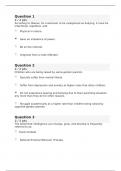
Question 1
pts
According to Olweus, for a behavior to be categorized as bullying, it must be
intentional, repetitive, and:

Physical in nature.


Have an imbalance of power.


Be on the internet.


Originate from a male offender.


Question 2
pts
Children who are being raised by same-gender parents:

Typically suffer from mental illness.


Suffer from depression and anxiety at higher rates that other children.


Do not experience teasing and bullying due to their parenting situation
any more than they do for other reasons.


Struggle academically at a higher rate than children being raised by
opposite-gender parents.


Question 3
pts
The belief that intelligence can change, grow, and develop is frequently
referred to as:

Fixed mindset.


Rational Emotive Behavior Therapy.

, Growth mindset.


Positive psychology.


Question 4
pts
Counselors need to focus on their self-care in working with traumatized
clients so they

Do not burnout.


Learn how to take on more emotional baggage.


Allow their clients’ narrative to influence their day-to-day mood.


Learn the necessity of being of service to others first and foremost.


Question 5
pts
Which of the following factors predict stress reactions in children following
traumatic events?

Level of exposure to the event.


Level of distress at the time of the event.


Level of exposure to the event AND level of distress at the time of the
event.


None of these are correct.


Question 6
pts

Document information

Uploaded on
September 20, 2024
Number of pages
10
Written in
2024/2025
Type
Exam (elaborations)
Contains
Questions & answers
$14.49

Wrong document? Swap it for free Within 14 days of purchase and before downloading, you can choose a different document. You can simply spend the amount again.
Written by students who passed
Immediately available after payment
Read online or as PDF

Seller avatar
Reputation scores are based on the amount of documents a seller has sold for a fee and the reviews they have received for those documents. There are three levels: Bronze, Silver and Gold. The better the reputation, the more your can rely on the quality of the sellers work.
Topscorer
4.2
(25)
Sold
151
Followers
13
Items
441
Last sold
2 weeks ago


Why students choose Stuvia

Created by fellow students, verified by reviews

Quality you can trust: written by students who passed their tests and reviewed by others who've used these notes.

Didn't get what you expected? Choose another document

No worries! You can instantly pick a different document that better fits what you're looking for.

Pay as you like, start learning right away

No subscription, no commitments. Pay the way you're used to via credit card and download your PDF document instantly.

Student with book image

“Bought, downloaded, and aced it. It really can be that simple.”

Alisha Student

Working on your references?

Create accurate citations in APA, MLA and Harvard with our free citation generator.

Working on your references?

Frequently asked questions

