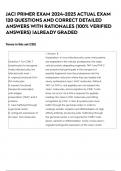
JACI PRIMER EXAM 2024-2025 ACTUAL EXAM
120 QUESTIONS AND CORRECT DETAILED
ANSWERS WITH RATIONALES (100% VERIFIED
ANSWERS) |ALREADY GRADED
Terms in this set (120)
1. Answer: B
Explanation: In virus-infected cells, some viral proteins
Question 1. For CD8+ T are degraded in the cellular proteasome, the major
lymphocytes to recognize cellular protein degrading organelle. TAP-1 and TAP-2
virally infected cells, the are proteins that participate in the transport of
infected cells must — peptide fragments from the proteasome into the
A. express functional HLA- endoplasmic reticulum where they are loaded into
DM molecules. newly synthesized class I MHC molecules. Without
B. express functional TAP-1 or TAP-2, viral peptides are not loaded into
transporter associated class I molecules, and recognition by CD8+ T cells
with antigen does not occur. HLA-DM is required for peptide
presentation (TAP) 1 and 2 loading into class II MHC molecules, permitting
proteins. recognition by CD4+ T cells. B-lymphocytes must
C. have trafficked through traffic through the germinal center in order to
a germinal center. undergo somatic mutation and differentiation to high
D. extinguish expression of affinity antibody producing cells. Trafficking through
its class I HLA molecules. the germinal center is not required for CD81 T cells
devel- opment or differentiation. Some viruses down-
regulate (extinguish) expression of the class I prote
,Question 2. The HLA 2. Answer: C
invariant chain — Explanation: Loading of peptide fragment from
A. controls loading of viral exogenous antigens into class II HLA molecules
peptide fragments into occurs when the acidified endosome fuses with the
class I HLA molecules. class II loading compartment. This fusion results in the
B. is delivered to HLA proteolytic degradation of the invariant chain that
molecules in endosomes. then allows peptides to associate with the class II
C. prevents loading of molecules. The invariant chain is not associated with
antigenic peptides into peptide loading into class I HLA molecules. The
class II HLA invariant chain associates with the newly synthesized
molecules until it is class II HLA molecules in the endoplasmic reticulum.
proteolytically degraded. The invariant chain is designated as ÔinvariantÕ
D. differs in primary amino because is shows very low sequence variability in
acid sequence among different individuals in the population.
different
subjects in the population.
3. Answer: D
Question 3. For TH cells, a
Explanation: b2-Microglobulin associates with class I
functional T-cell receptor
MHC molecules and several other molecules with
requires all of the
class I-like structures. The MHC molecules that are the
following except
targets of TH cells (CD41 T cells) are class II MHC
A. the CD3 complex.
molecules. These do not contain b2-microglobulin.
B. coexpression of CD4.
The CD3 complex, rearranged a and b chains of the T-
C. rearranged a and b
cell receptor, and the CD4 molecule are all important
chains.
components for recognition of peptide antigens
D. b2-microglobulin.
associated with class II MHC molecules.
,Question 4. Which of the 4. Answer: C
following statements is Explanation: TLRs are found on many somatic cells,
true? particularly ones that are involved in early contact
A. The extracellular with microbes that invade the body through skin and
domains of Toll-like mucosal tissues. The intracellular domains of TLRs are
receptors (TLRs) are homologous to the corresponding domains of the IL-
homologous to the 1 receptor. Most TLRs are cell-surface proteins, but
corresponding domains of TLR3 and TLR9 are intracellular proteins that interact
the IL-1 receptor. with their ligands during the intracellular part of their
B. All TLRs are cell-surface lifecycle. TLR4 is activated by LPS. TLR9, in contrast, is
proteins. activated by bacterial CpG DNA.
C. TLRs are found on
macrophages, dendritic
cells,
neutrophils, and
endothelial cells.
D. TLR4 is activated by
CpG DNA.
, Question 1. Which of the 1. Answer: C
following statements Explanation: Because TLRs are highly expressed on
regarding activa- tion of dendritic cells but not on T cells, the goal of TLR-
Toll-like receptor (TLR) 9 based therapies in patients with allergy and asthma is
in allergic responses is to activate dendritic cells to produce a cytokine milieu
true? (eg, IL-12 and interferons) that favors inhibition of the
A. Activation of TLR9 TH2 immune response.
expressed by eosinophils
inhibits generation of
prostaglandin D2.
B. Activation of TLR9
expressed by CD41 cells
inhibits generation of TH2
cytokines.
C. Activation of TLR9
expressed by dendritic
cells inhibits TH2 cell
generation of cytokines.
D. Activation of TLR9
expressed by endothelial
cells inhibits recruitment
of TH2 cells to sites of
allergic inflammation.
120 QUESTIONS AND CORRECT DETAILED
ANSWERS WITH RATIONALES (100% VERIFIED
ANSWERS) |ALREADY GRADED
Terms in this set (120)
1. Answer: B
Explanation: In virus-infected cells, some viral proteins
Question 1. For CD8+ T are degraded in the cellular proteasome, the major
lymphocytes to recognize cellular protein degrading organelle. TAP-1 and TAP-2
virally infected cells, the are proteins that participate in the transport of
infected cells must — peptide fragments from the proteasome into the
A. express functional HLA- endoplasmic reticulum where they are loaded into
DM molecules. newly synthesized class I MHC molecules. Without
B. express functional TAP-1 or TAP-2, viral peptides are not loaded into
transporter associated class I molecules, and recognition by CD8+ T cells
with antigen does not occur. HLA-DM is required for peptide
presentation (TAP) 1 and 2 loading into class II MHC molecules, permitting
proteins. recognition by CD4+ T cells. B-lymphocytes must
C. have trafficked through traffic through the germinal center in order to
a germinal center. undergo somatic mutation and differentiation to high
D. extinguish expression of affinity antibody producing cells. Trafficking through
its class I HLA molecules. the germinal center is not required for CD81 T cells
devel- opment or differentiation. Some viruses down-
regulate (extinguish) expression of the class I prote
,Question 2. The HLA 2. Answer: C
invariant chain — Explanation: Loading of peptide fragment from
A. controls loading of viral exogenous antigens into class II HLA molecules
peptide fragments into occurs when the acidified endosome fuses with the
class I HLA molecules. class II loading compartment. This fusion results in the
B. is delivered to HLA proteolytic degradation of the invariant chain that
molecules in endosomes. then allows peptides to associate with the class II
C. prevents loading of molecules. The invariant chain is not associated with
antigenic peptides into peptide loading into class I HLA molecules. The
class II HLA invariant chain associates with the newly synthesized
molecules until it is class II HLA molecules in the endoplasmic reticulum.
proteolytically degraded. The invariant chain is designated as ÔinvariantÕ
D. differs in primary amino because is shows very low sequence variability in
acid sequence among different individuals in the population.
different
subjects in the population.
3. Answer: D
Question 3. For TH cells, a
Explanation: b2-Microglobulin associates with class I
functional T-cell receptor
MHC molecules and several other molecules with
requires all of the
class I-like structures. The MHC molecules that are the
following except
targets of TH cells (CD41 T cells) are class II MHC
A. the CD3 complex.
molecules. These do not contain b2-microglobulin.
B. coexpression of CD4.
The CD3 complex, rearranged a and b chains of the T-
C. rearranged a and b
cell receptor, and the CD4 molecule are all important
chains.
components for recognition of peptide antigens
D. b2-microglobulin.
associated with class II MHC molecules.
,Question 4. Which of the 4. Answer: C
following statements is Explanation: TLRs are found on many somatic cells,
true? particularly ones that are involved in early contact
A. The extracellular with microbes that invade the body through skin and
domains of Toll-like mucosal tissues. The intracellular domains of TLRs are
receptors (TLRs) are homologous to the corresponding domains of the IL-
homologous to the 1 receptor. Most TLRs are cell-surface proteins, but
corresponding domains of TLR3 and TLR9 are intracellular proteins that interact
the IL-1 receptor. with their ligands during the intracellular part of their
B. All TLRs are cell-surface lifecycle. TLR4 is activated by LPS. TLR9, in contrast, is
proteins. activated by bacterial CpG DNA.
C. TLRs are found on
macrophages, dendritic
cells,
neutrophils, and
endothelial cells.
D. TLR4 is activated by
CpG DNA.
, Question 1. Which of the 1. Answer: C
following statements Explanation: Because TLRs are highly expressed on
regarding activa- tion of dendritic cells but not on T cells, the goal of TLR-
Toll-like receptor (TLR) 9 based therapies in patients with allergy and asthma is
in allergic responses is to activate dendritic cells to produce a cytokine milieu
true? (eg, IL-12 and interferons) that favors inhibition of the
A. Activation of TLR9 TH2 immune response.
expressed by eosinophils
inhibits generation of
prostaglandin D2.
B. Activation of TLR9
expressed by CD41 cells
inhibits generation of TH2
cytokines.
C. Activation of TLR9
expressed by dendritic
cells inhibits TH2 cell
generation of cytokines.
D. Activation of TLR9
expressed by endothelial
cells inhibits recruitment
of TH2 cells to sites of
allergic inflammation.