

Written by students who passed Immediately available after payment Read online or as PDF Wrong document? Swap it for free 4.6 TrustPilot
logo-home
Document preview thumbnail
Preview 2 out of 11 pages
Exam (elaborations)

QAL Laws Chapter 9 fully solved & updated(100% accuracy)

Document preview thumbnail
Preview 2 out of 11 pages

Ground water contamination resulting from legal, registered uses of pesticides: A. Does not occur B. Accounts for only a minor amount of the pesticide ground water contamination problem C. Can cause unacceptable risks to human health and the environment D. Occurs but causes no risks to humans or the environment C. Can cause unacceptable risks to human health and the environment In the Department of Pesticide Regulation surface water protection program a hydrologically isolated site is: A. Defined differently in each county depending on local treatment area and surface water conditions B. An area of surface water protected from pesticide run off from treatment areas by at least 150 feet of impermeable soil C. Considered to mean any pesticide treatment site that is completely surrounded by surface water D. Any treatment area that does not produce pesticide run off that can enter any surface water, such as in an irrigation canal or drainage ditch D. Any treatment area that does not produce pesticide run off that can enter any surface water, such as in an irrigation canal or drainage ditch Previous Play Next Rewind 10 seconds Move forward 10 seconds Unmute 0:00 / 0:15 Full screen Brainpower Read More The Healthy Schools Act is a: A. Federal program with requirements to promote integrated pest management to protect non-pest species from pesticides applied on school grounds B. California legislative mandate to protect children and staff from pesticides exposure in certain schools and child care facilities C. State mandated program that covers only schools and child care facilities located on State property D. Federal program that covers all schools and child care facilities that receive any federal funding B. California legislative mandate to protect children and staff from pesticides exposure in certain schools and child care facilities When a pest control business must meet requirements in the Healthy Schools Act, the pest control business shall: A. Submit a specific form to report weekly pest control activity conducted at all schools or day care facilities B. Complete and post an annual pest control notice at all entrances of K-12 schools and all child care facilities C. Provide specialized notification and pesticide safety training for all interested persons working at schools and day care facilities serviced by the pest control business D. Submit a school and child care pesticide use report to DPR at least annually D. Submit a school and child care pesticide use report to DPR at least annually The goal of the use requirements in the ground water protection regulations is to: A. Minimize the impact of rainfall on pesticides applied to orchards B. Encourage the use of mechanical weed control in ground water protection areas C. Reduce run off and leaching of certain pesticides into ground water D. Discourage the use of restricted materials on soils that contain water wells C. Reduce run off and leaching of certain pesticides into ground water The Department of Regulation surface water protection regulations are designed to: A. Accurately record and track pesticide use by location during the rainy season B. Prohibit use of pesticide products that are identified as generators of volatile organic compounds C. Control run off and drift of dormant season pesticides applied to tree and vine crops D. Provide local County Agricultural Commissioners with pre-application notification of all pesticides applied just prior to and after rain fall C. Control run off and drift of dormant season pesticides applied to tree and vine crops Under the Endangered Species Act, the ________ is responsible for ensuring that registered pesticides will not harm endangered species or their habitats. A. California Department of Pesticide Regulation B. U.S. Department of Agriculture C. California Environmental Protection Agency D. U.S. Environmental Protection Agency D. U.S. Environmental Protection Agency Protection of endangered or threatened plants or animals is prioritized by the U.S. Environmental Protection Agency according to: A. Location in relation to agricultural sites B. Type of organism C. Vulnerability of each endangered or threatened organism D. Distribution of each endangered or threatened organism throughout the U.S. C. Vulnerability of each endangered or threatened organism

Content preview

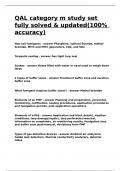
QAL category m study set
fully solved & updated(100%
accuracy)
Non-soil fumigants - answer Phosphine, sulfuryl fluoride, methyl
bromide, MITC and MITC generators, CO2, and SO2


Tarpaulin sealing - answer Gas tight tarp seal


Snakes - answer Hoses filled with water or sand used to weigh down
tarps


2 types of buffer zones - answer Treatment buffer zone and aeration
buffer zone


What fumigant requires buffer zones? - answer Methyl bromide


Elements of an FMP - answer Planning and preparation, personnel,
monitoring, notification, sealing procedures, application procedures
and fumigation periods, post application operations


Elements of a PAS - answer Application and block details, weather
conditions, tarp damage/repairs, tarp perforation/removal,
information on complaints, air monitoring results, fumigation area
and buffer zone post/removal, deviations from FMP


Types of gas detection devices - answer Ambient air analyzers,
halide leak detectors, thermal conductivity analyzers, detector
tubes

, What 2 gas detection devices should not be used for safe reentry? -
answer Halide leak detectors and thermal conductivity analyzers


What organization provides permits for gas detector usage? -
answer CAC


Why should gas canisters be kept off of the ground? - answer To
prevent cross contamination


What gas detection device uses infrared detection? - answer
Ambient air analyzers


Which gas detection devices are only used for methyl bromide and
sulfuryl fluoride? - answer Halide leak detectors and thermal
conductivity analyzers


Which fumigant does not require the use of a respirator? - answer
MITC and MITC generators


Types of air purifying respirators - answer Particulate, chemical, and
powered air purifying


Types of atmosphere supplying respirators - answer SCBA and SARS


Fumigation methods - answer Chamber, spot, structural, burrow,
quarantine, and sewer root control


Types of chamber fumigation - answer Atmospheric and vacuum

Document information

Uploaded on
September 10, 2024
Number of pages
11
Written in
2024/2025
Type
Exam (elaborations)
Contains
Questions & answers
$13.99

Wrong document? Swap it for free Within 14 days of purchase and before downloading, you can choose a different document. You can simply spend the amount again.
Written by students who passed
Immediately available after payment
Read online or as PDF

Seller avatar
Reputation scores are based on the amount of documents a seller has sold for a fee and the reviews they have received for those documents. There are three levels: Bronze, Silver and Gold. The better the reputation, the more your can rely on the quality of the sellers work.
BRAINBOOSTERS
4.5
(355)
Sold
784
Followers
257
Items
25924
Last sold
3 days ago


Why students choose Stuvia

Created by fellow students, verified by reviews

Quality you can trust: written by students who passed their tests and reviewed by others who've used these notes.

Didn't get what you expected? Choose another document

No worries! You can instantly pick a different document that better fits what you're looking for.

Pay as you like, start learning right away

No subscription, no commitments. Pay the way you're used to via credit card and download your PDF document instantly.

Student with book image

“Bought, downloaded, and aced it. It really can be that simple.”

Alisha Student

Working on your references?

Create accurate citations in APA, MLA and Harvard with our free citation generator.

Working on your references?

Frequently asked questions

