
• Wrong document? Swap it for free
  • Written by students who passed
  • Immediately available after payment
  • Read online or as PDF
Sell
Where do you study
Your language
Document preview thumbnail
Preview 1 out of 3 pages
Exam (elaborations)

accounting test 1

Document preview thumbnail
Preview 1 out of 3 pages

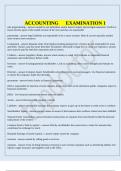
ACCOUNTING EXAMINATION 1 sole proprietorship - answer-owned by one individual, easiest doesn't require special legal maneuvers. Profits or losses become apart of the taxable income of the oner and they are responsible partnership - answer-legal liabilities are responsible of to or more oweners. More $, lawyer typically needed. more owners more resources. Corporation - answer-Separate entity from legal/accounting perspectives. Owners are not responsible for taxes and debts. Owners cant lose more then their investment. Downside is legal fees to create are expensive, income taxes must be paid by both the corporation and its owners. Creditors - answer-Suppliers, Banks, anyone whom money is owed. Will evaluate a companies financial statements and credit history before credit. Investors - answer-Existing/potential stockholders. Look to accounting info to asses strength and estimate its value. Directors - answer-Compnys board. Stockholders elect directors to oversee managers. Use financial statements to ensure the companys make best decisons. goverment - answer-looks closely at financial statements. (SEC)- responsible for function of stock markets, keeps close atch on the informtion public companies report in financial statements. (IRS) - Use financial statement to ensure taxes are correct Assets - answer-Resources the company controls Liabilites - answer-measurable amounts the company expects to give up in the future to settle owes to creditors Stockholders' Equity - answer-owners claims on assets of the business after creditors claims have been fulfilled Separate Entity Assumption - answer-business transactions are separate from and should exclude the personal transactions of the owners. Common Stock ( Paid-in capitol ) - answer-Paid by stockholders the owners have a claim for amounts they contributed in exchange for stock. Retained Earnings ( Earned Capitol ) - answer-equity earned by company revenues - answer-earned by selling good or services. expenses - answer-Costs of doing business necessary to earn revenue expenses such as advertising utilities rent salaries wages insurance and supplies used in the office. Net icome - answer-Calculated as revenues minus expenses. By generating net income a company increases its stockholders equity. dividends - answer-a company's profits are accumulated in retained earnings until a decision is made to distribute them to stockholders in what is called a dividend. Dividends are an optional distribution of earnings to stockholders approved by the companys board of directords fiscal year - answer-one-year period that companies and governments use for financial reporting and budgeting. unite measure of assumption - answer-Financial results of a companies worldwide business activites should be measured and reported using a single monetary unit such as the u.s dollar. Income statement - answer-Reports the revenues less the expenses of the accounting period. revenue - expenses + net income Statement of retained earnings - answer-reports the way that net income and distribution of dividends affected the financial position of the company during the accounting period. Beginning retained earnings + net income( this period) - dividends= ending retained earnings Balance sheet - answer-Reports the amount of assets, liabilities, and stockholders equity of an accounting entity at a point in time Assets= liabilities + stokholders equity Statement of cash flows - answer-Reports inflows and outflows of cash during the accounting period int he categories of operating investing and financing GAAP (Generally Accepted Accounting Principles) - answer-tHE RULES USED IN THE UNITED STATES THE CALCULATE AND REPORT INFORMATION INT HE FINANCIAL STATEMENTS cost principle - answer-Requires assets to be initially recorded at the historical cash-equivilent cost which is the amount paid or payable on the date of the transcation external echanges - answer-these are exchanges involving assets, liabilities, and/or stockholders equity between the company and someone else. internal events - answer-These events do not involve exhanges with others outside the business, but rather within the company itself. accounts payable - answer-owed to suppliers for goods or services bought on credit notes payable ( long term ) - answer-owed to lenders as per terms of promissory note T account - answer-a simplified version of ledger account used for summarizing transaction effects and determining balances for each account trail balance - answer-a list of all acounts with their balances to provide a check on the equity of all the debits and credits. current assets - answer-assets that will be used up or turned into cash within 12 months or the next operating cycle which ever is longer current liabilites - answer-short term obligations that will be paid in cash within 12 months or the next operating cycle which ever is longer classified balance sheet - answer-a balance sheet that classifies assets and liabilities into current and other categories accounting cycle - answer-1. analyze ( monthly adjustments , daily transactions 2. record (journal entries adjusting antries) 3. summerize in t-acounts 4. prepare trial balance 5. report financial statements cash bias acounting - answer-recording revenues when cash is recived and expenses when cash is paid accural basis accounting - answer-recording revenues when generated and expenses when inncured regarless of the timing of cash recipts or payments five-step model for reporting revenue - answer-step 1: identify the contract( a ontrat is written, verbal or implied) step 2: identify the seller's performance obligations ( what goods and services does the seller promise?) step 3: determine the transaction price ( what is the seller entitled to recive? ) step 4: allocate the transaction price to the performance obligations ( refer to stand-alone prices ) step 5: recognize reenue when (or as) each performance obligation is satisfied ( "when"=at a point in time. "AS"= over a period of time revenue recognition principle - answer-revenues are recorded when(or as_ the seller provides goods or services to customers, in the amount the seller expects to be entitled to recive. deferred revenue - answer-A liability representing a companys obligation to provide goods or services to customers in the future Expense recognition principle - answer-Expenses are recorded when incurred in earning revenue; also called matching - answer-

Content preview

ACCOUNTING EXAMINATION 1
sole proprietorship - answer-owned by one individual, easiest doesn't require special legal maneuvers. Profits or
losses become apart of the taxable income of the oner and they are responsible

partnership - answer-legal liabilities are responsible of to or more oweners. More $, lawyer typically needed.
more owners more resources.

Corporation - answer-Separate entity from legal/accounting perspectives. Owners are not responsible for taxes
and debts. Owners cant lose more then their investment. Downside is legal fees to create are expensive, income
taxes must be paid by both the corporation and its owners.

Creditors - answer-Suppliers, Banks, anyone whom money is owed. Will evaluate a companies financial
statements and credit history before credit.

Investors - answer-Existing/potential stockholders. Look to accounting info to asses strength and estimate its
value.

Directors - answer-Compnys board. Stockholders elect directors to oversee managers. Use financial statements
to ensure the companys make best decisons.

goverment - answer-looks closely at financial statements.

(SEC)- responsible for function of stock markets, keeps close atch on the informtion public companies report in
financial statements.

(IRS) - Use financial statement to ensure taxes are correct

Assets - answer-Resources the company controls

Liabilites - answer-measurable amounts the company expects to give up in the future to settle owes to creditors

Stockholders' Equity - answer-owners claims on assets of the business after creditors claims have been fulfilled

Separate Entity Assumption - answer-business transactions are separate from and should exclude the personal
transactions of the owners.

Common Stock ( Paid-in capitol ) - answer-Paid by stockholders the owners have a claim for amounts they
contributed in exchange for stock.

Retained Earnings ( Earned Capitol ) - answer-equity earned by company

revenues - answer-earned by selling good or services.

expenses - answer-Costs of doing business necessary to earn revenue expenses such as advertising utilities rent
salaries wages insurance and supplies used in the office.


Document information

Uploaded on
September 7, 2024
Number of pages
3
Written in
2024/2025
Type
Exam (elaborations)
Contains
Questions & answers
$10.99

Wrong document? Swap it for free Within 14 days of purchase and before downloading, you can choose a different document. You can simply spend the amount again.
Written by students who passed
Immediately available after payment
Read online or as PDF

Seller avatar
Reputation scores are based on the amount of documents a seller has sold for a fee and the reviews they have received for those documents. There are three levels: Bronze, Silver and Gold. The better the reputation, the more your can rely on the quality of the sellers work.
TOPDOCTOR
5.0
(1)
Sold
10
Followers
5
Items
3387
Last sold
1 year ago


Why students choose Stuvia

Created by fellow students, verified by reviews

Quality you can trust: written by students who passed their tests and reviewed by others who've used these notes.

Didn't get what you expected? Choose another document

No worries! You can instantly pick a different document that better fits what you're looking for.

Pay as you like, start learning right away

No subscription, no commitments. Pay the way you're used to via credit card and download your PDF document instantly.

Student with book image

“Bought, downloaded, and aced it. It really can be that simple.”

Alisha Student

Working on your references?

Create accurate citations in APA, MLA and Harvard with our free citation generator.

Working on your references?

Frequently asked questions
