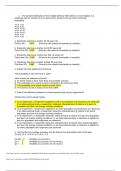
1. The percent distribution of live multiple-delivery births (three or more babies) in a
particular year for women 15 to 54 years old is shown in the pie chart. Find each
probability.
15-19 1.5%
20-24 6.4%
25-29 21.6%
30-34 37.3%
35-39 24.5%
40-44 5.1%
45-54 3.6%
a. Randomly selecting a mother 30-39 years old
P(30 to 39) 0.618 (Round to the nearest thousandth as needed.)
b. Randomly selecting a mother not 30-39 years old
P(not 30 to 39) 0.382 (Round to the nearest thousandth as needed.)
c. Randomly selecting a mother less than 45 years old
P(less than 45) 0.964 (Round to the nearest thousandth as needed.)
d. Randomly selecting a mother at least 20 years old
P(at least 20) 0.985 (Round to the nearest thousandth as needed.)
2. Explain why the statement is incorrect.
The probability of rain tomorrow is 136%.
What makes the statment incorrect?
A. An event needs to have more than one possible outcome.
B. The probability of an event must be contained in the interval [1,100].
C. The probability of an event cannot exceed 100%.
D. The chance of rain is always more than 100%.
3. What is the difference between an observational study and an experiment?
Choose the correct answer below.
A. In an experiment, a treatment is applied to part of a population and responses are observed.
In an observational study, a researcher measures characteristics of interest of a part of a
population but does not change existing conditions.
B. In an experiment, a treatment is applied to an entire population and responses are observed.
In an observational study, a researcher measures characteristics of interest of an entire
population but does not change existing conditions.
C. In an experiment, a researcher measures characteristics of interest of a part of a population
but does not change existing conditions. In an observational study, a treatment is applied to
part of a population and responses are observed.
D. In an experiment, a researcher measures characteristics of interest of an entire population
but does not change existing conditions. In an observational study, a treatment is applied to
an entire population and responses are observed.
4. (a) Find the five-number summary, and (b) draw a box-and-whisker plot of the data.
38862987969426298779
(a) Min = 2 (Simplify your answer.)
Q1 = 5 (Simplify your answer. Do not round.)
Q2 = 7 (Simplify your answer. Do not round.)
This study source was downloaded by 100000880779952 from CourseHero.com on 09-05-2024 13:03:27 GMT -05:00
https://www.coursehero.com/file/16676482/midterm-study-part2/
, Q3 = .5 (Simplify your answer. Do not round.)
Max = 9 (Simplify your answer.)
(b) Choose the correct box-and-whisker plot below.
a.
b.
c. (correct answer)
d.
5. You roll a six-sided die. Find the probability of each of the following scenarios.
(a) Rolling a or a number 5 greater than 3
(b) Rolling a number less than 4 or an even number
(c) Rolling a 4 or an odd number
(a) P(5 or number > 3) = ½ (Type an integer or a simplified fraction.)
(b) P(1 or 2 or 3 or 4 or 6) = 5/6 (Type an integer or a simplified fraction.)
(c) P(4 or 1 or 3 or 5) = 2/3 (Type an integer or a simplified fraction.)
6. The percent distribution of a person's accumulating specific amounts of credit
card charges over a 12month period is shown in the pie chart. Find each probability.
This study source was downloaded by 100000880779952 from CourseHero.com on 09-05-2024 13:03:27 GMT -05:00
https://www.coursehero.com/file/16676482/midterm-study-part2/
particular year for women 15 to 54 years old is shown in the pie chart. Find each
probability.
15-19 1.5%
20-24 6.4%
25-29 21.6%
30-34 37.3%
35-39 24.5%
40-44 5.1%
45-54 3.6%
a. Randomly selecting a mother 30-39 years old
P(30 to 39) 0.618 (Round to the nearest thousandth as needed.)
b. Randomly selecting a mother not 30-39 years old
P(not 30 to 39) 0.382 (Round to the nearest thousandth as needed.)
c. Randomly selecting a mother less than 45 years old
P(less than 45) 0.964 (Round to the nearest thousandth as needed.)
d. Randomly selecting a mother at least 20 years old
P(at least 20) 0.985 (Round to the nearest thousandth as needed.)
2. Explain why the statement is incorrect.
The probability of rain tomorrow is 136%.
What makes the statment incorrect?
A. An event needs to have more than one possible outcome.
B. The probability of an event must be contained in the interval [1,100].
C. The probability of an event cannot exceed 100%.
D. The chance of rain is always more than 100%.
3. What is the difference between an observational study and an experiment?
Choose the correct answer below.
A. In an experiment, a treatment is applied to part of a population and responses are observed.
In an observational study, a researcher measures characteristics of interest of a part of a
population but does not change existing conditions.
B. In an experiment, a treatment is applied to an entire population and responses are observed.
In an observational study, a researcher measures characteristics of interest of an entire
population but does not change existing conditions.
C. In an experiment, a researcher measures characteristics of interest of a part of a population
but does not change existing conditions. In an observational study, a treatment is applied to
part of a population and responses are observed.
D. In an experiment, a researcher measures characteristics of interest of an entire population
but does not change existing conditions. In an observational study, a treatment is applied to
an entire population and responses are observed.
4. (a) Find the five-number summary, and (b) draw a box-and-whisker plot of the data.
38862987969426298779
(a) Min = 2 (Simplify your answer.)
Q1 = 5 (Simplify your answer. Do not round.)
Q2 = 7 (Simplify your answer. Do not round.)
This study source was downloaded by 100000880779952 from CourseHero.com on 09-05-2024 13:03:27 GMT -05:00
https://www.coursehero.com/file/16676482/midterm-study-part2/
, Q3 = .5 (Simplify your answer. Do not round.)
Max = 9 (Simplify your answer.)
(b) Choose the correct box-and-whisker plot below.
a.
b.
c. (correct answer)
d.
5. You roll a six-sided die. Find the probability of each of the following scenarios.
(a) Rolling a or a number 5 greater than 3
(b) Rolling a number less than 4 or an even number
(c) Rolling a 4 or an odd number
(a) P(5 or number > 3) = ½ (Type an integer or a simplified fraction.)
(b) P(1 or 2 or 3 or 4 or 6) = 5/6 (Type an integer or a simplified fraction.)
(c) P(4 or 1 or 3 or 5) = 2/3 (Type an integer or a simplified fraction.)
6. The percent distribution of a person's accumulating specific amounts of credit
card charges over a 12month period is shown in the pie chart. Find each probability.
This study source was downloaded by 100000880779952 from CourseHero.com on 09-05-2024 13:03:27 GMT -05:00
https://www.coursehero.com/file/16676482/midterm-study-part2/