
• Wrong document? Swap it for free
  • Written by students who passed
  • Immediately available after payment
  • Read online or as PDF
Sell
Where do you study
Your language
Document preview thumbnail
Preview 1 out of 3 pages
Exam (elaborations)

FIN2601 Assignment 2.(BEST)

Document preview thumbnail
Preview 1 out of 3 pages

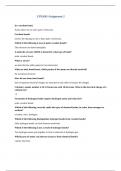
FIN2601 Assignment 2 In a covalent bond, Atoms share one or more pairs of electrons Covalent bonds: involve the sharing of one to three pairs of electrons. Which of the following is true of polar covalent bonds? The electrons are shared unequally A molecule of water (H2O) is formed by what type of bond? polar covalent bonds What is an ion? an atom that has either gained or lost electron(s) When an ionic bond forms, which part(s) of the atoms are directly involved? the outermost electrons How do ions form ionic bonds? Ions of opposite electrical charges are attracted to each other to balance the charges. Calcium's atomic number is 20. It forms ions with 18 electrons. What is the electrical charge of a calcium ion? +2 Formation of hydrogen bonds requires hydrogen atoms and what else? polar covalent bonds Which of the following correctly ranks the types of chemical bonds, in order, from strongest to weakest? covalent, ionic, hydrogen Which of the following distinguishes hydrogen bonds from covalent bonds? Only hydrogen bonds can form between molecules Which of the following is not a result of hydrogen bonds? Two hydrogen atoms join together to form a molecule of hydrogen gas. Which parts of atoms can interact (react) to form chemical bonds? valence electrons Atoms of oxygen have a total of 8 electrons. Are these atoms stable, and why or why not? No, because the atoms have only 6 valence electrons, but need 8 for stability. Carbon atoms have four valence electrons. Are they likely to react with other atoms, and why or why not? Yes, because they can become more stable by doing so. Which of the following is not produced through chemical bonding? atoms Which type(s) of subatomic particles can be located within the nucleus of an atom? protons and neutrons Which subatomic particles contribute to an atom's mass number but not its atomic number? neutrons An atom of oxygen has an atomic number of 8 and a mass number of 18. How many of each type of subatomic particle does it contain? 8 protons, 8 electrons, and 10 neutrons Drag the appropriate labels to their respective targets. 1.Transport work 2.Mechanical work 3.Chemical work Foods are broken down into their building blocks by adding water. This would be an example of which characteristic of water? Water acts as a reactant Water acts to dissolve molecules in the body. How does water dissolve the salt (NaCl) in your mouth from a salty pretzel? Water acts as a solvent because the partial negative charge on the oxygen in water attracts sodium, while the partial positive charge on hydrogen attracts chloride. This results in the separation of sodium from chloride, thus breaking the ionic bond. In plasma, a typical body fluid, protein floating around would be considered to be which of the following? a solute, specifically both a colloid and an electrolyte Electrolytes are charged particles called ions that are dissolved in body fluids. Which of the following ions would be considered a major anion in the body? chloride Which pH is more acidic, a pH of 3, a pH of 7, or a pH of 9? pH of 3 Cortisol is a type of lipid hormone. Which type of lipid would cortisol be classified as? Steroid.

Content preview

FIN2601 Assignment 2


In a covalent bond,
Atoms share one or more pairs of electrons
Covalent bonds:
involve the sharing of one to three pairs of electrons.
Which of the following is true of polar covalent bonds?
The electrons are shared unequally
A molecule of water (H2O) is formed by what type of bond?
polar covalent bonds
What is an ion?
an atom that has either gained or lost electron(s)
When an ionic bond forms, which part(s) of the atoms are directly involved?
the outermost electrons
How do ions form ionic bonds?
Ions of opposite electrical charges are attracted to each other to balance the charges.
Calcium's atomic number is 20. It forms ions with 18 electrons. What is the electrical charge of a
calcium ion?
+2
Formation of hydrogen bonds requires hydrogen atoms and what else?
polar covalent bonds
Which of the following correctly ranks the types of chemical bonds, in order, from strongest to
weakest?
covalent, ionic, hydrogen
Which of the following distinguishes hydrogen bonds from covalent bonds?
Only hydrogen bonds can form between molecules
Which of the following is not a result of hydrogen bonds?
Two hydrogen atoms join together to form a molecule of hydrogen gas.
Which parts of atoms can interact (react) to form chemical bonds?
valence electrons


Document information

Uploaded on
September 2, 2024
Number of pages
3
Written in
2024/2025
Type
Exam (elaborations)
Contains
Questions & answers
$7.79

Wrong document? Swap it for free Within 14 days of purchase and before downloading, you can choose a different document. You can simply spend the amount again.
Written by students who passed
Immediately available after payment
Read online or as PDF

Sold
6
Followers
5
Items
143
Last sold
1 year ago


Why students choose Stuvia

Created by fellow students, verified by reviews

Quality you can trust: written by students who passed their tests and reviewed by others who've used these notes.

Didn't get what you expected? Choose another document

No worries! You can instantly pick a different document that better fits what you're looking for.

Pay as you like, start learning right away

No subscription, no commitments. Pay the way you're used to via credit card and download your PDF document instantly.

Student with book image

“Bought, downloaded, and aced it. It really can be that simple.”

Alisha Student

Working on your references?

Create accurate citations in APA, MLA and Harvard with our free citation generator.

Working on your references?

Frequently asked questions
