
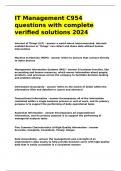
IT Management C954
questions with complete
verified solutions 2024
Internet of Things (IoT) - answer a world where interconnected, Internet-
enabled devices or "things" can collect and share data without human
intervention
Machine to Machine (M2M) - answer refers to devices that connect directly
to other devices
Management Information Systems (MIS) - answer A business function, like
accounting and human resources, which moves information about people,
products, and processes across the company to facilitate decision-making
and problem-solving
Information Granularity - answer refers to the extent of detail within the
information (fine and detailed or coarse and abstract)
Transactional Information - answer Encompasses all of the information
contained within a single business process or unit of work, and its primary
purpose is to support the performing of daily operational tasks
Analytical Information - answer Encompasses all organizational
information, and its primary purpose is to support the performing of
managerial analysis tasks
Five Common Characteristics of High-Quality Information - answer
Accurate, Complete, Consistent, Timely, Unique
data stewardship - answer the management and oversight of an
organization's data assets to help provide business users with high-quality
data that is easily accessible in a consistent manner
,data steward - answer responsible for ensuring the policies and
procedures are implemented across the organization and acts as a liaison
between the MIS department and the business
Data governance - answer refers to the overall management of the
availability, usability, integrity, and security of company data
Master data management (MDM) - answer the practice of gathering data
and ensuring that it is uniform, accurate, consistent, and complete,
including such entities as customers, suppliers, products, sales,
employees, and other critical entities that are commonly integrated across
organizational systems
Data Validation - answer includes the tests and evaluations used to
determine compliance with data governance policies to ensure correctness
of data
Database Management System (DBMS) - answer creates, reads, updates,
and deletes data in a database while controlling access and security
query-by-example (QBE) tool - answer helps users graphically design the
answer to a question against a database
Structured Query Language (SQL) - answer asks users to write lines of
code to answer questions against a database
data latency - answer the time it takes for data to be stored or retrieved
integrity constraints - answer rules that help ensure the quality of
information
relational integrity constraints - answer rules that enforce basic and
fundamental information-based constraints
,data-driven website - answer an interactive website kept constantly
updated and relevant to the needs of its customers using a database
static information - answer fixed data incapable of change in the event of
a user action
dynamic information - answer data that change based on user actions
Business-critical integrity constraints - answer enforce business rules vital
to an organization's success and often require more insight and
knowledge than relational integrity constraints
identity management - answer a broad administrative area that deals with
identifying individuals in a system (such as a country, a network, or an
enterprise) and controlling their access to resources within that system by
associating user rights and restrictions with the established identity
integration - answer Allows separate systems to communicate directly
with each other, eliminating the need for manual entry into multiple
systems
forward integration - answer takes information entered into a given
system and sends it automatically to all downstream systems and
processes
backward integration - answer takes information entered into a given
system and sends it automatically to all upstream systems and processes
distributed computing - answer processes and manages algorithms across
many machines in a computing environment
data mining - answer the process of analyzing data to extract information
not offered by the raw data alone
, data profiling - answer the process of collecting statistics and information
about data in an existing source
data replication - answer the process of sharing information to ensure
consistency between multiple data sources
estimation analysis - answer determines values for an unknown
continuous variable behavior or estimated future value
affinity grouping analysis - answer reveals the relationship between
variables along with the nature and frequency of the relationships
market basket analysis - answer evaluates such items as websites and
checkout scanner information to detect customers' buying behavior and
predict future behavior by identifying affinities among customers' choices
of products and services
cluster analysis - answer a technique used to divide an information set
into mutually exclusive groups such that the members of each group are
as close together as possible to one another and the different groups are
as far apart as possible
classification analysis - answer the process of organizing data into
categories or groups for its most effective and efficient use
data mining tools - answer use a variety of techniques to find patterns and
relationships in large volumes of information
fast data - answer the application of big data analytics to smaller data
sets in near-real or real-time in order to solve a problem or create
business value
infographics (information graphics) - answer presents the results of data
analysis, displaying the patterns, relationships, and trends in a graphical
format
questions with complete
verified solutions 2024
Internet of Things (IoT) - answer a world where interconnected, Internet-
enabled devices or "things" can collect and share data without human
intervention
Machine to Machine (M2M) - answer refers to devices that connect directly
to other devices
Management Information Systems (MIS) - answer A business function, like
accounting and human resources, which moves information about people,
products, and processes across the company to facilitate decision-making
and problem-solving
Information Granularity - answer refers to the extent of detail within the
information (fine and detailed or coarse and abstract)
Transactional Information - answer Encompasses all of the information
contained within a single business process or unit of work, and its primary
purpose is to support the performing of daily operational tasks
Analytical Information - answer Encompasses all organizational
information, and its primary purpose is to support the performing of
managerial analysis tasks
Five Common Characteristics of High-Quality Information - answer
Accurate, Complete, Consistent, Timely, Unique
data stewardship - answer the management and oversight of an
organization's data assets to help provide business users with high-quality
data that is easily accessible in a consistent manner
,data steward - answer responsible for ensuring the policies and
procedures are implemented across the organization and acts as a liaison
between the MIS department and the business
Data governance - answer refers to the overall management of the
availability, usability, integrity, and security of company data
Master data management (MDM) - answer the practice of gathering data
and ensuring that it is uniform, accurate, consistent, and complete,
including such entities as customers, suppliers, products, sales,
employees, and other critical entities that are commonly integrated across
organizational systems
Data Validation - answer includes the tests and evaluations used to
determine compliance with data governance policies to ensure correctness
of data
Database Management System (DBMS) - answer creates, reads, updates,
and deletes data in a database while controlling access and security
query-by-example (QBE) tool - answer helps users graphically design the
answer to a question against a database
Structured Query Language (SQL) - answer asks users to write lines of
code to answer questions against a database
data latency - answer the time it takes for data to be stored or retrieved
integrity constraints - answer rules that help ensure the quality of
information
relational integrity constraints - answer rules that enforce basic and
fundamental information-based constraints
,data-driven website - answer an interactive website kept constantly
updated and relevant to the needs of its customers using a database
static information - answer fixed data incapable of change in the event of
a user action
dynamic information - answer data that change based on user actions
Business-critical integrity constraints - answer enforce business rules vital
to an organization's success and often require more insight and
knowledge than relational integrity constraints
identity management - answer a broad administrative area that deals with
identifying individuals in a system (such as a country, a network, or an
enterprise) and controlling their access to resources within that system by
associating user rights and restrictions with the established identity
integration - answer Allows separate systems to communicate directly
with each other, eliminating the need for manual entry into multiple
systems
forward integration - answer takes information entered into a given
system and sends it automatically to all downstream systems and
processes
backward integration - answer takes information entered into a given
system and sends it automatically to all upstream systems and processes
distributed computing - answer processes and manages algorithms across
many machines in a computing environment
data mining - answer the process of analyzing data to extract information
not offered by the raw data alone
, data profiling - answer the process of collecting statistics and information
about data in an existing source
data replication - answer the process of sharing information to ensure
consistency between multiple data sources
estimation analysis - answer determines values for an unknown
continuous variable behavior or estimated future value
affinity grouping analysis - answer reveals the relationship between
variables along with the nature and frequency of the relationships
market basket analysis - answer evaluates such items as websites and
checkout scanner information to detect customers' buying behavior and
predict future behavior by identifying affinities among customers' choices
of products and services
cluster analysis - answer a technique used to divide an information set
into mutually exclusive groups such that the members of each group are
as close together as possible to one another and the different groups are
as far apart as possible
classification analysis - answer the process of organizing data into
categories or groups for its most effective and efficient use
data mining tools - answer use a variety of techniques to find patterns and
relationships in large volumes of information
fast data - answer the application of big data analytics to smaller data
sets in near-real or real-time in order to solve a problem or create
business value
infographics (information graphics) - answer presents the results of data
analysis, displaying the patterns, relationships, and trends in a graphical
format


