
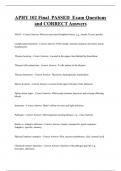
APHY 102 Final PASSED Exam Questions
and CORRECT Answers
MALT - Correct Answer- Mucosa-associated lymphoid tissue; e.g., tonsils, Peyer's patches
Lymph nodes functions - Correct Answer- Filter lymph, immune response activation, house
lymphocytes
Thymus location - Correct Answer- Located in the upper chest behind the breastbone
Thymus cells maturation - Correct Answer- T cells mature in the thymus
Thymus hormones - Correct Answer- Thymosin, thymopoietin, interleukins
Spleen location - Correct Answer- Located in the upper left part of the abdomen
Spleen tissue types - Correct Answer- White pulp (immune function) and red pulp (filtering
blood)
Immunity - Correct Answer- Body's ability to resist and fight infection
Pathogen - Correct Answer- Microorganism causing disease; e.g., virus, bacteria
Innate vs. Adaptive defenses - Correct Answer- Innate: nonspecific, quick response;
Adaptive: specific, memory
Physical barriers examples - Correct Answer- Skin, mucous membranes, cilia, stomach acid
Chemical barriers functions - Correct Answer- Interfere with pathogen growth; e.g.,
lysozyme, defensins
,Natural Killer cells - Correct Answer- Destroy infected and cancerous cells
Phagocytosis - Correct Answer- Engulfing and digesting pathogens; Neutrophils,
macrophages
Chemotaxis - Correct Answer- Movement of cells toward a chemical stimulus
Fever importance - Correct Answer- Slows pathogen growth, enhances immune response
Antigen vs. Antibody - Correct Answer- Antigen: foreign substance; Antibody: immune
protein
Cellular immune response - Correct Answer- T cells directly attack infected cells
Humoral immune response - Correct Answer- B cells produce antibodies to fight pathogens
Lymphocyte types - Correct Answer- B cells (bone marrow) and T cells (thymus); immune
response
Major histocompatibility complex - Correct Answer- Cell surface proteins for antigen
presentation
T cell types - Correct Answer- Helper T cells, Cytotoxic T cells, Memory T cells
B cell activation - Correct Answer- Antigen recognition, proliferation, differentiation
Memory B cells & Plasma cells - Correct Answer- Memory: long-term immunity; Plasma:
produce antibodies
Immunoglobulins types - Correct Answer- IgG, IgA, IgM, IgE, IgD; various immune
functions
, Negative feedback - Correct Answer- Regulatory process where a change in a physiological
variable triggers responses that reverse the change
Positive feedback - Correct Answer- Process that amplifies or increases the change that is
occurring
Releasing hormones - Correct Answer- Secreted by the hypothalamus to stimulate the release
of hormones from the anterior pituitary gland
Stimulating or tropic hormones - Correct Answer- Hormones that stimulate other endocrine
glands to release their hormones
Anterior pituitary gland - Correct Answer- Secretes hormones like growth hormone and
prolactin, regulated by hypothalamic hormones
Posterior pituitary gland - Correct Answer- Stores and releases hormones oxytocin and
antidiuretic hormone made in the hypothalamus
Growth Hormone - Correct Answer- Secreted by the anterior pituitary, stimulates growth and
cell reproduction
Prolactin - Correct Answer- Anterior pituitary hormone that stimulates milk production
Thyroxine (T4) - Correct Answer- Thyroid hormone that regulates metabolism
Triiodothyronine (T3) - Correct Answer- Thyroid hormone that regulates metabolism
Calcitonin - Correct Answer- Hormone that lowers blood calcium levels
Parathyroid hormone - Correct Answer- Hormone that raises blood calcium levels
Epinephrine - Correct Answer- Hormone released by the adrenal medulla in response to stress
and CORRECT Answers
MALT - Correct Answer- Mucosa-associated lymphoid tissue; e.g., tonsils, Peyer's patches
Lymph nodes functions - Correct Answer- Filter lymph, immune response activation, house
lymphocytes
Thymus location - Correct Answer- Located in the upper chest behind the breastbone
Thymus cells maturation - Correct Answer- T cells mature in the thymus
Thymus hormones - Correct Answer- Thymosin, thymopoietin, interleukins
Spleen location - Correct Answer- Located in the upper left part of the abdomen
Spleen tissue types - Correct Answer- White pulp (immune function) and red pulp (filtering
blood)
Immunity - Correct Answer- Body's ability to resist and fight infection
Pathogen - Correct Answer- Microorganism causing disease; e.g., virus, bacteria
Innate vs. Adaptive defenses - Correct Answer- Innate: nonspecific, quick response;
Adaptive: specific, memory
Physical barriers examples - Correct Answer- Skin, mucous membranes, cilia, stomach acid
Chemical barriers functions - Correct Answer- Interfere with pathogen growth; e.g.,
lysozyme, defensins
,Natural Killer cells - Correct Answer- Destroy infected and cancerous cells
Phagocytosis - Correct Answer- Engulfing and digesting pathogens; Neutrophils,
macrophages
Chemotaxis - Correct Answer- Movement of cells toward a chemical stimulus
Fever importance - Correct Answer- Slows pathogen growth, enhances immune response
Antigen vs. Antibody - Correct Answer- Antigen: foreign substance; Antibody: immune
protein
Cellular immune response - Correct Answer- T cells directly attack infected cells
Humoral immune response - Correct Answer- B cells produce antibodies to fight pathogens
Lymphocyte types - Correct Answer- B cells (bone marrow) and T cells (thymus); immune
response
Major histocompatibility complex - Correct Answer- Cell surface proteins for antigen
presentation
T cell types - Correct Answer- Helper T cells, Cytotoxic T cells, Memory T cells
B cell activation - Correct Answer- Antigen recognition, proliferation, differentiation
Memory B cells & Plasma cells - Correct Answer- Memory: long-term immunity; Plasma:
produce antibodies
Immunoglobulins types - Correct Answer- IgG, IgA, IgM, IgE, IgD; various immune
functions
, Negative feedback - Correct Answer- Regulatory process where a change in a physiological
variable triggers responses that reverse the change
Positive feedback - Correct Answer- Process that amplifies or increases the change that is
occurring
Releasing hormones - Correct Answer- Secreted by the hypothalamus to stimulate the release
of hormones from the anterior pituitary gland
Stimulating or tropic hormones - Correct Answer- Hormones that stimulate other endocrine
glands to release their hormones
Anterior pituitary gland - Correct Answer- Secretes hormones like growth hormone and
prolactin, regulated by hypothalamic hormones
Posterior pituitary gland - Correct Answer- Stores and releases hormones oxytocin and
antidiuretic hormone made in the hypothalamus
Growth Hormone - Correct Answer- Secreted by the anterior pituitary, stimulates growth and
cell reproduction
Prolactin - Correct Answer- Anterior pituitary hormone that stimulates milk production
Thyroxine (T4) - Correct Answer- Thyroid hormone that regulates metabolism
Triiodothyronine (T3) - Correct Answer- Thyroid hormone that regulates metabolism
Calcitonin - Correct Answer- Hormone that lowers blood calcium levels
Parathyroid hormone - Correct Answer- Hormone that raises blood calcium levels
Epinephrine - Correct Answer- Hormone released by the adrenal medulla in response to stress


