

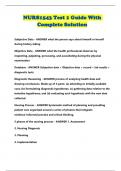
NURS1543 Test 1 Guide With
Complete Solution
Subjective Data - ANSWER what the person says about himself or herself
during history taking
Objective Data - ANSWER what the health professional observes by
inspecting, palpating, percussing, and auscultating during the physical
examination
Database - ANSWER Subjective data + Objective data + record + lab results +
diagnostic tests
Diagnostic Reasoning - ANSWER process of analyzing health data and
drawing conclusions. Made up of 4 parts: (a) attending to initially available
cues; (b) formulating diagnostic hypotheses; (c) gathering data relative to the
tentative hypotheses; and (d) evaluating each hypothesis with the new data
collected
Nursing Process - ANSWER Systematic method of planning and providing
patient care organized around a series of phrases that integrate
evidence-informed practice and critical thinking.
5 phases of the nursing process - ANSWER 1. Assessment
2. Nursing Diagnosis
3. Planning
4. Implementation
,5. Evaluation
First-level priority problems - ANSWER emergent, life-threatening, and
immediate, such as establishing an airway or supporting breathing
Second-level priority problems - ANSWER those that are next in urgency
requiring your prompt intervention to forestall further deterioration. (mental
status change, acute pain, acute urinary elimination problem, untreated
medical problems, abnormal lab test results)
Third-level priority problems - ANSWER those that are important to the
patient's health but can be addressed after more urgent health problems are
addressed. (Knowledge deficit, altered family processes, and low self esteem)
Collaborative problems - ANSWER approach to treatment involves multiple
disciplines
Evidence-informed practice - ANSWER a paradigm and life-long problem
solving approach to clinical decision-making that involves the conscientious
use of the best available evidence (including a systematic search for and
critical appraisal of the most relevant evidence to answer a clinical question)
with one's own clinical expertise and patient values and preferences to
improve outcomes for individuals, groups, communities, and systems
Biomedical model of health - ANSWER Predominant model of the Canadian
health care system, health is the absence of disease.
Health and disease are viewed as two ends of a continuum. Disease is
assumed to be caused by specific agents or pathogens. Thus the biomedical
focus is the diagnosis and treatment of those pathogens and the curing of
,disease.
Behavioural Model of Health - ANSWER health care extends beyond treating
disease to include secondary and primary preventions, with emphasis on
changing behaviours and lifestyles
Socioenvironmental Model of Health - ANSWER incorporates sociological
and environmental aspects in addition to the biomedical and behavioural
ones.
Relational Approach in Nursing Practice - ANSWER accounts for the fact that
health, illness, and the meanings they hold for a person are shaped by the
person's social, cultural, family, historical, and geographical contexts, as well
as the person's gender, age, ability, and other individual contexts. Focuses
nurses' attention on what is significant to people in the context of their
everyday lives and how capacities and socioenvironmental limitations shape
people's choices.
Complete (Total Health) Database - ANSWER Includes complete health
history and full physical examination
Describes current and past health state and forms baseline to measure all
future changes
Yields first diagnoses
, episodic/problem centered database - ANSWER limited, or short term
problem
- collect a "mini" database, smaller in scope and more targeted.
Follow-up database - ANSWER used in all settings to monitor progress of
short-term or chronic health problems. Evaluated the status of identified
problems
Emergency database - ANSWER rapid collection of the database, often
compiled concurrently with lifesaving measures
Periodic Health Examinations - ANSWER Designed to prevent morbidity and
mortality but identifying modifiable risk factors and early signs of treatable
conditions
primary prevention - ANSWER People and populations are prevented from
becoming ill, sick, or injured in the first place
secondary prevention - ANSWER early detection and treatment of disease
tertiary prevention - ANSWER prevention of complications from an existing
Complete Solution
Subjective Data - ANSWER what the person says about himself or herself
during history taking
Objective Data - ANSWER what the health professional observes by
inspecting, palpating, percussing, and auscultating during the physical
examination
Database - ANSWER Subjective data + Objective data + record + lab results +
diagnostic tests
Diagnostic Reasoning - ANSWER process of analyzing health data and
drawing conclusions. Made up of 4 parts: (a) attending to initially available
cues; (b) formulating diagnostic hypotheses; (c) gathering data relative to the
tentative hypotheses; and (d) evaluating each hypothesis with the new data
collected
Nursing Process - ANSWER Systematic method of planning and providing
patient care organized around a series of phrases that integrate
evidence-informed practice and critical thinking.
5 phases of the nursing process - ANSWER 1. Assessment
2. Nursing Diagnosis
3. Planning
4. Implementation
,5. Evaluation
First-level priority problems - ANSWER emergent, life-threatening, and
immediate, such as establishing an airway or supporting breathing
Second-level priority problems - ANSWER those that are next in urgency
requiring your prompt intervention to forestall further deterioration. (mental
status change, acute pain, acute urinary elimination problem, untreated
medical problems, abnormal lab test results)
Third-level priority problems - ANSWER those that are important to the
patient's health but can be addressed after more urgent health problems are
addressed. (Knowledge deficit, altered family processes, and low self esteem)
Collaborative problems - ANSWER approach to treatment involves multiple
disciplines
Evidence-informed practice - ANSWER a paradigm and life-long problem
solving approach to clinical decision-making that involves the conscientious
use of the best available evidence (including a systematic search for and
critical appraisal of the most relevant evidence to answer a clinical question)
with one's own clinical expertise and patient values and preferences to
improve outcomes for individuals, groups, communities, and systems
Biomedical model of health - ANSWER Predominant model of the Canadian
health care system, health is the absence of disease.
Health and disease are viewed as two ends of a continuum. Disease is
assumed to be caused by specific agents or pathogens. Thus the biomedical
focus is the diagnosis and treatment of those pathogens and the curing of
,disease.
Behavioural Model of Health - ANSWER health care extends beyond treating
disease to include secondary and primary preventions, with emphasis on
changing behaviours and lifestyles
Socioenvironmental Model of Health - ANSWER incorporates sociological
and environmental aspects in addition to the biomedical and behavioural
ones.
Relational Approach in Nursing Practice - ANSWER accounts for the fact that
health, illness, and the meanings they hold for a person are shaped by the
person's social, cultural, family, historical, and geographical contexts, as well
as the person's gender, age, ability, and other individual contexts. Focuses
nurses' attention on what is significant to people in the context of their
everyday lives and how capacities and socioenvironmental limitations shape
people's choices.
Complete (Total Health) Database - ANSWER Includes complete health
history and full physical examination
Describes current and past health state and forms baseline to measure all
future changes
Yields first diagnoses
, episodic/problem centered database - ANSWER limited, or short term
problem
- collect a "mini" database, smaller in scope and more targeted.
Follow-up database - ANSWER used in all settings to monitor progress of
short-term or chronic health problems. Evaluated the status of identified
problems
Emergency database - ANSWER rapid collection of the database, often
compiled concurrently with lifesaving measures
Periodic Health Examinations - ANSWER Designed to prevent morbidity and
mortality but identifying modifiable risk factors and early signs of treatable
conditions
primary prevention - ANSWER People and populations are prevented from
becoming ill, sick, or injured in the first place
secondary prevention - ANSWER early detection and treatment of disease
tertiary prevention - ANSWER prevention of complications from an existing


