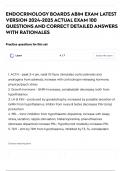
ENDOCRINOLOGY BOARDS ABIM EXAM LATEST
VERSION 2024-2025 ACTUAL EXAM 100
QUESTIONS AND CORRECT DETAILED ANSWERS
WITH RATIONALES
Practice questions for this set
Learn 4 /7 Study with Learn
1. ACTH - peak 3-4 am, nadir 10-11pm; stimulates corticosteroids and
androgens from adrenals; increase with corticotropin releasing hormone,
physical/psych stress
2. Growth hormone - GHRH increases, somatastatin decreases, both from
hypothalamus
3. LH & FSH - produced by gonadotrophs; increased by pulsatile secretion of
GnRH from hypothalamus; Inhibin from ovary & testes decreases FSH (only)
production
4. PRL - tonic inhibition from hypothalamic dopamine; increase with sleep,
stress, lactation, nipple stimulation; Metaclopramine, phenothiazines
(decrease dopamine) increase PRL; Hypothyroid modestly increases PRL
5. TSH - stim by TRH from hypothalamus, inhibited by T3, T4, somatastatin
Choose matching term
, Anterior pituitary - hormones and 2 Mass effect sx of pituitary mass
1
controls (6 hormones)
3 Growth hormone regulation 4 Hypoglycemia
Don't know?
Terms in this set (140)
Primary - problem with the gland that secretes the
hormone (ie: thyroid doesn't produce thyroid hormone)
Secondary - problem is the gland that controls the
What are primary, primary gland (ie. pituitary doesn't produce TSH to
secondary, and tertiary stimulate the thyroid)
disease? Tertiary - problem with the gland that controls the
secondary gland that controls the primary gland (ie.
hypothalamus not producing TRH ->no TSH from
pituitary -> no T3/T4 from thyroid)
How does the Controls the anterior pituitary via hormones
hypothalamus control the Controls the posterior pituitary via neurohypophysis -
pituitary? direct nerve stimulation
Posterior pituitary functions Secrete ADH and oxytocin
Anterior pituitary - osmoreceptors to control ADH
release and thirst
Increased release rapidly with elevated osmolarity
Also see increased release with nausea
ADH regulation ADH osmolar release set point is affected by:
Lower set point (release at lower osm) with pregnancy
and pre-menses
Higher set point with chronic hypovolemia, acute HTN,
corticosteroids
, 1. ACTH - peak 3-4 am, nadir 10-11pm; stimulates
corticosteroids and androgens from adrenals; increase
with corticotropin releasing hormone, physical/psych
stress
2. Growth hormone - GHRH increases, somatastatin
decreases, both from hypothalamus
Anterior pituitary - 3. LH & FSH - produced by gonadotrophs; increased by
hormones and controls (6 pulsatile secretion of GnRH from hypothalamus; Inhibin
hormones) from ovary & testes decreases FSH (only) production
4. PRL - tonic inhibition from hypothalamic dopamine;
increase with sleep, stress, lactation, nipple stimulation;
Metaclopramine, phenothiazines (decrease dopamine)
increase PRL; Hypothyroid modestly increases PRL
5. TSH - stim by TRH from hypothalamus, inhibited by T3,
T4, somatastatin
1. Lactotrophs - secrete PRL; tied, most common
macroademona
2. Gonadotrophs -tied, most common macroademona;
presents as mass effect +/- silent or panhypopit or
Pituitary adenoma cell gonadotropin hypersecretion
types 3. Somatotrophs- acromegaly
4. Corticotrophs - cushings
5. Thyrotrophs - hyperthyroidism (least common)
6. Mixed (somatotrophs+lactotrophs) - acromegaly +
hyperPRL
Mass effect sx of pituitary HA, diplopia, visual field defect, seizures; occasionally
mass can get CNS rhinorrhea
VERSION 2024-2025 ACTUAL EXAM 100
QUESTIONS AND CORRECT DETAILED ANSWERS
WITH RATIONALES
Practice questions for this set
Learn 4 /7 Study with Learn
1. ACTH - peak 3-4 am, nadir 10-11pm; stimulates corticosteroids and
androgens from adrenals; increase with corticotropin releasing hormone,
physical/psych stress
2. Growth hormone - GHRH increases, somatastatin decreases, both from
hypothalamus
3. LH & FSH - produced by gonadotrophs; increased by pulsatile secretion of
GnRH from hypothalamus; Inhibin from ovary & testes decreases FSH (only)
production
4. PRL - tonic inhibition from hypothalamic dopamine; increase with sleep,
stress, lactation, nipple stimulation; Metaclopramine, phenothiazines
(decrease dopamine) increase PRL; Hypothyroid modestly increases PRL
5. TSH - stim by TRH from hypothalamus, inhibited by T3, T4, somatastatin
Choose matching term
, Anterior pituitary - hormones and 2 Mass effect sx of pituitary mass
1
controls (6 hormones)
3 Growth hormone regulation 4 Hypoglycemia
Don't know?
Terms in this set (140)
Primary - problem with the gland that secretes the
hormone (ie: thyroid doesn't produce thyroid hormone)
Secondary - problem is the gland that controls the
What are primary, primary gland (ie. pituitary doesn't produce TSH to
secondary, and tertiary stimulate the thyroid)
disease? Tertiary - problem with the gland that controls the
secondary gland that controls the primary gland (ie.
hypothalamus not producing TRH ->no TSH from
pituitary -> no T3/T4 from thyroid)
How does the Controls the anterior pituitary via hormones
hypothalamus control the Controls the posterior pituitary via neurohypophysis -
pituitary? direct nerve stimulation
Posterior pituitary functions Secrete ADH and oxytocin
Anterior pituitary - osmoreceptors to control ADH
release and thirst
Increased release rapidly with elevated osmolarity
Also see increased release with nausea
ADH regulation ADH osmolar release set point is affected by:
Lower set point (release at lower osm) with pregnancy
and pre-menses
Higher set point with chronic hypovolemia, acute HTN,
corticosteroids
, 1. ACTH - peak 3-4 am, nadir 10-11pm; stimulates
corticosteroids and androgens from adrenals; increase
with corticotropin releasing hormone, physical/psych
stress
2. Growth hormone - GHRH increases, somatastatin
decreases, both from hypothalamus
Anterior pituitary - 3. LH & FSH - produced by gonadotrophs; increased by
hormones and controls (6 pulsatile secretion of GnRH from hypothalamus; Inhibin
hormones) from ovary & testes decreases FSH (only) production
4. PRL - tonic inhibition from hypothalamic dopamine;
increase with sleep, stress, lactation, nipple stimulation;
Metaclopramine, phenothiazines (decrease dopamine)
increase PRL; Hypothyroid modestly increases PRL
5. TSH - stim by TRH from hypothalamus, inhibited by T3,
T4, somatastatin
1. Lactotrophs - secrete PRL; tied, most common
macroademona
2. Gonadotrophs -tied, most common macroademona;
presents as mass effect +/- silent or panhypopit or
Pituitary adenoma cell gonadotropin hypersecretion
types 3. Somatotrophs- acromegaly
4. Corticotrophs - cushings
5. Thyrotrophs - hyperthyroidism (least common)
6. Mixed (somatotrophs+lactotrophs) - acromegaly +
hyperPRL
Mass effect sx of pituitary HA, diplopia, visual field defect, seizures; occasionally
mass can get CNS rhinorrhea