
OCR A Level Biology A - Chapter 22 Cloning and Biotechnology
Study online at https://quizlet.com/_ep2liz
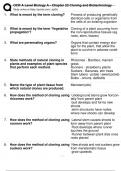
1. What is meant by the term cloning? Process of producing genetically
identical cells or organisms from
the cells of an existing organism
2. What is meant by the term 'Vegetative Cloning of a plant occurring from
propagation'? the non-reproductive tissues (eg.
roots, stem, leaves)
3. What are perennating organs? Organs that contain energy stor-
age for the plant, that allow the
plant to survive in adverse condi-
tions
4. State methods of natural cloning in Rhizomes - Bamboo, marram
plants and examples of plant species grass
that perform each method. Runners - strawberry plants
Suckers - Bananas, elm trees
Stem tubers - potato / sweet potato
Bulbs - onions, daffodils
5. Name the type of plant tissue from Meristem(atic)
which natural clones are produced.
6. How does the method of cloning using Underground stems grow horizon-
rhizomes work? tally from parent plant
bud develops and forms new
shoots
stem structures have nodes
where new shoots can develop
7. How does the method of cloning using Lateral stem causes shoots to
runners work? form away from parent plant
Root develops where runner
touches the ground
Runner between plant dies once
roots placed
8. How does the method of cloning using New shoots and root suckers grow
suckers work? from meristematic tissue
grow upwards
, OCR A Level Biology A - Chapter 22 Cloning and Biotechnology
Study online at https://quizlet.com/_ep2liz
9. How does the method of cloning using large underground stems acting
stem tubers work? as perennating organs
covered in dimples that sprout to
form new plant
10. How does the method of cloning using Leaf bases swell with nutrients
bulbs work? develop into new plants
11. Describe how to clone a plant by taking use a healthy, non-flowering shoot
a cutting cut (stem) at a slant / oblique cut;
(dip in) rooting powder / plant hor-
mone / auxin ;
place in , soil / compost , and add
water ;
(to reduce transpiration) cover
with plastic bag / remove some
leaves
12. Why is a non-flowering stem used Puts all energy into the root devel-
when taking a cutting? opment rather than flowering
13. Why is an oblique cut performed when Maximum surface area exposed to
taking a cutting? auxin as maximum surface area
for root development
14. When taking the plant cutting, why Increase humidity, so reduced dif-
should you cover the plant with a plas- fusion gradient of water, so min-
tic bag? imised loss of water vapour
15. Identify three advantages and one dis- ADVANTAGES
advantage of vegetative propagation of some crop plants can reproduce
agriculture sexually (so can use vegetative
propagation)
quicker than growing from seed
propagation can be done at any
time of year
always get a good yield with de-
sireable quality
, OCR A Level Biology A - Chapter 22 Cloning and Biotechnology
Study online at https://quizlet.com/_ep2liz
DISADVANTAGE
less genetic variation, as no sex-
ual reproduction, so susceptible to
new diseases
16. What is meant by the micropropaga- The process of making large num-
tion? bers of genetically identical plants
by using tissue culture
17. Why is it important that micropropaga- reduces contamination by mi-
tion is carried out under aseptic condi- croorganisms
tions?
18. Describe the process of micropropaga- take explants from shoot tip of
tion (5) parent plant
sterilise explant from with alcohol
/ sodium hypochlorite
place explants on agar
growth medium containing glu-
cose, amino acids and high auxin
and cytokinin concentration
subdivide callus and transfer to
new culture medium and plantlets
formed and subdivided to soil
aspetic conditions
19. List advantages and disadvantages of ADVANTAGES
cloning plants by tissue culture rapid
desireable, predictable character-
istics
can be transported easily / grown
in less space
can save rare species of plant
from extinction
DISADVANTAGES
expensive process, due to high
production cost and complex as-
petic procedures
little genetic variation so all off-
Study online at https://quizlet.com/_ep2liz
1. What is meant by the term cloning? Process of producing genetically
identical cells or organisms from
the cells of an existing organism
2. What is meant by the term 'Vegetative Cloning of a plant occurring from
propagation'? the non-reproductive tissues (eg.
roots, stem, leaves)
3. What are perennating organs? Organs that contain energy stor-
age for the plant, that allow the
plant to survive in adverse condi-
tions
4. State methods of natural cloning in Rhizomes - Bamboo, marram
plants and examples of plant species grass
that perform each method. Runners - strawberry plants
Suckers - Bananas, elm trees
Stem tubers - potato / sweet potato
Bulbs - onions, daffodils
5. Name the type of plant tissue from Meristem(atic)
which natural clones are produced.
6. How does the method of cloning using Underground stems grow horizon-
rhizomes work? tally from parent plant
bud develops and forms new
shoots
stem structures have nodes
where new shoots can develop
7. How does the method of cloning using Lateral stem causes shoots to
runners work? form away from parent plant
Root develops where runner
touches the ground
Runner between plant dies once
roots placed
8. How does the method of cloning using New shoots and root suckers grow
suckers work? from meristematic tissue
grow upwards
, OCR A Level Biology A - Chapter 22 Cloning and Biotechnology
Study online at https://quizlet.com/_ep2liz
9. How does the method of cloning using large underground stems acting
stem tubers work? as perennating organs
covered in dimples that sprout to
form new plant
10. How does the method of cloning using Leaf bases swell with nutrients
bulbs work? develop into new plants
11. Describe how to clone a plant by taking use a healthy, non-flowering shoot
a cutting cut (stem) at a slant / oblique cut;
(dip in) rooting powder / plant hor-
mone / auxin ;
place in , soil / compost , and add
water ;
(to reduce transpiration) cover
with plastic bag / remove some
leaves
12. Why is a non-flowering stem used Puts all energy into the root devel-
when taking a cutting? opment rather than flowering
13. Why is an oblique cut performed when Maximum surface area exposed to
taking a cutting? auxin as maximum surface area
for root development
14. When taking the plant cutting, why Increase humidity, so reduced dif-
should you cover the plant with a plas- fusion gradient of water, so min-
tic bag? imised loss of water vapour
15. Identify three advantages and one dis- ADVANTAGES
advantage of vegetative propagation of some crop plants can reproduce
agriculture sexually (so can use vegetative
propagation)
quicker than growing from seed
propagation can be done at any
time of year
always get a good yield with de-
sireable quality
, OCR A Level Biology A - Chapter 22 Cloning and Biotechnology
Study online at https://quizlet.com/_ep2liz
DISADVANTAGE
less genetic variation, as no sex-
ual reproduction, so susceptible to
new diseases
16. What is meant by the micropropaga- The process of making large num-
tion? bers of genetically identical plants
by using tissue culture
17. Why is it important that micropropaga- reduces contamination by mi-
tion is carried out under aseptic condi- croorganisms
tions?
18. Describe the process of micropropaga- take explants from shoot tip of
tion (5) parent plant
sterilise explant from with alcohol
/ sodium hypochlorite
place explants on agar
growth medium containing glu-
cose, amino acids and high auxin
and cytokinin concentration
subdivide callus and transfer to
new culture medium and plantlets
formed and subdivided to soil
aspetic conditions
19. List advantages and disadvantages of ADVANTAGES
cloning plants by tissue culture rapid
desireable, predictable character-
istics
can be transported easily / grown
in less space
can save rare species of plant
from extinction
DISADVANTAGES
expensive process, due to high
production cost and complex as-
petic procedures
little genetic variation so all off-


