
WGU D199- Geography Study
Study online at https://quizlet.com/_eqguvw
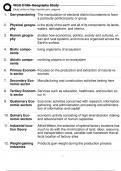
1. Gerrymandering The manipulation of electoral district boundaries to favor
a particular political party or group
2. Physical geogra- is the study of the earth and all of its components: its lands,
phy waters, atmosphere, and interior.
3. Human geogra- studies how economics, politics, society and cultures, ur-
phy ban and rural systems, and more are organized across the
Earth's surface.
4. Biotic compo- living organisms of ecosystem
nents
5. Abiotic compo- nonliving players in an ecosystem
nents
6. Primary Econom- Focuses on the production and extraction of natural re-
ic sector sources
7. Secondary Eco- Manufacturing and construction activities belong here
nomic sector
8. Tertiary Econom- Services such as education, healthcare, and tourism oc-
ic sector cur in
9. Quaternary Eco- Economic activities concerned with research, information
nomic sectors gathering, and administration; processing and administra-
tion of information and capital
10. Quinary Eco- economic activity consisting of high-level decision making
nomic sectors and advancement of human capacities
11. Industrial loca- Alfred Weber, the selection of optimal factory locations has
tion theory much to do with the minimization of land, labor, resource,
and transportation costs, variable-cost framework that af-
fects location of factory sites
12. Weight-gaining Products gain weight during the production process
industries
1/6
, WGU D199- Geography Study
Study online at https://quizlet.com/_eqguvw
13. Weight-losing in- Products loose weight during the production process
dustries
14. Agglomeration The concentration of similar industries in a particular city
or region
15. Territoriality The rules governing who has access to a particular space
and what happens in that space
16. Organic state theory views the state as a living organism, with its parts
theory functioning together for the well-being of the whole
17. Heartland theory geopolitical concept is associated with the idea of a central
landmass as the key to global power
18. Rimland theory theory emphasizes the significance of coastal areas and
peripheral regions
19. Shape of states have relatively equal distances from their center to any
Compact boundary, much like a circle. They are often regarded as
efficient states.
20. Shape of states have a long and narrow shape. The major problem with
Elongated these states is with internal communication, which causes
isolation of towns from the capital city
21. Shape of states Have other state territories or states within them.
Prorupted
22. Perforated State A state whose territory completely surrounds another
state
23. Fragmented A state that includes several discontinuous pieces of terri-
State tory.
24. Shape of states Lack a direct outlet to a major body of water, such as a sea
Landlocked or
ocean. This becomes problematic for exporting and im-
porting and can hinder a state's economy.
2/6
Study online at https://quizlet.com/_eqguvw
1. Gerrymandering The manipulation of electoral district boundaries to favor
a particular political party or group
2. Physical geogra- is the study of the earth and all of its components: its lands,
phy waters, atmosphere, and interior.
3. Human geogra- studies how economics, politics, society and cultures, ur-
phy ban and rural systems, and more are organized across the
Earth's surface.
4. Biotic compo- living organisms of ecosystem
nents
5. Abiotic compo- nonliving players in an ecosystem
nents
6. Primary Econom- Focuses on the production and extraction of natural re-
ic sector sources
7. Secondary Eco- Manufacturing and construction activities belong here
nomic sector
8. Tertiary Econom- Services such as education, healthcare, and tourism oc-
ic sector cur in
9. Quaternary Eco- Economic activities concerned with research, information
nomic sectors gathering, and administration; processing and administra-
tion of information and capital
10. Quinary Eco- economic activity consisting of high-level decision making
nomic sectors and advancement of human capacities
11. Industrial loca- Alfred Weber, the selection of optimal factory locations has
tion theory much to do with the minimization of land, labor, resource,
and transportation costs, variable-cost framework that af-
fects location of factory sites
12. Weight-gaining Products gain weight during the production process
industries
1/6
, WGU D199- Geography Study
Study online at https://quizlet.com/_eqguvw
13. Weight-losing in- Products loose weight during the production process
dustries
14. Agglomeration The concentration of similar industries in a particular city
or region
15. Territoriality The rules governing who has access to a particular space
and what happens in that space
16. Organic state theory views the state as a living organism, with its parts
theory functioning together for the well-being of the whole
17. Heartland theory geopolitical concept is associated with the idea of a central
landmass as the key to global power
18. Rimland theory theory emphasizes the significance of coastal areas and
peripheral regions
19. Shape of states have relatively equal distances from their center to any
Compact boundary, much like a circle. They are often regarded as
efficient states.
20. Shape of states have a long and narrow shape. The major problem with
Elongated these states is with internal communication, which causes
isolation of towns from the capital city
21. Shape of states Have other state territories or states within them.
Prorupted
22. Perforated State A state whose territory completely surrounds another
state
23. Fragmented A state that includes several discontinuous pieces of terri-
State tory.
24. Shape of states Lack a direct outlet to a major body of water, such as a sea
Landlocked or
ocean. This becomes problematic for exporting and im-
porting and can hinder a state's economy.
2/6


