Test bank
,FULLTESTBANK
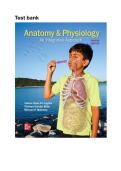
ANATOMY & PHYSIOLOGY: AN INTEGRATIVE APPROACH
4TH EDITION
Michael McKinley
Valerie O’Loughlin
Theresa Bidle
Test Bank with Answer Key
ISBN-10: 1260265218
ISBN-13: 9781260265217
TABLE OF CONTENTS
Chapter 1. The Sciences of Anatomy and Physiology
Chapter 2. Atoms, Ions, and Molecules
Chapter 3. Energy, Chemical Reactions, and Cellular Respiration
Chapter 4. Biology of the Cell
Chapter 5. Tissue Organization
Chapter 6. Integumentary System
Chapter 7. Skeletal System: Bone Structure and Function
Chapter 8. Skeletal System: Axial and Appendicular Skeleton
Chapter 9. Skeletal System: Articulations
Chapter 10. Muscle Tissue
Chapter 11. Muscular System: Axial and Appendicular Muscles
Chapter 12. Nervous System: Nervous Tissue
Chapter 13. Nervous System: Brain and Cranial Nerves
Chapter 14. Nervous System: Spinal Cord and Spinal Nerves
,Chapter 15. Nervous System: Autonomic Nervous System
Chapter 16. Nervous System: Senses
Chapter 17. Endocrine System
Chapter 18. Cardiovascular System: Blood
Chapter 19. Cardiovascular System: Heart
Chapter 20. Cardiovascular System: Vessels and Circulation
Chapter 21. Lymphatic System
Chapter 22. The Immune System and the Body’s Defense
Chapter 23. Respiratory System
Chapter 24. Urinary System
Chapter 25. Fluid and Electrolytes
Chapter 26. Digestive System
Chapter 27. Nutrition and Metabolism
Chapter 28. Reproductive System
Chapter 29. Development, Pregnancy, and Heredity
, Chapter 01
The Sciences of Anatomy and Physiology
Multiple choice:
1) If a scientist forms and tests a hypothesis, but gets unexpected results, what is a logical
next step? Check all that apply.
A) Accept the original hypothesis
B) Reject the original hypothesis
C) Revise the original hypothesis
D) Design a new experiment based on a new or modified hypothesis.
2) Some researchers think pheromones are important tools in human communication.
Pheromones are chemical signals that one individual sends to another. What research questions
might be asked by anatomists, and what questions might be asked by physiologists, to determine
if pheromones are important to humans?
3) Iron atoms help our blood transport oxygen. Describe each level of anatomical structural
complexity for an iron atom in your blood, working from the simplest level (atom) to the most
complex (organism).
,FULLTESTBANK
ANATOMY & PHYSIOLOGY: AN INTEGRATIVE APPROACH
4TH EDITION
Michael McKinley
Valerie O’Loughlin
Theresa Bidle
Test Bank with Answer Key
ISBN-10: 1260265218
ISBN-13: 9781260265217
TABLE OF CONTENTS
Chapter 1. The Sciences of Anatomy and Physiology
Chapter 2. Atoms, Ions, and Molecules
Chapter 3. Energy, Chemical Reactions, and Cellular Respiration
Chapter 4. Biology of the Cell
Chapter 5. Tissue Organization
Chapter 6. Integumentary System
Chapter 7. Skeletal System: Bone Structure and Function
Chapter 8. Skeletal System: Axial and Appendicular Skeleton
Chapter 9. Skeletal System: Articulations
Chapter 10. Muscle Tissue
Chapter 11. Muscular System: Axial and Appendicular Muscles
Chapter 12. Nervous System: Nervous Tissue
Chapter 13. Nervous System: Brain and Cranial Nerves
Chapter 14. Nervous System: Spinal Cord and Spinal Nerves
,Chapter 15. Nervous System: Autonomic Nervous System
Chapter 16. Nervous System: Senses
Chapter 17. Endocrine System
Chapter 18. Cardiovascular System: Blood
Chapter 19. Cardiovascular System: Heart
Chapter 20. Cardiovascular System: Vessels and Circulation
Chapter 21. Lymphatic System
Chapter 22. The Immune System and the Body’s Defense
Chapter 23. Respiratory System
Chapter 24. Urinary System
Chapter 25. Fluid and Electrolytes
Chapter 26. Digestive System
Chapter 27. Nutrition and Metabolism
Chapter 28. Reproductive System
Chapter 29. Development, Pregnancy, and Heredity
, Chapter 01
The Sciences of Anatomy and Physiology
Multiple choice:
1) If a scientist forms and tests a hypothesis, but gets unexpected results, what is a logical
next step? Check all that apply.
A) Accept the original hypothesis
B) Reject the original hypothesis
C) Revise the original hypothesis
D) Design a new experiment based on a new or modified hypothesis.
2) Some researchers think pheromones are important tools in human communication.
Pheromones are chemical signals that one individual sends to another. What research questions
might be asked by anatomists, and what questions might be asked by physiologists, to determine
if pheromones are important to humans?
3) Iron atoms help our blood transport oxygen. Describe each level of anatomical structural
complexity for an iron atom in your blood, working from the simplest level (atom) to the most
complex (organism).