HCMG Final Exam
1sl3su
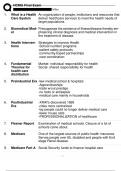
1. What is a Health An organization of people, institutions and resources that
Care System deliver healthcare services to meet the health needs of
target populations.
2. Biomedical Mod- Presupposes the existence of illness/disease thereby em-
el phasizing clinical diagnosis and medical intervention in
the treatment of disease.
3. Health Interven- Strategies to improve Health
tions -School nutrition programs
-patient safety protocols
-community-based partnerships
-care coordination
4. Fundamental Market- individual responsibility for health
Theories for Social- shared responsibility for health
health care
distribution
5. Preindustrial Era -few medical school & hospitals
-Apprenticeships
-trade w/out prestige
-no tools or antisepsis
-medical care mainly in households
6. PostIndustrial -XRAYs discovered 1895
Era -cities more centralized
-lay people could no longer deliver medical care
-fewer house calls
-PROFESSIONALIZATION of healthcare
7. Flexner Report Examination of medical schools. Closure of a lot of
schools came about.
8. Medicare One of the largest sources of public health insurance.
Serves people over 65, disabled and people with End
stage Renal disease.
9. Medicare Part A Social Security funds to finance hospital care
, HCMG Final Exam
1sl3su
10. Medicare Part B covers physician services
11. Medicaid The third largest source of health insurance in the US.
provides coverage for low-income adults, children and
elderly and individuals with disabilities.
12. Blue Cross hospital insurance
13. Blue Shield physican fees (both merges in the 1970's)
14. Corporate Era -1970's to present
-Managed care- control physician and hospital fees
-Integrated delivery system
-Information revolutions(telemedicine, e-health)
-Globilization-crossborder activities
15. 3 Cornerstones -High in COST
of Healthcare de- -Unequal in ACCESS
livery -Average in QUALITY
16. 3 Reasons for 1- Growth of technology- inexpensive technology makes
High Health Care people live longer.
Costs 2- Increased Elderly Population- Elderly consume more
health care costs than the general population
3- Multipayer system & Administrative Costs- its takes a
lot of time and effort to keep up with all payers, single
payer would cut administrative costs.
17. Ways to contain -EHRs should make it easier to share information be-
costs tween physicians
-A new focus on prevention and chronic disease manage-
ment should keep costs from rising
-ACA
18. Moral Hazard consumer behavior that leads to higher utilization of
health care services when services are covered by insur-
ance.
19. Single payer sys- _____________ systems are usually financed more pro-
tem gressively, and rely on existing taxation systems; they
1sl3su
1. What is a Health An organization of people, institutions and resources that
Care System deliver healthcare services to meet the health needs of
target populations.
2. Biomedical Mod- Presupposes the existence of illness/disease thereby em-
el phasizing clinical diagnosis and medical intervention in
the treatment of disease.
3. Health Interven- Strategies to improve Health
tions -School nutrition programs
-patient safety protocols
-community-based partnerships
-care coordination
4. Fundamental Market- individual responsibility for health
Theories for Social- shared responsibility for health
health care
distribution
5. Preindustrial Era -few medical school & hospitals
-Apprenticeships
-trade w/out prestige
-no tools or antisepsis
-medical care mainly in households
6. PostIndustrial -XRAYs discovered 1895
Era -cities more centralized
-lay people could no longer deliver medical care
-fewer house calls
-PROFESSIONALIZATION of healthcare
7. Flexner Report Examination of medical schools. Closure of a lot of
schools came about.
8. Medicare One of the largest sources of public health insurance.
Serves people over 65, disabled and people with End
stage Renal disease.
9. Medicare Part A Social Security funds to finance hospital care
, HCMG Final Exam
1sl3su
10. Medicare Part B covers physician services
11. Medicaid The third largest source of health insurance in the US.
provides coverage for low-income adults, children and
elderly and individuals with disabilities.
12. Blue Cross hospital insurance
13. Blue Shield physican fees (both merges in the 1970's)
14. Corporate Era -1970's to present
-Managed care- control physician and hospital fees
-Integrated delivery system
-Information revolutions(telemedicine, e-health)
-Globilization-crossborder activities
15. 3 Cornerstones -High in COST
of Healthcare de- -Unequal in ACCESS
livery -Average in QUALITY
16. 3 Reasons for 1- Growth of technology- inexpensive technology makes
High Health Care people live longer.
Costs 2- Increased Elderly Population- Elderly consume more
health care costs than the general population
3- Multipayer system & Administrative Costs- its takes a
lot of time and effort to keep up with all payers, single
payer would cut administrative costs.
17. Ways to contain -EHRs should make it easier to share information be-
costs tween physicians
-A new focus on prevention and chronic disease manage-
ment should keep costs from rising
-ACA
18. Moral Hazard consumer behavior that leads to higher utilization of
health care services when services are covered by insur-
ance.
19. Single payer sys- _____________ systems are usually financed more pro-
tem gressively, and rely on existing taxation systems; they