
• Wrong document? Swap it for free
  • Written by students who passed
  • Immediately available after payment
  • Read online or as PDF
Sell
Where do you study
Your language
Document preview thumbnail
Preview 2 out of 8 pages
Exam (elaborations)

Pathophysiology SLCC Guaranteed Solutions

Document preview thumbnail
Preview 2 out of 8 pages

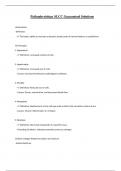
Pathophysiology SLCC Guaranteed Solutions Homeostasis - Definition: - The body's ability to maintain a dynamic steady state of internal balance or equilibrium. Cell Changes 1. Hyperplasia - Definition: Increased number of cells. 2. Hypertrophy - Definition: Increased size of cells. - Causes: Increased workload or pathological conditions. 3. Atrophy - Definition: Reduced size of cells. - Causes: Disuse, malnutrition, and decreased blood flow. 4. Metaplasia - Definition: Replacement of one cell type with another that can better endure stress. - Causes: Chronic inflammation or irritation. 5. Dysplasia - Definition: Abnormal cell growth of a specific tissue. - Preceding Condition: Indicates potential cancerous changes. Cellular Changes Related to Sodium and Calcium - Sodium Build-up: - Occurs due to the breakdown of the sodium-potassium pump. - Consequence: Sodium collects in the cell, attracting water and causing intracellular swelling. - Fatty Changes: - Lipid accumulation in cells leads to impaired cell functions, often resulting in conditions like "fatty liver." - Calcium Build-up: - Calcium accumulates due to the breakdown of the Ca²⁺/Mg²⁺ pump. - Consequence: Inappropriate activation of cellular enzymes. Cell Death Mechanisms 1. Apoptosis - Controlled cell death (implosion) where all components remain within the cell, eliciting no inflammatory response. 2. Necrosis - Uncontrolled cell death (explosion) where cell contents are released into the extracellular space, triggering an inflammatory response. Organs of the Immune System - Bone Marrow: Produces RBCs, WBCs, and platelets. - Thymus Gland: Site of T-cell production. - Lymph Nodes - Tonsils - Spleen Telomeres - Outermost tails of the chromosome arms. Cells of Inflammation 1. Endothelial Cells: - - Vasodilation/constriction - - Regulate blood thinning/prevent clotting - - Control entry/exit of blood vessels - - Control inflammatory mediators 2. Platelets: - Responsible for blood coagulation/clotting. - Release 300+ inflammatory mediators. 3. Leukocytes: - Major cellular component of the inflammatory response. - High neutrophil counts indicate inflammation and infection. - WBCs classified as granular or agranular. S.H.A.R.P. - Swelling - Heat - Altered function - Redness - Pain Granulocytes - GRANpa BEN 1. Neutrophils: First responders and most common. 2. Basophils: Respond to allergic reactions. 3. Eosinophils: Respond to allergic reactions and parasites. Agranulocytes - "A"nd GRANma Loves Money 1. Lymphocytes: Increase during viral and chronic infections; include B and T cells. 2. Monocytes: Become macrophages in tissues; perform phagocytosis to consume foreign particles. T-Cells - Function: Respond before B cells. - Produced in: Thymus Gland. 1. T Memory Cells: Remain in lymph nodes post-infection; enable rapid response to re-infection. 2. Helper T Cells: Activate/regulate T and B cells. 3. Killer T Cells: Attack viruses and tumor cells; ingest antigens via phagocytosis. 4. Natural Killer Cells: Attack abnormal cells, like cancer cells. 5. Suppressor T-Cells: Restore normal immune function post-infection; prevent autoimmunity. B Cells - Function: Respond after T cells by releasing antibodies and assisting T cell activation. - Produced in: Bone Marrow. Antigen - Antibody generator, essentially any substance that can provoke an immune response. - Location on Cells: They are present on the surface of cells, marking them for recognition by the immune system. --- It triggers the body to make antibodies (pollen, toxins, pathogens etc)

Content preview

Pathophysiology SLCC Guaranteed Solutions


Homeostasis

- Definition:

- ✅ The body's ability to maintain a dynamic steady state of internal balance or equilibrium.


Cell Changes

1. Hyperplasia

- ✅ Definition: Increased number of cells.


2. Hypertrophy

- ✅ Definition: Increased size of cells.

- Causes: Increased workload or pathological conditions.


3. Atrophy

- ✅ Definition: Reduced size of cells.

- Causes: Disuse, malnutrition, and decreased blood flow.


4. Metaplasia

- ✅ Definition: Replacement of one cell type with another that can better endure stress.

- Causes: Chronic inflammation or irritation.


5. Dysplasia

- ✅ Definition: Abnormal cell growth of a specific tissue.

- Preceding Condition: Indicates potential cancerous changes.


Cellular Changes Related to Sodium and Calcium

- Sodium Build-up:

, - ✅ Occurs due to the breakdown of the sodium-potassium pump.

- Consequence: Sodium collects in the cell, attracting water and causing intracellular swelling.


- Fatty Changes:

- ✅ Lipid accumulation in cells leads to impaired cell functions, often resulting in conditions like "fatty
liver."


- Calcium Build-up:

- ✅ Calcium accumulates due to the breakdown of the Ca²⁺/Mg²⁺ pump.

- Consequence: Inappropriate activation of cellular enzymes.


Cell Death Mechanisms

1. Apoptosis

- ✅ Controlled cell death (implosion) where all components remain within the cell, eliciting no
inflammatory response.


2. Necrosis

- ✅ Uncontrolled cell death (explosion) where cell contents are released into the extracellular space,
triggering an inflammatory response.


Organs of the Immune System

- Bone Marrow: Produces RBCs, WBCs, and platelets.

- Thymus Gland: Site of T-cell production.

- Lymph Nodes

- Tonsils

- Spleen


Telomeres

- ✅ Outermost tails of the chromosome arms.

Document information

Uploaded on
August 16, 2024
Number of pages
8
Written in
2024/2025
Type
Exam (elaborations)
Contains
Questions & answers
$10.39

Wrong document? Swap it for free Within 14 days of purchase and before downloading, you can choose a different document. You can simply spend the amount again.
Written by students who passed
Immediately available after payment
Read online or as PDF

Seller avatar
Reputation scores are based on the amount of documents a seller has sold for a fee and the reviews they have received for those documents. There are three levels: Bronze, Silver and Gold. The better the reputation, the more your can rely on the quality of the sellers work.
CertifiedGrades
3.9
(38)
Sold
149
Followers
61
Items
8729
Last sold
1 month ago


Why students choose Stuvia

Created by fellow students, verified by reviews

Quality you can trust: written by students who passed their tests and reviewed by others who've used these notes.

Didn't get what you expected? Choose another document

No worries! You can instantly pick a different document that better fits what you're looking for.

Pay as you like, start learning right away

No subscription, no commitments. Pay the way you're used to via credit card and download your PDF document instantly.

Student with book image

“Bought, downloaded, and aced it. It really can be that simple.”

Alisha Student

Working on your references?

Create accurate citations in APA, MLA and Harvard with our free citation generator.

Working on your references?

Frequently asked questions

