
NBME 26
Exam Section 1: Item 2 of 50
National, Board of Medical Examiners
Comprehensive Basic Science Self-Assessment
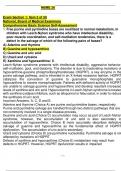
1. Free purine and pyrimidine bases are reutilized in normal metabolism. In
children with Lesch-Nyhan syndrome who have intellectual disability,
poor muscle coordination, and self-mutilation tendencies, there is a
defect in the salvage of which of the following pairs of bases?
A) Adenine and thymine
B) Guanine and hypoxanthine
C) Guanine and uric acid
D) Uracil and cytosine
E) Xanthine and hypoxanthine: B.
Lesch-Nyhan syndrome presents with intellectual disability, aggressive behavior,
self-mutilation, gout, and dystonia. The disorder is due to inactivating mutations of
hypoxanthine-guanine phosphoribosyltransferase (HGPRT), a key enzyme in the
purine salvage pathway, and is inherited in an X-linked recessive fashion. HGPRT
catalyzes the conversion of guanine to guanosine monophosphate and
hypoxanthine to inosine monophosphate. Patients with deficient activity of HGPRT
are unable to salvage guanine and hypoxanthine and develop resultant increased
levels of xanthine and uric acid. Hyperuricemia in Lesch-Nyhan syndrome is treated
with xanthine oxidase inhibitors, such as allopurinol or febuxostat, in order to reduce
the synthesis of uric acid.
Incorrect Answers: A, C, D and E.
Adenine and thymine (Choice A) are purine and pyrimidine bases, respectively.
Purine and pyrimidine salvage are handled through two distinct pathways that are
not commonly involved in a single disease process.
Guanine and uric acid (Choice C) accumulation may occur as part of Lesch-Nyhan
syndrome, however, the accumulation of uric acid is also secondary to
accumulation of hypoxanthine. Choice B more accurately describes defective
salvage of guanine and hypoxanthine as the fundamental effect of HGPRT
dysfunction. The accumulation of uric acid is secondary.
Uracil and cytosine (Choice D) are pyrimidine nucleotides. Pyrimidine salvage is not
affected by mutations of HGPRT.
Defects of xanthine and hypoxanthine (Choice E) metabolism may result from
defects in HGPRT. However, HGPRT dysfunction results in impaired
, NBME 26
hypoxanthine
salvage with resultant excessive production of xanthine, rather than impaired
xanthine salvage.
Educational Objective: Lesch-Nyhan syndrome presents with intellectual disability,
aggressive behavior, self-mutilation, gout, and dyst
2. 2
----------
Exam Section 1: Item 3 of 50
National Board of Medical Examiners
Comprehensive Basic Science Self-Assessment
3. A 42-year-old man is struck by a motor vehicle. His only injury is a closed
fracture of the proximal tibia. Initial neurovascular examination shows no
deficits. Twenty-four hours later, he has increased leg pain and
paresthesias in the dorsal space between his first and second toes. The
patient begins to pass dark red urine and becomes oliguric. Urinalysis is
positive for blood but no erythrocytes are seen on microscopic
examination. Which of the following acute disorders is the most likely
cause of the renal
failure?
A) Glomerulonephritis
B) Hemolytic-uremic syndrome
C) Interstitial nephritis
D) Nephrotic syndrome
E) Tubular necrosis: E.
Tibial fractures present a high risk for compartment syndrome. The fracture results
in blood vessel injury and muscle injury, inflammation, and edema. Because the
fascia containing the anterior compartment of the leg does not stretch, bleeding and
swelling can cause increased pressure in the compartment. This increased
pressure in turn inhibits venous drainage, further increasing pressure in the
compartment. Eventually the nerve supply and associated arteries are
compromised, leading to the classic signs and symptoms of compartment
syndrome. Signs and symptoms of compartment syndrome include pain out of
proportion to examination findings, pain with passive movement of the muscles,
paresthesia, pallor, pulselessness, and paralysis. Compromised blood supply
deprives muscle and tissue of oxygen and glucose, leading to tissue ischemia and
necrosis. Muscle necrosis leads to rhabdomyolysis, myoglobinuria, and acute renal
, NBME 26
failure. Evaluation
of rhabdomyolysis reveals red or brown urine and urinalysis is typically positive for
blood due to the presence of myoglobinuria without microscopic evidence of red
blood cells. A complication of rhabdomyolysis is acute kidney injury from acute
tubular necrosis secondary to the release of nephrotoxic myoglobin and nonprotein
heme pigments.
Acute tubular necrosis typically occurs following an ischemic or nephrotoxic insult
to the kidneys, which results in loss of the tubular epithelium. Granular, muddy
brown casts are common on urinalysis. Compartment syndrome is treated by
immediate fasciotomy to decrease compartment pressure and support tissue
perfusion.
Incorrect Answers: A, B, C, and D.
Glomerulonephritis (Choice A) refers to a variety of glomerular diseases, including
nephritic and nephrotic syndromes. Nephritic syndromes typically present with
acute renal failure associated with h
3. 3
----------
Exam Section 1: Item 5 of 50
National, Board of Medical Examiners
Comprehensive Basic Science Self-Assessment
5. A 65-year-old woman has ascites. Which of the following additional
findings indicates a diagnosis of constrictive pericarditis rather than
cirrhosis?
O A) Edema of the lower extremities
B) Esophageal varices
C) Hypoalbuminemia
D) Hyponatremia
E) Increased jugular venous pressure
F) Splenomegaly: E.
Increased jugular venous pressure (JVP) is an expected finding in constrictive
pericarditis (CP) and would not be found in patients with volume overload secondary
to cirrhosis. CP describes a pathologic state whereby the pericardium, which
encases the entirety of the heart and the origins of the great vessels, loses its
elasticity. This can occur in patients with viral infections, connective tissue disease,
tuberculosis, or as a result of cardiac surgery or radiation. During the normal cardiac
cycle, increased venous return to the right atrium (RA) and right ventricle (RV)
during inspiration leads to transient expansion of the RV with slight bowing of the
, NBME 26
interventricular
septum into the left ventricle (LV). This increased RV preload does not impair LV
filling as the pericardial sac expands to
accommodate the increased RV volume. In constrictive pericarditis, the pericardial
sac loses its elasticity. When venous return to the right heart increases, the
pericardial sac is unable to expand, which exacerbates movement of the
interventricular septum into the
LV. This impairs diastolic filling of the LV and reduces cardiac output. LV diastolic
filling is further reduced by a reduction in preload from the pulmonary veins. The
constricted pericardium does not respond to normal changes in intrathoracic
pressure during inspiration, but the pulmonary venous system, which lies outside of
the pericardium, experiences a normal drop in pressure during inspiration. This
difference creates an abnormal pressure gradient that reduces LV preload and
leads to reduced cardiac output. The
RV and LV develop interventricular dependence whereby increased pressure in
each ventricle begins to affect the other ventricle. CP ultimately results in
equalization of pressures in all four chambers, with clinical evidence of right heart
failure exhib 4. 4
----------
Exam Section 1: Item 4 of 50
National Board of Medical Examiners
Comprehensive Basic Science Self-Assessment
4. A male newborn is found to have a defect in anchoring fibrils. Which of
the following skin findings is most likely in this patient?
A) Blisters
B) Easy bruising
O C) Eczematous rash
O D) Inability to sweat
O E) Thickened skin
O F) Ulcers: A.
The hemidesmosome is an intricate complex of proteins whose ultimate function is
to anchor the basal keratinocytes of the epidermis to the dermis at the dermal-
epidermal junction. Any impairment of the hemidesmosome will cause the basal
keratinocytes to separate from the dermis, causing a blister to form. Because the
hemidesmosomes of neighboring skin are still intact, these will be tense blisters.
Anchoring fibrils are made of type VII collagen and are a component of the
hemidesmosome. A mutation or antibody to collagen type VII, as seen in
Exam Section 1: Item 2 of 50
National, Board of Medical Examiners
Comprehensive Basic Science Self-Assessment
1. Free purine and pyrimidine bases are reutilized in normal metabolism. In
children with Lesch-Nyhan syndrome who have intellectual disability,
poor muscle coordination, and self-mutilation tendencies, there is a
defect in the salvage of which of the following pairs of bases?
A) Adenine and thymine
B) Guanine and hypoxanthine
C) Guanine and uric acid
D) Uracil and cytosine
E) Xanthine and hypoxanthine: B.
Lesch-Nyhan syndrome presents with intellectual disability, aggressive behavior,
self-mutilation, gout, and dystonia. The disorder is due to inactivating mutations of
hypoxanthine-guanine phosphoribosyltransferase (HGPRT), a key enzyme in the
purine salvage pathway, and is inherited in an X-linked recessive fashion. HGPRT
catalyzes the conversion of guanine to guanosine monophosphate and
hypoxanthine to inosine monophosphate. Patients with deficient activity of HGPRT
are unable to salvage guanine and hypoxanthine and develop resultant increased
levels of xanthine and uric acid. Hyperuricemia in Lesch-Nyhan syndrome is treated
with xanthine oxidase inhibitors, such as allopurinol or febuxostat, in order to reduce
the synthesis of uric acid.
Incorrect Answers: A, C, D and E.
Adenine and thymine (Choice A) are purine and pyrimidine bases, respectively.
Purine and pyrimidine salvage are handled through two distinct pathways that are
not commonly involved in a single disease process.
Guanine and uric acid (Choice C) accumulation may occur as part of Lesch-Nyhan
syndrome, however, the accumulation of uric acid is also secondary to
accumulation of hypoxanthine. Choice B more accurately describes defective
salvage of guanine and hypoxanthine as the fundamental effect of HGPRT
dysfunction. The accumulation of uric acid is secondary.
Uracil and cytosine (Choice D) are pyrimidine nucleotides. Pyrimidine salvage is not
affected by mutations of HGPRT.
Defects of xanthine and hypoxanthine (Choice E) metabolism may result from
defects in HGPRT. However, HGPRT dysfunction results in impaired
, NBME 26
hypoxanthine
salvage with resultant excessive production of xanthine, rather than impaired
xanthine salvage.
Educational Objective: Lesch-Nyhan syndrome presents with intellectual disability,
aggressive behavior, self-mutilation, gout, and dyst
2. 2
----------
Exam Section 1: Item 3 of 50
National Board of Medical Examiners
Comprehensive Basic Science Self-Assessment
3. A 42-year-old man is struck by a motor vehicle. His only injury is a closed
fracture of the proximal tibia. Initial neurovascular examination shows no
deficits. Twenty-four hours later, he has increased leg pain and
paresthesias in the dorsal space between his first and second toes. The
patient begins to pass dark red urine and becomes oliguric. Urinalysis is
positive for blood but no erythrocytes are seen on microscopic
examination. Which of the following acute disorders is the most likely
cause of the renal
failure?
A) Glomerulonephritis
B) Hemolytic-uremic syndrome
C) Interstitial nephritis
D) Nephrotic syndrome
E) Tubular necrosis: E.
Tibial fractures present a high risk for compartment syndrome. The fracture results
in blood vessel injury and muscle injury, inflammation, and edema. Because the
fascia containing the anterior compartment of the leg does not stretch, bleeding and
swelling can cause increased pressure in the compartment. This increased
pressure in turn inhibits venous drainage, further increasing pressure in the
compartment. Eventually the nerve supply and associated arteries are
compromised, leading to the classic signs and symptoms of compartment
syndrome. Signs and symptoms of compartment syndrome include pain out of
proportion to examination findings, pain with passive movement of the muscles,
paresthesia, pallor, pulselessness, and paralysis. Compromised blood supply
deprives muscle and tissue of oxygen and glucose, leading to tissue ischemia and
necrosis. Muscle necrosis leads to rhabdomyolysis, myoglobinuria, and acute renal
, NBME 26
failure. Evaluation
of rhabdomyolysis reveals red or brown urine and urinalysis is typically positive for
blood due to the presence of myoglobinuria without microscopic evidence of red
blood cells. A complication of rhabdomyolysis is acute kidney injury from acute
tubular necrosis secondary to the release of nephrotoxic myoglobin and nonprotein
heme pigments.
Acute tubular necrosis typically occurs following an ischemic or nephrotoxic insult
to the kidneys, which results in loss of the tubular epithelium. Granular, muddy
brown casts are common on urinalysis. Compartment syndrome is treated by
immediate fasciotomy to decrease compartment pressure and support tissue
perfusion.
Incorrect Answers: A, B, C, and D.
Glomerulonephritis (Choice A) refers to a variety of glomerular diseases, including
nephritic and nephrotic syndromes. Nephritic syndromes typically present with
acute renal failure associated with h
3. 3
----------
Exam Section 1: Item 5 of 50
National, Board of Medical Examiners
Comprehensive Basic Science Self-Assessment
5. A 65-year-old woman has ascites. Which of the following additional
findings indicates a diagnosis of constrictive pericarditis rather than
cirrhosis?
O A) Edema of the lower extremities
B) Esophageal varices
C) Hypoalbuminemia
D) Hyponatremia
E) Increased jugular venous pressure
F) Splenomegaly: E.
Increased jugular venous pressure (JVP) is an expected finding in constrictive
pericarditis (CP) and would not be found in patients with volume overload secondary
to cirrhosis. CP describes a pathologic state whereby the pericardium, which
encases the entirety of the heart and the origins of the great vessels, loses its
elasticity. This can occur in patients with viral infections, connective tissue disease,
tuberculosis, or as a result of cardiac surgery or radiation. During the normal cardiac
cycle, increased venous return to the right atrium (RA) and right ventricle (RV)
during inspiration leads to transient expansion of the RV with slight bowing of the
, NBME 26
interventricular
septum into the left ventricle (LV). This increased RV preload does not impair LV
filling as the pericardial sac expands to
accommodate the increased RV volume. In constrictive pericarditis, the pericardial
sac loses its elasticity. When venous return to the right heart increases, the
pericardial sac is unable to expand, which exacerbates movement of the
interventricular septum into the
LV. This impairs diastolic filling of the LV and reduces cardiac output. LV diastolic
filling is further reduced by a reduction in preload from the pulmonary veins. The
constricted pericardium does not respond to normal changes in intrathoracic
pressure during inspiration, but the pulmonary venous system, which lies outside of
the pericardium, experiences a normal drop in pressure during inspiration. This
difference creates an abnormal pressure gradient that reduces LV preload and
leads to reduced cardiac output. The
RV and LV develop interventricular dependence whereby increased pressure in
each ventricle begins to affect the other ventricle. CP ultimately results in
equalization of pressures in all four chambers, with clinical evidence of right heart
failure exhib 4. 4
----------
Exam Section 1: Item 4 of 50
National Board of Medical Examiners
Comprehensive Basic Science Self-Assessment
4. A male newborn is found to have a defect in anchoring fibrils. Which of
the following skin findings is most likely in this patient?
A) Blisters
B) Easy bruising
O C) Eczematous rash
O D) Inability to sweat
O E) Thickened skin
O F) Ulcers: A.
The hemidesmosome is an intricate complex of proteins whose ultimate function is
to anchor the basal keratinocytes of the epidermis to the dermis at the dermal-
epidermal junction. Any impairment of the hemidesmosome will cause the basal
keratinocytes to separate from the dermis, causing a blister to form. Because the
hemidesmosomes of neighboring skin are still intact, these will be tense blisters.
Anchoring fibrils are made of type VII collagen and are a component of the
hemidesmosome. A mutation or antibody to collagen type VII, as seen in


