
Study unit 9
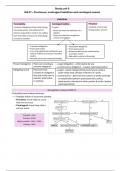
IAS 37 – Provisions, contingent liabilities and contingent assets
Liabilities
Pure liability – Contingent liability – Provision –
A present obligation of the entity arising 2 types: A liability of uncertain
from past events, the settlement of - Does not meet the definition of a timing and/or amount
which is expected to result in an outflow liability
from the entity of resources embodying - Does not meet the recognition
economic benefits. criteria of a liability
• A present obligation • A possible obligation
• From past events • From past events
• It is not probable that settlement will • Existence will only be confirmed by
lead to outflow of economic benefits uncertain events
and/or • Not within control of the entity
• Amount cannot be measured reliably
Present obligation Past even creating a Legal obligation – enforceable by law
present obligation Constructive obligation – creates valid expectation
Obligating event Past even that Legal – exists independently from future actions
creates an obligation (walk-away test); always involved a 3rd party
that the entity has no Constructive – derives from actions of entity whereby
realistic alternative an established pattern (past practices, policy,
to settling statements) indicated to other parties & entity creates
valid expectation
Recognition criteria of IAS 37:
Probability and reliable estimate:
Probable inflow of economic benefit:
Provision: more likely to occur
than not to occur
Contingent: more likely that it
will not occur
Probable: >50%
Possible: 50/50
Highly possible: >50%; <100%
Unlikely: <50%
IAS 37 – Provisions, contingent liabilities and contingent assets
Liabilities
Pure liability – Contingent liability – Provision –
A present obligation of the entity arising 2 types: A liability of uncertain
from past events, the settlement of - Does not meet the definition of a timing and/or amount
which is expected to result in an outflow liability
from the entity of resources embodying - Does not meet the recognition
economic benefits. criteria of a liability
• A present obligation • A possible obligation
• From past events • From past events
• It is not probable that settlement will • Existence will only be confirmed by
lead to outflow of economic benefits uncertain events
and/or • Not within control of the entity
• Amount cannot be measured reliably
Present obligation Past even creating a Legal obligation – enforceable by law
present obligation Constructive obligation – creates valid expectation
Obligating event Past even that Legal – exists independently from future actions
creates an obligation (walk-away test); always involved a 3rd party
that the entity has no Constructive – derives from actions of entity whereby
realistic alternative an established pattern (past practices, policy,
to settling statements) indicated to other parties & entity creates
valid expectation
Recognition criteria of IAS 37:
Probability and reliable estimate:
Probable inflow of economic benefit:
Provision: more likely to occur
than not to occur
Contingent: more likely that it
will not occur
Probable: >50%
Possible: 50/50
Highly possible: >50%; <100%
Unlikely: <50%



