
UCI BioSci D170, Williams Urinary System
Reading: Chapter 24
What are the functions of the kidneys, ureters, bladder, and urethra?
Urinary system: urine-forming kidneys, ureter (tubes that carry urine from the kidney to
the bladder), bladder (storage sac for urine), and urethra (tube that carries urine from the
bladder to the body exterior).
Where are the kidneys located in the abdominal cavity?
They lie retroperitoneal (behind the parietal peritoneum) in the superolateral region of the
posterior abdominal wall. The right kidney is slightly inferior to the left b/c it is crowded
by the liver.
Describe the external gross anatomy of the kidney, noting the following structures:
The soap bar-sized kidney is convex on its lateral surface
and concave on its medial surface.
Hilum – vertical cleft on the medial surface; where
vessels, ureters, and nerves leave/enter the kidney.
Fibrous capsule – layer of dense CT that adheres to the
kidney’s surface. Maintains kidney’s shape and inhibits
any spread of infection.
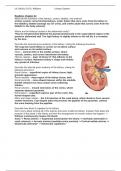
Describe the internal gross anatomy of the kidney, noting the
following structures:
Renal cortex – superficial region of kidney tissue; light,
granular appearance.
Renal medulla – deep region of the kidney tissue; dark.
Renal pyramids – cone-shaped masses within the medulla.
Exhibit striations b/c they contain urine-collecting
tubules.
Renal columns – inward extensions of the cortex, which
separate adjacent pyramids.
Renal pelvis – expanded superior part of the ureter; flat,
funnel-shaped tube.
Minor and major calices – the 2-3 branches of the renal pelvis, which divide to form several
smaller branches. Cup-shaped tubes that enclose the papillae of the pyramids; collects
the urine draining from the papillae.
Describe how blood is supplied to the kidney.
Don’t worry about naming all of the arteries and veins inside the kidney. Instead, think about the
purpose of the blood in the kidney and how the arrangement of vessels makes that happen. ->
Kidneys continuously cleanse the blood.
Aorta -> Renal arteries -> Segmental arteries(enter the hilum) -> interlobar arteries(lie in
renal columns) -> Arcuate arteries (medulla-cortex junction) -> Cortical radiate arteries ->
Glomerular arterioles* -> Glomerular capillaries.*
, UCI BioSci D170, Williams Urinary System
Describe the summary of the three steps of urine production.
1. Glomerular filtration. Blood filtrate leaves kidney capillaries and enters the renal
tubule.
2. Tubular resorption. Nutrients, water, and ions are recovered from the filtrate and
returned to the blood in surrounding capillaries.
3. Tubular secretion. Moves undesirable molecules from the blood of surrounding
capillaries into the tubules.
Describe the structure and functions of a nephron, noting the following components:
The nephron is the structural/functional unit of the kidney. It is lined by simple
epithelium.
Renal corpuscle – spherical portion of the nephron where filtration occurs; limited to the
cortex.
Glomerulus – bundle of capillaries stemming from the glomerular arterioles. Highly
fenestrated -> allows fluid/small molecules to pass from the capillary blood to the
capsular space.
Glomerular capsule (Bowman’ capsule) – surrounds the glomerulus.
Capsular space – hollow interior of the glomerular capsule.
Afferent and efferent glomerular arterioles – afferent supplies the glomerulus, while efferent
drains the glomerulus.
Glomerular capillaries – make up the glomerulus. Covered by the visceral layer composed
of podocytes.
Filtration membrane – the filter that lies b/w the blood in the glomerulus and the capsular
space. Consists of the capillary endothelium, basement membrane, and filtration slits.
Renal tubule – long, tubular section of the nephron where the filtrate proceeds after the
corpuscle. In continuous order from the renal corpuscle...
Proximal convoluted tubule – contains microvilli on apical surfaces and ion-
pumping enzymes in folds on their basal surfaces -> most active in resorption and
secretion. Contain many mitochondria which provides energy for resorption;
confined to the renal cortex.
Nephron loop (loop of Henle) – U-shaped tubules consisting of a descending limb
(DTL) and ascending limb(ATL, TAL). The descending thin limb is the narrowest
part of the nephron, consisting of permeable simple squamous epithelium.
Distal convoluted tubule – Consist of simple cuboidal epithelium, which allows for
selective secretion and resorption of ions. Similar structure and same location to
the convoluted tubule, except w/ less microvilli.
Reading: Chapter 24
What are the functions of the kidneys, ureters, bladder, and urethra?
Urinary system: urine-forming kidneys, ureter (tubes that carry urine from the kidney to
the bladder), bladder (storage sac for urine), and urethra (tube that carries urine from the
bladder to the body exterior).
Where are the kidneys located in the abdominal cavity?
They lie retroperitoneal (behind the parietal peritoneum) in the superolateral region of the
posterior abdominal wall. The right kidney is slightly inferior to the left b/c it is crowded
by the liver.
Describe the external gross anatomy of the kidney, noting the following structures:
The soap bar-sized kidney is convex on its lateral surface
and concave on its medial surface.
Hilum – vertical cleft on the medial surface; where
vessels, ureters, and nerves leave/enter the kidney.
Fibrous capsule – layer of dense CT that adheres to the
kidney’s surface. Maintains kidney’s shape and inhibits
any spread of infection.
Describe the internal gross anatomy of the kidney, noting the
following structures:
Renal cortex – superficial region of kidney tissue; light,
granular appearance.
Renal medulla – deep region of the kidney tissue; dark.
Renal pyramids – cone-shaped masses within the medulla.
Exhibit striations b/c they contain urine-collecting
tubules.
Renal columns – inward extensions of the cortex, which
separate adjacent pyramids.
Renal pelvis – expanded superior part of the ureter; flat,
funnel-shaped tube.
Minor and major calices – the 2-3 branches of the renal pelvis, which divide to form several
smaller branches. Cup-shaped tubes that enclose the papillae of the pyramids; collects
the urine draining from the papillae.
Describe how blood is supplied to the kidney.
Don’t worry about naming all of the arteries and veins inside the kidney. Instead, think about the
purpose of the blood in the kidney and how the arrangement of vessels makes that happen. ->
Kidneys continuously cleanse the blood.
Aorta -> Renal arteries -> Segmental arteries(enter the hilum) -> interlobar arteries(lie in
renal columns) -> Arcuate arteries (medulla-cortex junction) -> Cortical radiate arteries ->
Glomerular arterioles* -> Glomerular capillaries.*
, UCI BioSci D170, Williams Urinary System
Describe the summary of the three steps of urine production.
1. Glomerular filtration. Blood filtrate leaves kidney capillaries and enters the renal
tubule.
2. Tubular resorption. Nutrients, water, and ions are recovered from the filtrate and
returned to the blood in surrounding capillaries.
3. Tubular secretion. Moves undesirable molecules from the blood of surrounding
capillaries into the tubules.
Describe the structure and functions of a nephron, noting the following components:
The nephron is the structural/functional unit of the kidney. It is lined by simple
epithelium.
Renal corpuscle – spherical portion of the nephron where filtration occurs; limited to the
cortex.
Glomerulus – bundle of capillaries stemming from the glomerular arterioles. Highly
fenestrated -> allows fluid/small molecules to pass from the capillary blood to the
capsular space.
Glomerular capsule (Bowman’ capsule) – surrounds the glomerulus.
Capsular space – hollow interior of the glomerular capsule.
Afferent and efferent glomerular arterioles – afferent supplies the glomerulus, while efferent
drains the glomerulus.
Glomerular capillaries – make up the glomerulus. Covered by the visceral layer composed
of podocytes.
Filtration membrane – the filter that lies b/w the blood in the glomerulus and the capsular
space. Consists of the capillary endothelium, basement membrane, and filtration slits.
Renal tubule – long, tubular section of the nephron where the filtrate proceeds after the
corpuscle. In continuous order from the renal corpuscle...
Proximal convoluted tubule – contains microvilli on apical surfaces and ion-
pumping enzymes in folds on their basal surfaces -> most active in resorption and
secretion. Contain many mitochondria which provides energy for resorption;
confined to the renal cortex.
Nephron loop (loop of Henle) – U-shaped tubules consisting of a descending limb
(DTL) and ascending limb(ATL, TAL). The descending thin limb is the narrowest
part of the nephron, consisting of permeable simple squamous epithelium.
Distal convoluted tubule – Consist of simple cuboidal epithelium, which allows for
selective secretion and resorption of ions. Similar structure and same location to
the convoluted tubule, except w/ less microvilli.


