
UCI BioSci D170, Williams Blood Vessels
Reading: Chapter 20
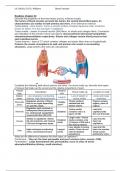
Describe the properties of the three layers (tunics) of blood vessels.
The tunics of blood vessels surround the lumen, the central blood-filled space. Its
characteristics are similar in both arteries and veins. From internal to external:
Tunica intima – Most interior. Forms a smooth surface of simple squamous cells; minimizes
friction for blood. *It is the only layer in capillaries.
Tunica media – sheets of smooth muscle (SM) fibers, w/ elastin and collagen fibrils. Contraction
and relaxation of the smooth muscle can lead to vasoconstriction (increased sympathetic
stimulation)/vasodilation respectively. Elastin and collagen resists blood pressure that
each heartbeat exerts.
Tunica externa – layer of CT which contains collagen and elastic fibers that run longitudinally.
Protects the vessel, strengthens its wall, and anchors the vessel to surrounding
structures. Large arteries and veins are vascularized.
Complete the following table about arteries and veins. For tissue make-up, describe what types
of tissues that make up the vessel and the relative proportions of each.
Vessel Relative
Description Tissue make-up Location in body
type size
Elastic Low resistance conducting Lots of elastin in Aorta and major
Largest
artery arteries, high blood pressure tunica media branches
Regulates amount of blood Tunica media is Organs system,
Muscular “middle-
flow to an organ depending sandwiched b/w organs, parts of
artery on specific needs.
sized”
elastin sheets. organs.
Regulates both localized or
Tunica media Lead into
widespread blood pressure.
Arteriole Smallest contains only 1-2 capillary beds
Ex. widespread sympathetic
layers of SM. thru out the body.
vasoconstriction INCs BP.
Larger ones: Tunica
Similar to capillaries: deliver Lead into the
Smallest media contains only
Venule O2 and nutrients, and remove heart via
(vein) 1-2 layers of SM and a
CO2 and nitrogenous waste. capillaires.
thin tunica externa.
Less elastin in tunica Lead into the
High resistance-conducting Largest media. (Veins do not heart via venules.
Vein veins. Low blood pressure. (vein) need to dampen Venae cavae,
pulsations.) pulmonary veins.
What are the differences between the three types of capillaries?
Continuous – They are the least permeable and most common (skin, muscle, CNS).
Fenestrated – Large fenestrations INC permeability; occur in areas of active
absorption/filtration (kidney, small intestine).
, UCI BioSci D170, Williams Blood Vessels
Sinusoid – Most permeable; occur in special locations (liver, bone marrow, spleen).
How do molecules pass into and out of capillaries? Describe four ways.
1. Direct diffusion thru the endothelial cell membranes. (O2, CO2)
2. Intercellular clefts. (Small molecules)
3. Fenestrations. Pores in the endothelial cells of fenestrated capillaries.
4. Pinocytotic vesicles. Invaginate from the plasma membrane and migrate across
endothelial cells. (Dissolved gasses, nutrients, waste products)
Describe the general characteristics of capillaries and of capillary beds, noting the following
structures:
Metarteriole – Found in mesenteries of the digestive system. The metarteriole is an arteriole that
runs through the capillary bed, and carries blood past capillaries if no digestion is taking place.
Thoroughfare channel – channel that drains into the venule. Along w/ the metarteriole, forms
the vascular shunt that allows blood to bypass the true capillaries.
Precapillary sphincter – SM cells that wrap around each true capillary where it leaves the
metarteriole. Regulates blood flow thru the capillary bed. -> Supplies surrounding tissue
based on their needs.
Describe what mechanisms are used to propel blood through arteries and veins. How are they
similar, how are they different?
● Arteries: blood is under pressure.
● Veins: no blood pressure, plus some negative forces of gravity. Valves prevent
backward movement, skeletal muscles squeeze the veins to force the blood toward the
heart.
What are vascular anastomoses? Provide examples of where you find them in the body.
Where vessels unite; provide alternate pathways for blood to reach a given body region.
Ex. occurs around joints, where body movement hinders blood flow.
What are the functions of the pulmonary and systemic circuits?
Pulmonary allows for the uptake of O2 and removal of CO2 in the blood; systemic carries
oxygenated blood throughout the body and picks up CO2 from body tissues.
Describe the path of blood through the pulmonary circuit (low MAP), noting the following
structures:
Reading: Chapter 20
Describe the properties of the three layers (tunics) of blood vessels.
The tunics of blood vessels surround the lumen, the central blood-filled space. Its
characteristics are similar in both arteries and veins. From internal to external:
Tunica intima – Most interior. Forms a smooth surface of simple squamous cells; minimizes
friction for blood. *It is the only layer in capillaries.
Tunica media – sheets of smooth muscle (SM) fibers, w/ elastin and collagen fibrils. Contraction
and relaxation of the smooth muscle can lead to vasoconstriction (increased sympathetic
stimulation)/vasodilation respectively. Elastin and collagen resists blood pressure that
each heartbeat exerts.
Tunica externa – layer of CT which contains collagen and elastic fibers that run longitudinally.
Protects the vessel, strengthens its wall, and anchors the vessel to surrounding
structures. Large arteries and veins are vascularized.
Complete the following table about arteries and veins. For tissue make-up, describe what types
of tissues that make up the vessel and the relative proportions of each.
Vessel Relative
Description Tissue make-up Location in body
type size
Elastic Low resistance conducting Lots of elastin in Aorta and major
Largest
artery arteries, high blood pressure tunica media branches
Regulates amount of blood Tunica media is Organs system,
Muscular “middle-
flow to an organ depending sandwiched b/w organs, parts of
artery on specific needs.
sized”
elastin sheets. organs.
Regulates both localized or
Tunica media Lead into
widespread blood pressure.
Arteriole Smallest contains only 1-2 capillary beds
Ex. widespread sympathetic
layers of SM. thru out the body.
vasoconstriction INCs BP.
Larger ones: Tunica
Similar to capillaries: deliver Lead into the
Smallest media contains only
Venule O2 and nutrients, and remove heart via
(vein) 1-2 layers of SM and a
CO2 and nitrogenous waste. capillaires.
thin tunica externa.
Less elastin in tunica Lead into the
High resistance-conducting Largest media. (Veins do not heart via venules.
Vein veins. Low blood pressure. (vein) need to dampen Venae cavae,
pulsations.) pulmonary veins.
What are the differences between the three types of capillaries?
Continuous – They are the least permeable and most common (skin, muscle, CNS).
Fenestrated – Large fenestrations INC permeability; occur in areas of active
absorption/filtration (kidney, small intestine).
, UCI BioSci D170, Williams Blood Vessels
Sinusoid – Most permeable; occur in special locations (liver, bone marrow, spleen).
How do molecules pass into and out of capillaries? Describe four ways.
1. Direct diffusion thru the endothelial cell membranes. (O2, CO2)
2. Intercellular clefts. (Small molecules)
3. Fenestrations. Pores in the endothelial cells of fenestrated capillaries.
4. Pinocytotic vesicles. Invaginate from the plasma membrane and migrate across
endothelial cells. (Dissolved gasses, nutrients, waste products)
Describe the general characteristics of capillaries and of capillary beds, noting the following
structures:
Metarteriole – Found in mesenteries of the digestive system. The metarteriole is an arteriole that
runs through the capillary bed, and carries blood past capillaries if no digestion is taking place.
Thoroughfare channel – channel that drains into the venule. Along w/ the metarteriole, forms
the vascular shunt that allows blood to bypass the true capillaries.
Precapillary sphincter – SM cells that wrap around each true capillary where it leaves the
metarteriole. Regulates blood flow thru the capillary bed. -> Supplies surrounding tissue
based on their needs.
Describe what mechanisms are used to propel blood through arteries and veins. How are they
similar, how are they different?
● Arteries: blood is under pressure.
● Veins: no blood pressure, plus some negative forces of gravity. Valves prevent
backward movement, skeletal muscles squeeze the veins to force the blood toward the
heart.
What are vascular anastomoses? Provide examples of where you find them in the body.
Where vessels unite; provide alternate pathways for blood to reach a given body region.
Ex. occurs around joints, where body movement hinders blood flow.
What are the functions of the pulmonary and systemic circuits?
Pulmonary allows for the uptake of O2 and removal of CO2 in the blood; systemic carries
oxygenated blood throughout the body and picks up CO2 from body tissues.
Describe the path of blood through the pulmonary circuit (low MAP), noting the following
structures:


