
UCI BioSci D170, Williams Central Nervous System (CNS)
Reading: Chapter 13
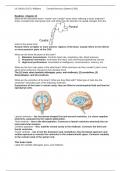
What do the directional terms “rostral” and “caudal” mean when referring to brain anatomy?
Draw a simple brain and spinal cord, and show how the direction of caudal changes from the
Rostral
Caudal
brain to the spinal cord.
Rostral refers to higher or more anterior regions of the brain. Caudal refers to the inferior
or more posterior parts of the CNS.
What are the three functions of the brain?
1. Maintains homeostasis. Controls heart rate, respiratory rate, blood pressure.
2. Peripheral innervation. Innervates the head, neck and thoracic/abdominal viscera.
3. High-level performance. Associated w/ intelligence, consciousness, memory, etc.
What are the four main parts of the adult brain? What structures do they contain? (don’t worry
about what embryonic structures they develop from)
The (1) brain stem (medulla oblongata, pons, and midbrain), (2) cerebellum, (3)
diencephalon, and (4) cerebrum.
What are the ventricles of the brain? What are they filled with? What type of cells line the
ventricles? Describe each of the following ventricles.
Expansions of the brain’s central cavity; they are filled w/ cerebrospinal fluid and lined w/
ependymal cells.
Lateral ventricles – the horseshoe-shaped first and second ventricles. Lie closer together
anteriorly, separated by the septum pellucidum.
Third ventricle – lies in the diencephalon. Connects to lateral ventricles anteriorly thru an
interventricular foramen.
Cerebral aqueduct – thin, tubelike central cavity in the midbrain. Connects the third and
fourth ventricles.
Fourth ventricle – lies in b/w the brainstem and cerebellum. Has the lateral apertures and
median aperture to connect the ventricles to the subarachnoid space. Connects caudally
to the central canal of the spinal cord.
The brain stem
Label the medulla oblongata, pons, and midbrain:
Reading: Chapter 13
What do the directional terms “rostral” and “caudal” mean when referring to brain anatomy?
Draw a simple brain and spinal cord, and show how the direction of caudal changes from the
Rostral
Caudal
brain to the spinal cord.
Rostral refers to higher or more anterior regions of the brain. Caudal refers to the inferior
or more posterior parts of the CNS.
What are the three functions of the brain?
1. Maintains homeostasis. Controls heart rate, respiratory rate, blood pressure.
2. Peripheral innervation. Innervates the head, neck and thoracic/abdominal viscera.
3. High-level performance. Associated w/ intelligence, consciousness, memory, etc.
What are the four main parts of the adult brain? What structures do they contain? (don’t worry
about what embryonic structures they develop from)
The (1) brain stem (medulla oblongata, pons, and midbrain), (2) cerebellum, (3)
diencephalon, and (4) cerebrum.
What are the ventricles of the brain? What are they filled with? What type of cells line the
ventricles? Describe each of the following ventricles.
Expansions of the brain’s central cavity; they are filled w/ cerebrospinal fluid and lined w/
ependymal cells.
Lateral ventricles – the horseshoe-shaped first and second ventricles. Lie closer together
anteriorly, separated by the septum pellucidum.
Third ventricle – lies in the diencephalon. Connects to lateral ventricles anteriorly thru an
interventricular foramen.
Cerebral aqueduct – thin, tubelike central cavity in the midbrain. Connects the third and
fourth ventricles.
Fourth ventricle – lies in b/w the brainstem and cerebellum. Has the lateral apertures and
median aperture to connect the ventricles to the subarachnoid space. Connects caudally
to the central canal of the spinal cord.
The brain stem
Label the medulla oblongata, pons, and midbrain:


